Cadillac
An American General Motors luxury marque shaped by precision manufacture, V-engine development, coachbuilt prestige cars, post-war design and changing definitions of luxury.
Historical overview
Cadillac is an American luxury-vehicle marque founded in Detroit in 1902 and owned by General Motors since 1909. It began as the Cadillac Automobile Company, became the Cadillac Motor Car Company in 1905 and later operated as a GM division. A present-day Cadillac is therefore a General Motors product, just as a Chevrolet is; the two marques have occupied very different positions within GM’s range.
The marque first built single-cylinder cars distinguished by precise manufacture. It then became associated with electric starting, series-produced V8 engines, bespoke V12 and V16 luxury cars, fully automatic transmissions, post-war tailfins, large rear-wheel-drive saloons and coupés, front-wheel-drive personal cars, performance derivatives, sport-utility vehicles and battery-electric models.
Selected milestones
The first two dates mark corporate events; the remaining dates identify vehicle model years or catalogue lines.
- 1902 — corporate founding: Cadillac was established in Detroit.
- 1909 — corporate acquisition: General Motors acquired Cadillac.
- 1912 model year — electric system: The Model 30 incorporated electric starting, lighting and ignition.
- 1915 model line — V8: Cadillac adopted a series-built V8.
- 1967 model year — front-wheel drive: The Fleetwood Eldorado introduced front-wheel drive to the personal-luxury hardtop line.
The corporate dates follow the Detroit Historical Society’s company history. The engineering milestones are recorded in Cadillac’s A Brief History of Cadillac Since 1902.
Cadillac matters historically because it repeatedly linked luxury to manufacturing or engineering change. Interchangeable components supported its early reputation; the self-starter made driving less physically demanding; multi-cylinder engines and specialist coachwork defined its interwar prestige; and post-war styling turned the marque into a visual symbol of American prosperity. Later downsizing, front-wheel drive, electronic controls, V-Series performance cars, Escalade sport-utility vehicles and electric models show that the meaning of a Cadillac continued to change.
Origins in Detroit
The Detroit Historical Society’s company history traces Cadillac to the remnants of the Henry Ford Company. After Henry Ford’s departure, Henry M. Leland persuaded its backers to continue with his engine. The Society dates the Cadillac Automobile Company’s founding to 27 August 1902 and explains its name as a reference to Antoine de la Mothe Cadillac, associated with Detroit’s foundation.
The first cars appeared at the New York Automobile Show in January 1903. Their simple front-engined chassis could carry open runabout or tonneau bodies. The Society records the 1905 consolidation of Cadillac and engine maker Leland & Faulconer as the Cadillac Motor Car Company.
It also records GM’s acquisition in 1909 and Henry and Wilfred Leland’s continued production management until 1917. Thus 1909 marks a corporate change, separate from the marque’s founding and its first cars. Within GM’s developing hierarchy, Cadillac became the upper luxury make, far removed in price and purpose from the volume-oriented Chevrolet division.
Precision manufacture and early engineering
Leland brought experience in close-tolerance machining and interchangeable components. Cadillac’s A Brief History of Cadillac Since 1902 connects its 1908 Dewar Trophy and “Standard of the World” reputation to a demonstration of interchangeability involving three cars. The cars were dismantled, their parts mixed with stock replacements, and the rebuilt cars successfully tested. GM Heritage identifies the cars as Model Ks. This demonstration did not imply interchangeability across every later Cadillac model or year.
Cadillac’s timeline records the Kettering-designed Delco electrical system for 1912. The Model 30 combined electric starting, lighting and ignition. The GM Heritage Model 30 account attributes Cadillac’s second Dewar Trophy to electric starting and lighting. It explicitly presents the fatal hand-cranking accident said to have motivated Leland as a legend. That account should remain distinct from the documented introduction of the starter on the 1912 car.
Cadillac adopted a 90-degree V8 for the 1915 line and built it in series; the company’s timeline records the 1915 V8 milestone. The new engine allowed a shorter package than a comparable straight-eight and helped make the V8 central to Cadillac engineering for much of the twentieth century. It was not one permanent design: the early side-valve V8, the high-compression overhead-valve engine introduced for 1949, later large-displacement families, the Northstar overhead-cam engine and subsequent GM V8s are distinct families with different dimensions, materials, induction and controls.
Interwar luxury, styling and coachwork
During the 1920s Cadillac paired engineering refinement with a wider choice of colour, trim and bodies. GM created LaSalle as a smaller companion marque for 1927. Harley Earl styled its first car before going on to establish and lead General Motors’ central design organisation. LaSalle was built and marketed alongside Cadillac until 1940, but it was a separate marque rather than a Cadillac model or trim.
Cadillac’s 1930 catalogue added V12 and V16 cars above its V8 range. The V16 was offered with numerous body styles, and coachbuilders completed bodies over wood framing for individual clients. Fisher and Fleetwood names can refer to body-building organisations, body series or later Cadillac naming conventions depending on period. A Fleetwood-bodied V16, a later Fleetwood series and a Fleetwood trim are not automatically the same model lineage.
The interwar catalogue included roadsters, phaetons, convertibles, coupés, formal sedans, limousines and town cars. Some bodies were regular catalogue offerings; others were built in very small numbers or to special order. Body design and construction credit therefore belongs to the documented car. It should not be assigned to Harley Earl, Fisher or Fleetwood solely because a vehicle carries a Cadillac badge.
Engineering continued alongside coachwork. Cadillac adopted synchromesh transmission, safety glass and improved chassis controls during the late 1920s, while the Hydra-Matic four-speed fully automatic transmission entered the range for 1941. Civilian car production was curtailed after the United States entered the Second World War as Cadillac facilities contributed to military production. Post-war cars initially developed pre-war engineering before a substantially new design cycle took hold.
Post-war design and engineering
The 1948 Cadillacs introduced the small rear-fin motif that became a defining post-war feature. In 1949 a new short-stroke, overhead-valve V8 replaced the earlier side-valve family, and the Coupe de Ville appeared as a pillarless hardtop derivative of the Series 62.
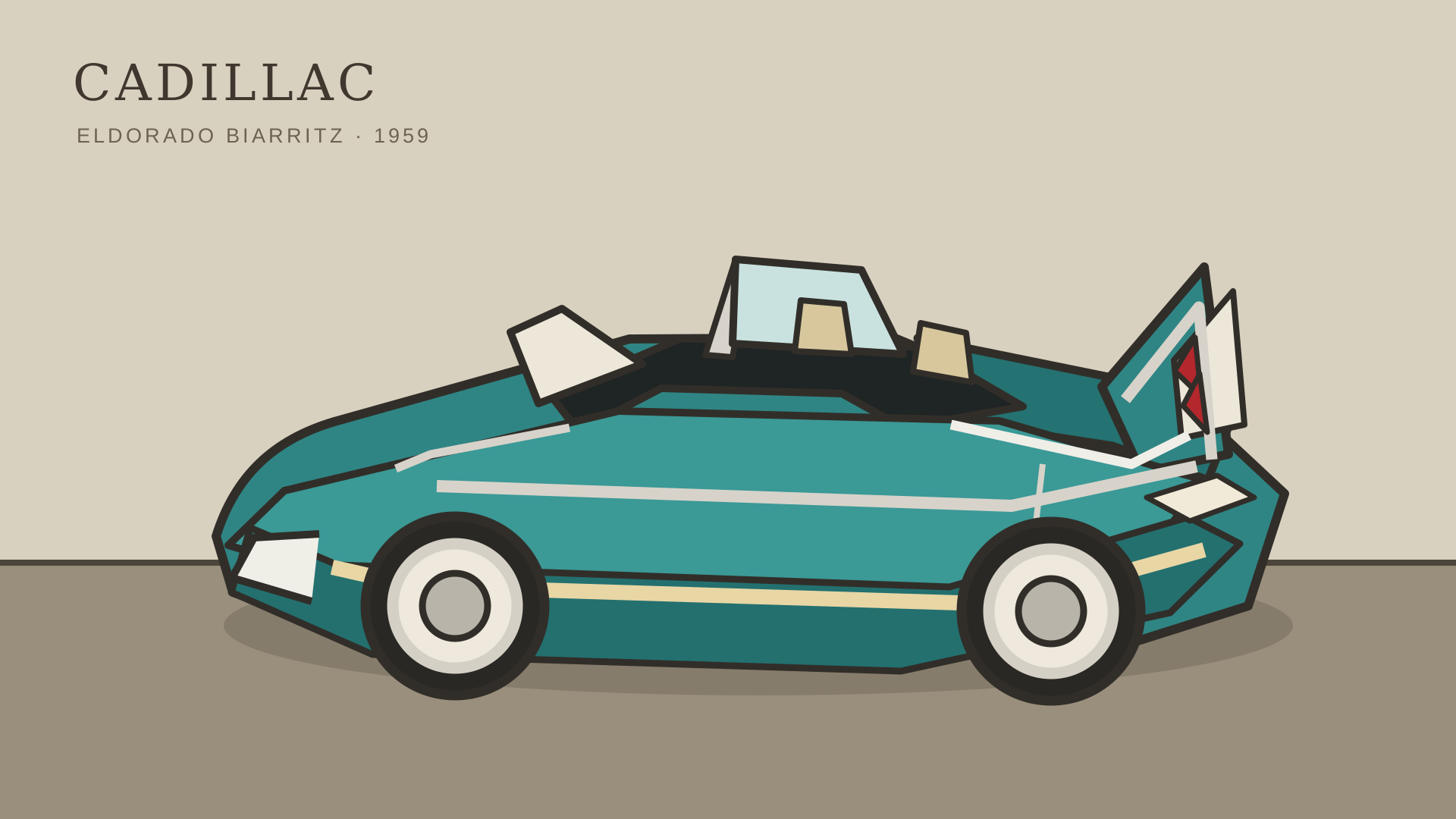
Cadillac’s 1950s range combined large saloons, coupés and convertibles with increasingly elaborate styling and comfort equipment. Eldorado began as a limited-production convertible for 1953, then developed through multiple bodies and generations. The hand-built 1957 Eldorado Brougham used four doors, a stainless-steel roof and an extensive standard-equipment list; the 1959 Eldorado Biarritz convertible represented a different branch of the Eldorado line. Its tall fins and twin taillamp nacelles became a lasting image of the period. Cadillac’s Twelve Significant Designs discusses these distinct Coupe de Ville, Brougham and Biarritz designs.
Most post-war Cadillacs used a front-mounted engine, rear-wheel drive and body-on-frame construction, but important exceptions multiplied. The same design retrospective describes the 1967 Fleetwood Eldorado’s move to front-wheel drive in a two-door personal-luxury hardtop. The first Seville, introduced for the 1976 model year, was smaller than Cadillac’s traditional full-size cars while retaining rear-wheel drive. Cadillac then moved much of its range to downsized front-wheel-drive platforms in the 1980s.
The Allanté roadster illustrates why body production and final assembly can have different locations. Pininfarina produced its bodies in Italy, and Cadillac completed the cars in the United States. Cadillac’s historical timeline describes Italian body shipment and American final assembly in its Allanté introduction entry; it does not identify a model-year exception to that arrangement.
Separately, the Northstar overhead-cam V8 arrived in the Allanté for the 1993 model year. The qualification about availability concerns the engine: earlier Allanté model years did not use Northstar. “Northstar” itself covered related but changing applications.
Changing range and definitions of luxury
For much of the twentieth century Cadillac organised its range through numbered series and recurring names such as DeVille, Fleetwood, Eldorado and Seville. The same word could change status over time. De Ville began as a body-style or derivative designation before becoming a long-running series and eventually the DeVille model name. Fleetwood could indicate coachwork, a series or an equipment position. Brougham and d’Elegance likewise moved between descriptive, trim and model usage. The badge must be interpreted against a specific year and market.
The Escalade, introduced for the 1999 model year, established a full-size sport-utility line within Cadillac and became one of the marque’s most visible later products. The CTS sedan, launched for 2003, introduced the angular “Art & Science” design language to series production. Its CTS-V derivative helped establish V-Series as Cadillac’s performance sub-brand; later V and Blackwing labels identified different levels of performance hardware and do not by themselves define an engine or generation.
Cadillac also offered coupés, convertibles and less common body styles alongside saloons and SUVs. The second-generation CTS range, for example, included sedan, coupé and Sport Wagon bodies. These share a model generation but not door count, body structure or necessarily engine specification. Commercial chassis supplied for hearses, ambulances and limousines similarly require identification of the specialist body builder rather than being treated as factory saloons.
Electrification arrived in stages. The ELR was a plug-in hybrid coupé for the 2014 model year, while LYRIQ launched Cadillac’s battery-electric production range in 2022. These are different powertrain categories. Later electric vehicles reused established names such as Escalade alongside newly coined names, so an electric derivative should not be merged with an internal-combustion model merely because their branding is related.
Production and markets
The Detroit Historical Society records manufacture at Amsterdam Street and the 1921 move to Clark Street, where Cadillac production continued until 1987. Later assembly dispersed across General Motors plants according to model and period. GM’s U.S. operations directory lists Cadillac vehicle assembly in Michigan, Tennessee and Texas, including Lansing Grand River, Spring Hill and Arlington. Headquarters, engineering centre, engine plant, body supplier and final-assembly plant may therefore all be different places.
Production outside the United States was not simply a matter of exporting identical American cars. General Motors’ April 2013 China fact sheet, under “2013 Focus Areas”, recorded local Shanghai manufacture of the XTS. Locally developed sales programmes and later models expanded Cadillac’s Chinese range. A Cadillac sharing a name across the United States and China may have different production dates, engines, equipment, wheelbase or even market-specific body development. The vehicle identification number, market literature and plant record are stronger evidence than appearance alone.
Regulation also created market differences. Lighting, bumpers, emissions equipment, instruments, engines and standard features could vary between North American and export versions. Model availability and name usage were not universal, and a car first registered in one calendar year may belong to the preceding or following American model year.
Chronology and catalogue boundaries
Corporate events, such as Cadillac’s 1902 founding and GM’s 1909 acquisition, use calendar dates. Cadillac’s American vehicle documentation is commonly organised by model year, which often begins before the matching calendar year. The 1949 Coupe de Ville or 1967 Fleetwood Eldorado labels therefore describe catalogue model years, not necessarily the exact date every example left its plant. Production date, sales introduction, first delivery, registration date and model year should remain separate.
A model line identifies a vehicle programme within the marque. A generation is a major design or engineering cycle within that line; a facelift revises the cycle without automatically beginning a new one. A variant identifies a particular derivative. Series, trim and equipment package indicate catalogue position or content, while sedan, hardtop, coupé, convertible, wagon and SUV describe body style. An engine family can cross several series and generations, with specifications changing by application and year.
Read a Cadillac specification in the context of its model, generation, variant, body style, trim, engine, market and model year. Those distinctions explain why the 1949 V8 introduction and Coupe de Ville hardtop debut are separate developments, and why the 1957 Eldorado Brougham and 1959 Eldorado Biarritz convertible cannot share one generic Eldorado specification. Cadillac’s repeated reuse of Fleetwood, DeVille, Eldorado, Brougham and Escalade makes the year and market especially important when interpreting a badge.
Notable model lines
- Early single-cylinder Cadillacs: The 1903-era runabouts and tonneaus that established the marque’s precision-manufacturing reputation.
- Model 30: The four-cylinder line associated with Cadillac’s 1912 electric starting, lighting and ignition system.
- V8, V12 and V-16 series: Distinct interwar luxury ranges, often offered with multiple catalogue and coachbuilt bodies. The V-16 model line spans 1930–1940 and two different sixteen-cylinder engine designs.
- Sixty Special: The luxury sedan lineage introduced for 1938, later associated with Fleetwood Brougham and revived with front-wheel drive for 1987–1993.
- Series 75: The long-wheelbase V8 line introduced for 1936, best known for Fleetwood sedans and limousines, with later Fleetwood Limousine and front-wheel-drive 75 successors.
- Series 62: The 1940–1964 model line, interrupted by wartime production, from which the Coupe de Ville hardtop and later DeVille naming developed; succeeded by Calais for 1965.
- DeVille: The luxury-car line with 1949 Series 62 hardtop origins, separate series status from 1959, later front-wheel-drive sedans and a final 2005 model year before DTS.
- Eldorado: A prestige name used across convertibles, hardtops, a hand-built four-door and several front-wheel-drive generations.
- Fleetwood and Fleetwood Brougham: Names whose coachbuilding, series and trim meanings changed across periods.
- Seville: The luxury sedan line introduced in 1975 for the 1976 model year, spanning five rear- and front-wheel-drive generations through 2004, including the STS and SLS derivatives.
- Allanté: The roadster offered for the 1987–1993 model years, with Italian-built Pininfarina bodies and American final assembly.
- XLR: The Northstar-powered retractable-hardtop roadster built at Bowling Green in 2003–2009, including the supercharged XLR-V derivative.
- CTS and V-Series: The sedan-led programme that introduced Art & Science design and supported Cadillac’s modern performance identity.
- Escalade: The full-size luxury SUV line introduced for the 1999 model year.
- ELR and LYRIQ: Separate plug-in-hybrid and battery-electric programmes marking different stages of electrification.
Legacy
Cadillac’s historical importance lies in the breadth of what it made luxury mean. Precision and interchangeability mattered in its earliest years; electric starting and the series-built V8 altered the effort and engineering of motoring; V12 and V16 cars joined specialised bodies to industrial manufacture; and the tailfin era gave the marque an influence far beyond its sales volume. Its post-war cars became symbols of American scale, comfort and aspiration, while Eldorado, DeVille and Fleetwood became enduring names.
The later history is one of adaptation rather than a single decline or revival. Front-wheel drive, downsizing, international body production, electronic chassis systems, performance branding, SUVs and electrification each changed the product without erasing the marque.
Sources
- Cadillac Motor Company — Detroit Historical Society
- Cadillac: 120 Years of Design and Engineering Innovation — Cadillac
- A Brief History of Cadillac Since 1902 — Cadillac / General Motors
- Twelve Significant Designs — Cadillac / General Motors
- 1912 Cadillac Model 30 — GM Heritage Collection
- 1931 Cadillac V16 — GM Heritage Collection
- 1949 Cadillac Coupe Deville — GM Heritage Collection
- Cadillac vehicle information kits — GM Heritage Archive
- United States operations and assembly plants — General Motors
- GM China company fact sheet, April 2013 — General Motors
Browse related records
11 records
Cadillac Allanté
A two-seat luxury convertible combining Pininfarina bodywork, transatlantic air freight and Cadillac front-wheel-drive V8 engineering, culminating in the Northstar-powered 1993 model.
ModelCadillac CTS
A three-generation luxury car line led by a rear-wheel-drive sports sedan, with coupé, Sport Wagon and CTS-V derivatives that helped redefine Cadillac's modern identity.
ModelCadillac DeVille
Cadillac's long-running luxury-car line, rooted in the 1949 Coupe de Ville hardtop and offered as a separate series from 1959 through 2005, spanning tailfins, downsizing and front-wheel-drive sedans.
ModelCadillac Eldorado
Cadillac's prestige model line for 1953–2002 US model years, evolving from a special rear-wheel-drive convertible into a personal-luxury car with the 1967 transition to front-wheel drive.
ModelCadillac Escalade
Cadillac's full-size luxury sport-utility vehicle (SUV), introduced in 1998 for the 1999 model year. This history covers five conventional generations through the documented 2025 refresh, including ESV, EXT, Hybrid and Escalade-V, with the separate electric Escalade IQ discussed separately.
ModelCadillac Series 62
Cadillac's V8 passenger-car line for the 1940–1942 and 1946–1964 US model years, spanning pre-war Fisher bodies, post-war tailfins and the origins of Coupe de Ville and Eldorado.
ModelCadillac Series 75
Cadillac's long-wheelbase V8 model line, best known for Fleetwood sedans and limousines. The original Series 75 covered 1936–1942 and 1946–1976, with a wartime interruption. Its passenger-service role continued separately through the 1977–1984 Fleetwood Limousine and the 1985–1987 front-wheel-drive Fleetwood 75 successors. Dates are model years.
ModelCadillac Seville
Introduced in May 1975, Cadillac's five-generation Seville sedan line spans the 1976–2004 North American model years, evolving from rear-wheel drive to front-wheel drive and Northstar V8 power. The final 2004 catalogue year is distinct from the announced December 2003 SLS production end.
ModelCadillac Sixty Special
A Cadillac luxury sedan lineage that began with Bill Mitchell's influential 1938 design, developed into the Fleetwood Sixty Special Brougham and returned with front-wheel drive for 1987–1993.
ModelCadillac V-16 (1930–1940)
Cadillac's sixteen-cylinder flagship of 1930–1940, combining individually specified coachwork with two distinct engine designs across its production life.
ModelCadillac XLR
A Northstar-powered luxury roadster that combined Cadillac's angular Art & Science design with a retractable hardtop and Corvette-related engineering.
Model
No matching records.