Cadillac Series 62
Cadillac's V8 passenger-car line for the 1940–1964 model years, spanning pre-war Fisher bodies, post-war tailfins and the origins of Coupe de Ville and Eldorado.
Overview
The Series 62, also written Sixty-Two, was a Cadillac V8 passenger-car line offered for the 1940–1942 and 1946–1964 model years. Its history crosses several body and chassis designs, from pre-war sedans and convertibles to the pillarless hardtops and conspicuous tailfins of post-war American luxury cars. It was a model series, not an engine designation or a single generation.
The line occupied a different role from the more formal Sixty Special and long-wheelbase Series 75. It also provided the early catalogue home for names that became distinct Cadillac lines: Coupe de Ville and Eldorado. The dates below refer to American model years unless explicitly identified as calendar dates.
Introduction and wartime interruption
For 1940, the Series 62 replaced the preceding Series 61 with Fisher’s new torpedo-style C body. The range included a sedan, coupé, convertible coupé and four-door convertible sedan. Smoother body forms, concealed door hinges and sealed-beam headlights helped distinguish the new cars from their immediate predecessors. The Series 61 returned for 1941 alongside the 62, so the original replacement did not permanently remove that cheaper line.
Cadillac offered Hydra-Matic automatic transmission as an extra-cost choice for 1941. Civilian manufacture stopped during the 1942 wartime conversion; there were no regular 1943–1945 Series 62 model-year ranges. These changes are documented in the Cadillac Database’s 1938–1945 record.
Production and the post-war return
The Series 62 was built in Detroit, Michigan, within Cadillac’s Clark Street manufacturing operation. The Detroit Historical Society’s factory history places Cadillac production there from 1921 to 1987; factory photographs in the 1959 Cadillac archive show the later Series 62 era on the Clark Street assembly lines.
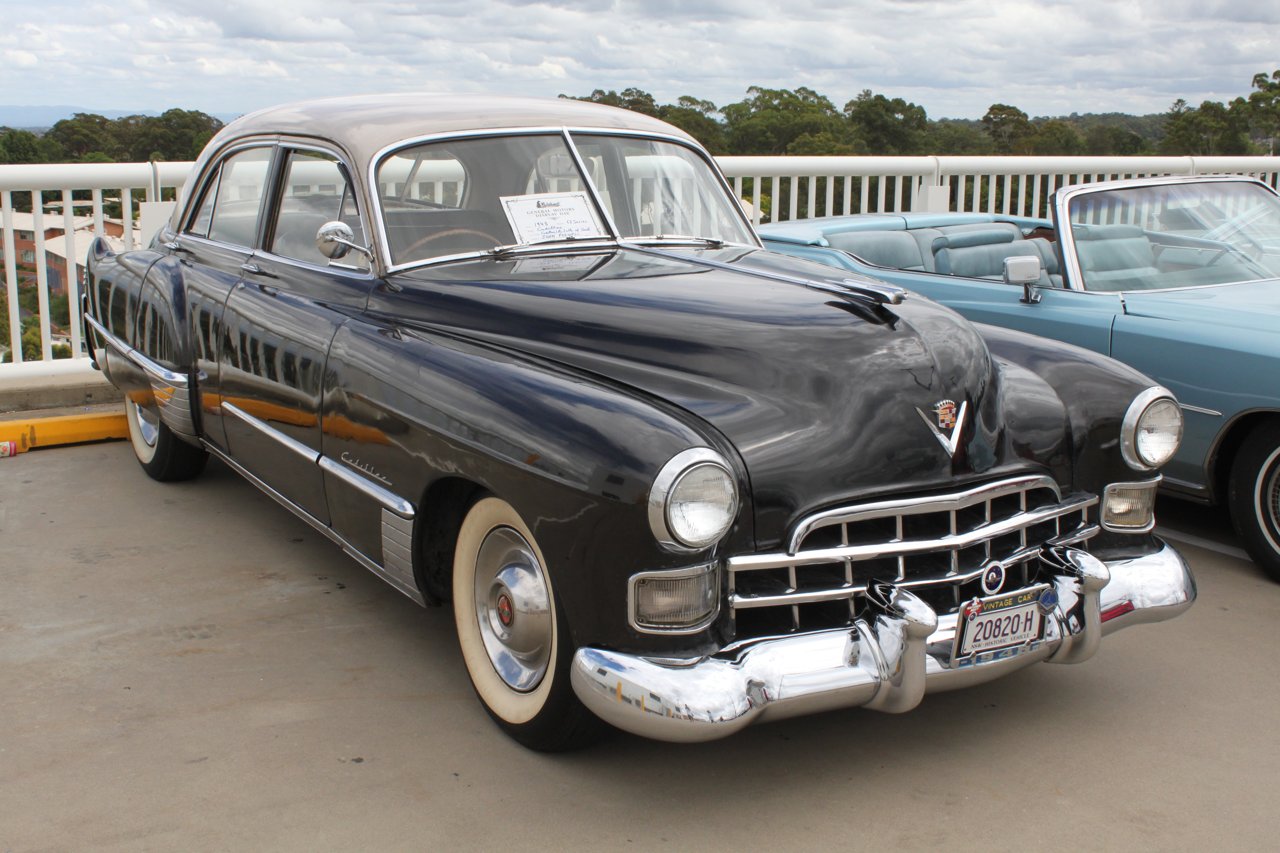
Post-war manufacture resumed in calendar 1945 for the 1946 model year. The first returning cars developed the pre-war design, with sedan, coupé and two-door convertible bodies. The more substantial 1948 restyling introduced small tailfins and a smoother integration of the fenders with the body. Its side-valve engine remained in use for that year.
For 1949, the new overhead-valve V8 changed the mechanical specification while the Coupe de Ville added a pillarless hardtop body to the Series 62. Styling and engine development therefore followed separate schedules: a 1948 finned Cadillac did not yet have the 1949 engine. The 1946–1950 reference and its corrections also distinguish the 1949 three-speed manual from the optional four-speed Hydra-Matic.
De Ville, Eldorado and body development
The 1953 Eldorado was a special convertible within the Series 62 numbering structure, identified as body style 6267SX. It differed from the regular convertible, rather than merely supplying another name for it. The broader 1954 range adopted a wraparound windshield, while power-assisted controls and comfort equipment became increasingly prominent. The 1951–1955 catalogue record separates the ordinary Series 62 bodies, Coupe de Ville and Eldorado applications.
The Sedan de Ville joined the range for 1956 as a four-door pillarless hardtop. Cadillac’s 1956 catalogue illustrations show the ordinary Sixty-Two sedan and coupé alongside the more lavishly trimmed Coupe de Ville and Sedan de Ville. A hardtop has a fixed roof but lacks the conventional central pillar between the side windows; it is not a convertible. Upholstery and equipment position were additional distinctions, independent of door count.
For 1959, the catalogue separated Series 62, Series 63 De Ville and Series 64 Eldorado. The period catalogue material reproduced by the Cadillac Database identifies a Series 62 coupé, four-window sedan, six-window sedan and convertible. The sedan window descriptions distinguish roof and side-glazing arrangements, not different passenger capacities. The dramatic fins and paired bullet-shaped rear lamps belonged to the wider 1959 design programme; they did not identify every car as an Eldorado.
Chassis and engines
The Series 62 used a front-mounted V8 driving the rear wheels. Its separate-frame construction, independent front suspension and live rear axle evolved through successive redesigns. Rear suspension changed from leaf springs on earlier cars to coils on later examples. The 1956–1965 technical chronology records these changing chassis arrangements; dimensions and equipment must be attached to a particular model year and body.
The following displacement sequence covers the Series 62’s US model-year span, using the Cadillac & LaSalle Club engine reference, printed page 42. It does not imply identical induction, compression or output across all derivatives.
| Model years | Displacement | Engine development |
|---|---|---|
| 1940–1942, 1946–1948 | 346 cubic inches | Side-valve V8 |
| 1949–1955 | 331 cubic inches | New overhead-valve V8 |
| 1956–1958 | 365 cubic inches | Enlarged overhead-valve engine |
| 1959–1962 | 390 cubic inches | Further displacement increase |
| 1963 | 390 cubic inches | Redesigned engine, retaining the earlier displacement |
| 1964 | 429 cubic inches | Enlarged version of the revised design |
The club specifically distinguishes the 1963 design from the earlier 390. Equal displacement is therefore insufficient to identify an engine family or establish parts interchangeability. Likewise, the higher-output Eldorado specifications should not be assigned to an ordinary Series 62 merely because both appear in the same year’s catalogue.
Final years and successor
After the exuberance of 1959, Cadillac reduced the fins for 1960 and continued to revise its bodies through the early 1960s. The Series 62 remained alongside De Ville, rather than becoming another name for it. These changes and the transition to Calais appear in the 1956–1965 chronology.
The 1964 range was the final Series 62 offering. Its catalogue and photographic record lists a coupé and four- and six-window sedans, while placing the convertible in the De Ville series. For 1965, Calais took over the Series 62’s position in the range. The 1965 catalogue record presents Calais, DeVille and Fleetwood separately. A later registration date does not extend Series 62 model-year production beyond 1964.
Markets, identification and legacy
The specifications here follow the US catalogue. Export documentation could differ: the 1949 reference records Hydra-Matic as standard for export and notes a lower compression ratio in Belgian literature. That evidence concerns a particular year and document; it does not establish a universal specification for every overseas Series 62. The Australian location of the photographed survivor likewise does not establish its original sales market or assembly location.
Identification should combine model year, series, body-style code and engine information. De Ville’s shift from a Series 62 derivative to a separate series is especially important, as is the distinction between the regular convertible and Eldorado. Annual styling revisions need not be treated as new generations, and an engine redesign need not coincide with a new body.
The Series 62 links Cadillac’s pre-war passenger-car range to the marque’s post-war luxury identity. Its significance lies in that continuity: it carried the early tailfin designs, adopted the new overhead-valve V8 and helped establish body and model names that outlasted the numbered series itself.