Cadillac Eldorado
Cadillac's prestige model line for 1953–2002, evolving from a special rear-wheel-drive convertible into a front-wheel-drive personal-luxury coupe.
Overview
The Eldorado was Cadillac’s prestige model line for the 1953–2002 US model years. It began as a specially bodied convertible, expanded to include hardtop coupes and the separate four-door Eldorado Brougham branch, and became a front-wheel-drive personal-luxury car for 1967. Later cars combined Cadillac comfort with progressively smaller bodies and, eventually, Northstar V8 power. Production was principally American, with an important Italian coachbuilding episode for the 1959–1960 Brougham.
Eldorado belongs at model level: Biarritz, Seville, Brougham and Touring Coupe identify particular bodies, series or derivatives within its history. The Eldorado Seville coupe should not be confused with the independent Seville sedan introduced in 1975. Cadillac’s changing use of these names is documented in the Cadillac Database’s Eldorado history.
Chronology at a glance
These are broad design and body-style periods, not a numbered generation scheme. Dates refer to US model years; a car’s assembly or first registration may fall in a different calendar year. Early restyles and the parallel Brougham series make an unqualified generation count less useful than an identified design period.
| Model years | Place in the line |
|---|---|
| 1953 | Special-bodied rear-drive convertible |
| 1954–1955 | Convertible more closely related to the regular Cadillac body |
| 1956–1960 | Seville hardtop coupe and Biarritz convertible; four-door Brougham added for 1957–1960 |
| 1961–1966 | Regular Eldorado offering reduced to a rear-drive convertible |
| 1967–1970 | Front-drive Fleetwood Eldorado hardtop coupe |
| 1971–1978 | Redesigned front-drive line; convertible through 1976, coupe only for 1977–1978 |
| 1979–1985 | Downsized front-drive design; convertible offered again for 1984–1985 |
| 1986–1991 | Further downsizing; coupe body and transverse engine layout |
| 1992–2002 | Larger final coupe design; Northstar introduced after the first model year |
The early periods follow the Cadillac Database’s 1953–1955 and 1956–1966 records. The Society of Automotive Historians’ Eldorado retrospective, pages 4–5 documents the changes in body availability; the later engine chronology follows the annual records cited below.
Origins and the rear-drive cars
The original Eldorado brought show-car ideas into limited production. Its wrap-around windscreen, low-cut door line and folding roof concealed beneath a metal cover distinguished it from an ordinary Series 62 convertible. Fisher/Fleetwood craftsmen made substantial special bodywork rather than simply adding trim. Matt Larson’s examination of GM’s surviving build sheets confirms 532 cars for 1953; a higher surviving body number does not establish a larger total. 1953 Eldorado research based on factory records.
For 1954 Cadillac used a body more closely shared with its regular range, reducing the amount of special construction while retaining Eldorado’s prestige position. In 1956, the Seville hardtop coupe joined the convertible, which acquired the distinguishing Biarritz name. These were different bodies within the Eldorado range, not successive models. Cadillac Database, early Eldorados; 1956 factory catalogue material.
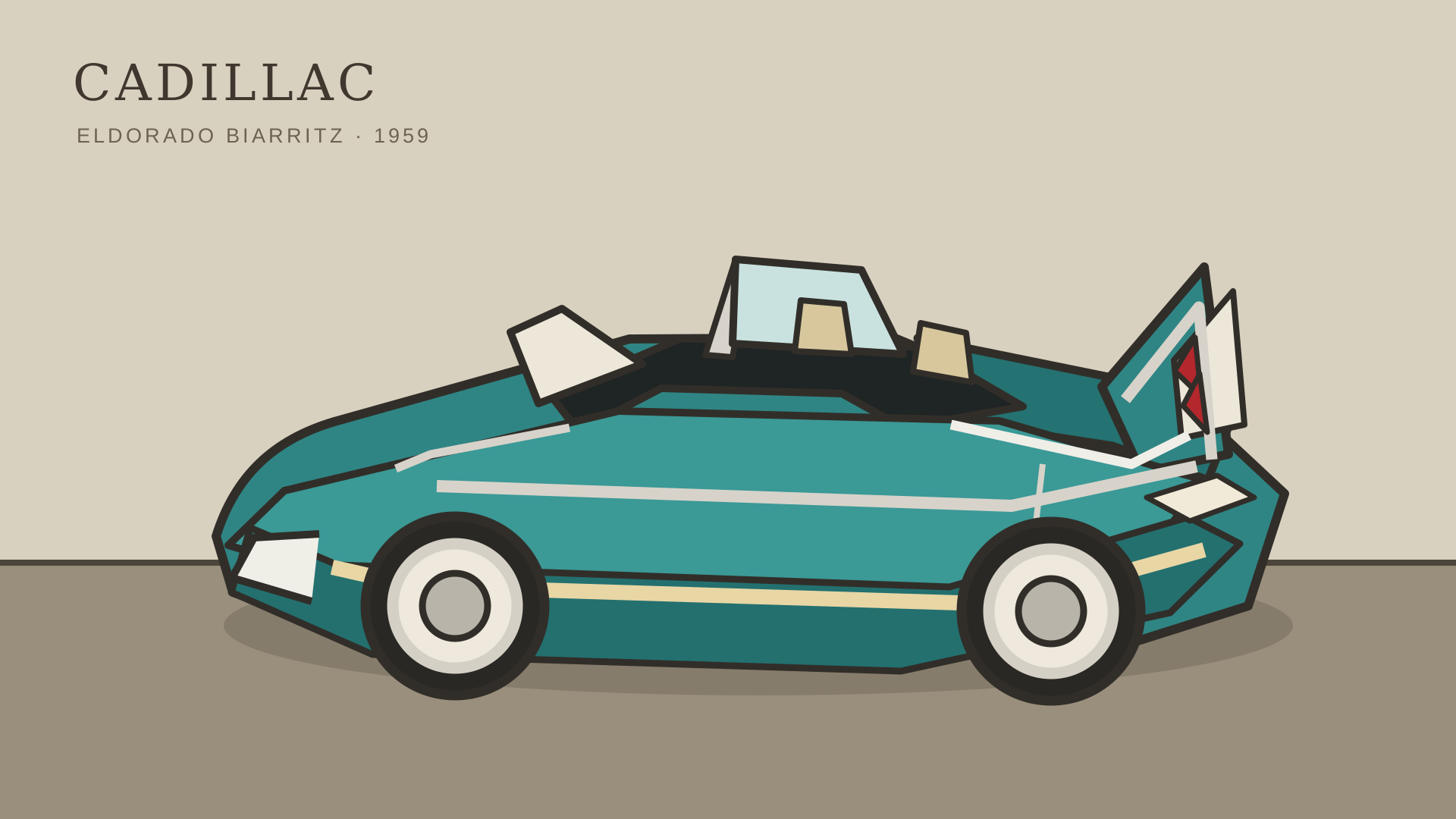
The 1959 Biarritz’s tall fins and paired taillamp housings became a particularly enduring image of Cadillac. Those features belong to a particular styling year, however, rather than to every Eldorado. Cadillac’s own design retrospective places it alongside the very different 1957 Brougham and 1967 coupe.
After 1960 the Seville coupe disappeared, leaving the regular Eldorado as a convertible through 1966. The early 1960s cars increasingly shared the restrained styling of the wider Cadillac range. For 1964, Eldorado received the 429-cubic-inch V8 and Turbo Hydra-Matic automatic transmission. This rear-drive combination must be distinguished from the front-drive installation that followed. Cadillac Database’s reproduced model descriptions and factory material.
Eldorado Brougham: a parallel flagship
The 1957–1960 Eldorado Brougham was a specialised four-door luxury car, separate from the contemporary Seville coupe and Biarritz convertible. The 1957 design featured a brushed stainless-steel roof, rear-hinged rear doors and an unusually extensive equipment package. Its restrained roof and formal cabin created a different kind of prestige from the open Eldorado. Cadillac’s account of the 1957 Brougham.
For 1959–1960, Pinin Farina in Italy constructed the Brougham bodies on Cadillac chassis. The Cadillac Database distinguishes that coachbuilding work from the Fleetwood design: Italian manufacture does not justify assigning the production design to Pinin Farina. These cars also had different fins and roof treatment from the familiar 1959 Biarritz. Research on the Italian Broughams and their design attribution.
Front-wheel drive and the large personal-luxury car
The 1967 Fleetwood Eldorado changed the line’s purpose and engineering. Its sharply defined two-door hardtop body replaced the rear-drive convertible. Cadillac identified it as a personal-luxury car, with front-wheel drive underpinning a distinctive design from the Bill Mitchell era. GM’s design history.
The 1967 car used Cadillac’s 429-cubic-inch overhead-valve V8, followed by the 472 for 1968. Its front-drive chassis had its own suspension arrangements; specifications for contemporary rear-drive DeVille or Fleetwood sedans cannot be transferred to it. 1967–1968 factory specifications reproduced by the Cadillac Database.
A redesigned line for 1971 restored the convertible alongside the coupe. The open car continued through 1976, while the coupe survived into 1977–1978. Cadillac’s departure from convertible production in 1976 was therefore an interruption, not the final appearance of an Eldorado convertible. SAH’s body-style chronology.
The 1976 Eldorado used a 500-cubic-inch V8; the 1977–1978 cars used the smaller 425-cubic-inch V8. These are year-specific changes, not interchangeable descriptions of the whole 1970s line. The Cadillac Database’s contemporary-specification compilation records the transition.
Downsizing and changing luxury, 1979–1991
The 1979 redesign reduced the Eldorado’s size while retaining front-wheel drive. Independent rear suspension was a significant engineering change: Cadillac engineers J. T. Hoban, C. J. Cislo and R. H. Triemstra documented its development in SAE paper 790375. The public abstract establishes the development programme; detailed suspension geometry is outside this model-level record.
Engine choices changed during this period. For 1982, the range included Cadillac’s 4.1-litre fuel-injected petrol V8 and an optional Oldsmobile-built 5.7-litre diesel V8. The Touring Coupe added a different chassis and appearance emphasis, while Biarritz denoted a luxury presentation. Neither label defines a separate generation. A simulated convertible roof on a closed car must also be distinguished from the 1984–1985 convertible offering. Cadillac Database’s 1982–1983 entries; SAH’s convertible chronology.
For 1986, Eldorado became smaller again, adopting a transverse-engine front-drive package and a more compact, upright coupe body. The design proved controversial because it diminished the visual presence long associated with the name. Cadillac lengthened and revised its appearance for 1988 within that design cycle. Thomas Klockau’s history of the 1986 Eldorado examines the downsizing and subsequent revision.
Final coupe and Northstar, 1992–2002
The 1992 redesign restored a longer, broader appearance. Despite related engineering, Eldorado and the contemporary Seville sedan had distinct bodies. The Touring Coupe combined firmer suspension with a different exterior and interior presentation.
The launch-year powertrain used a 4.9-litre overhead-valve V8 and four-speed automatic. For 1993, Northstar’s 4.6-litre, 32-valve V8 entered the Touring Coupe and Sport Coupe, while the basic Eldorado retained the 4.9. Northstar became standard for 1994. Thus, neither a 1992 body shape nor a 1993 registration alone establishes which engine a car has. Subsequent changes to equipment, controls and engine ratings continued within the final design rather than creating a new Eldorado generation. Consumer Guide’s annual model and engine history.
Production ended on 22 April 2002, during the line’s fiftieth model year. A Collector Series commemorated the ending; it was a final derivative, not a successor model. Cadillac & LaSalle Club Museum’s Collector Series record.
Production and market context
Eldorado’s manufacturing history centres on Michigan, United States, beginning in Cadillac’s Detroit manufacturing system. The original cars’ factory records distinguish shipping destinations from where owners ultimately registered them; they even identify factory collection in Detroit. Larson’s build-sheet research.
Later assembly included Detroit/Hamtramck, followed by the Lansing Craft Centre for the final production period. GM announced the planned transfer in November 1999; its April 2002 farewell identified Lansing as the site of the final car. The 1959–1960 Italian-bodied Broughams remain a distinct production arrangement within this largely American history. GM’s assembly-transfer announcement; Cadillac’s production-ending announcement.
This chronology follows the US catalogue. It does not imply that every engine, trim or equipment combination was offered in every export market. Identification should retain the original model year, body designation and engine specification separately from the destination country or first-registration date. No single worldwide power or equipment specification is assigned to this fifty-model-year line.
Historical significance
Eldorado illustrates several distinct Cadillac ideas of prestige: special bodywork in 1953, elaborate flagship luxury in the Brougham, dramatic tailfin styling in 1959, front-drive personal luxury from 1967 and electronically controlled V8 motoring in the final cars. Its continuity lay in its place within Cadillac’s image, rather than in an unchanged body or mechanical formula.
The DeVille provides the parallel history of Cadillac’s broader coupe and sedan range. The Allanté and XLR show other approaches to an exclusive Cadillac open car; they are separate model lines rather than Eldorado generations.