Jaguar XK8
Jaguar's 1996–2005 X100 grand-touring range introduced the AJ-V8, with XK8 and supercharged XKR coupés and convertibles.
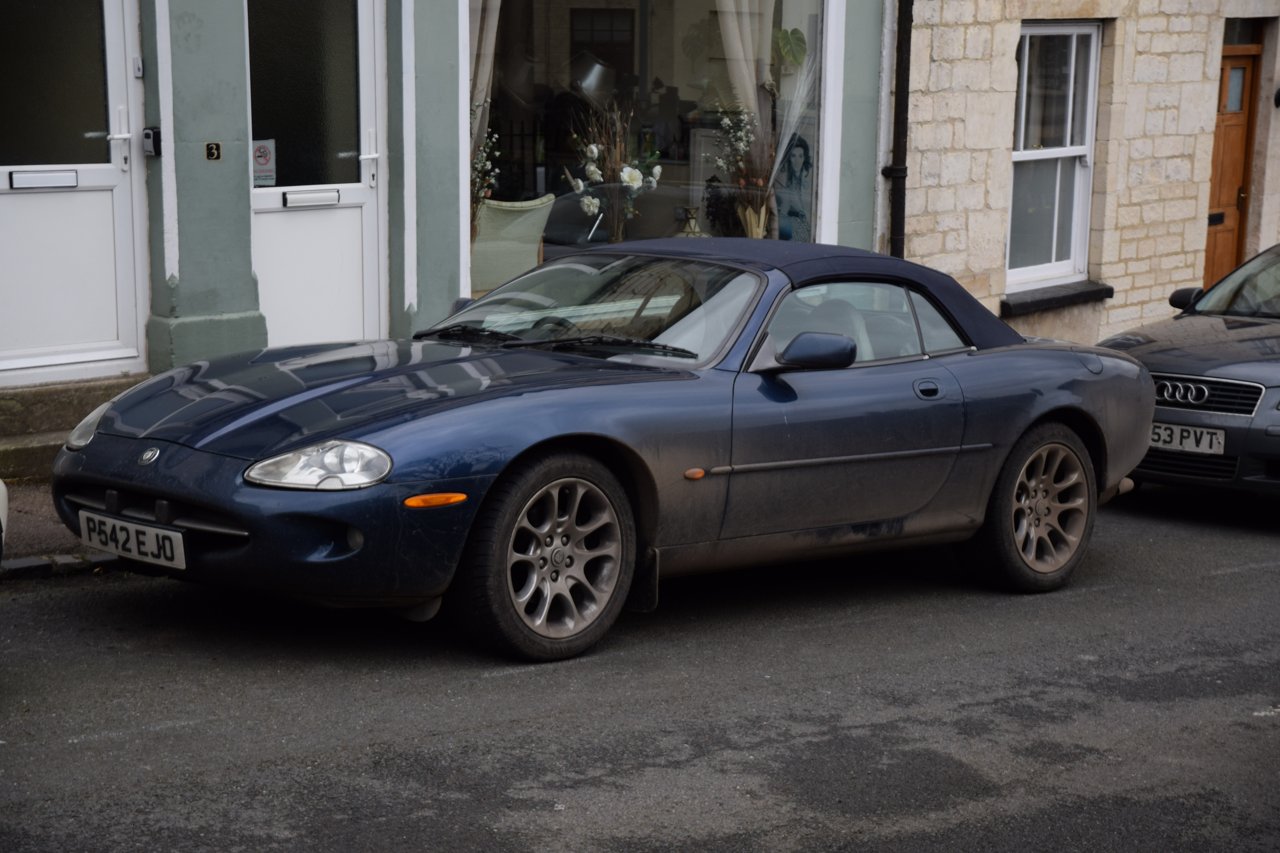
Overview
The XK8 was Jaguar’s V8-powered replacement for the XJS, introduced at the Geneva Motor Show in March 1996. Built at Browns Lane, Coventry, England, the X100 range remained in production until May 2005. It offered coupé and convertible bodies, with the supercharged XKR joining in 1998. Jaguar Heritage identifies it as Jaguar’s first V8-powered production car, while distinguishing the earlier V8s of sister marque Daimler. Jaguar Daimler Heritage Trust’s final-X100 record.
This model record covers the XK8-era X100 family, including the related XKR derivative. X100 is the programme identifier; XK8 and XKR distinguish naturally aspirated and supercharged versions. The later aluminium-bodied XK, code X150, is a successor rather than a facelift of this car. Jaguar Heritage records X100 production as 1996–2005, followed by the new XK’s public unveiling in September 2005 and market introduction in spring 2006. Successor-model archive record.
Development and design
Jaguar Heritage dates the X100 programme to 1991, during Ford ownership. Styling proposals came from the Whitley studio under Geoff Lawson. Mechanical development initially used XJS-like test cars; MP19, built in December 1993, carried a glass-fibre representation of the new shape on a modified XJS underframe before steel-panel tooling was available. Film of this prototype helped secure Ford board approval on 9 December 1993. It subsequently underwent cold-weather testing at Timmins, Canada. The prototype’s construction should not be mistaken for the production body’s material. JDHT’s MP19 development account.
The finished car recalled the E-Type through its curved surfaces and low nose. JDHT credits Fergus Pollock working under Lawson, with Bob Dover directing the programme. Its new AJ-V8 was an aluminium engine with twin overhead camshafts per cylinder bank and four valves per cylinder, initially of 4.0 litres. Thus the revived XK name accompanied a new engine family, rather than a return to the old XK straight-six. JDHT’s 1997 XK8 collection sheet.
Body, chassis and touring character
Production X100s used a steel monocoque, front-mounted engine and rear-wheel drive. The early XK8 combined a five-speed automatic with independent suspension and ventilated disc brakes with anti-lock control. Its rear suspension drew on the more modern arrangement associated with the X300 XJ, rather than simply carrying over every XJS component. The cabin’s leather, wood veneer and emphasis on refinement placed the car firmly in the grand-touring tradition. Classic & Sports Car’s X100 retrospective, reproduced by JDHT.
Both XK8 and XKR were offered as closed coupés and fabric-roof convertibles. These are body choices within the range, not successive generations. Export sales, particularly to the United States, were central to the model’s role; Jaguar Heritage notes that the open car was the more popular body. JDHT’s range summary.
Engines, revisions and market chronology
The main mechanical division is between the original 4.0-litre cars and the later 4.2-litre range. Supercharging identifies the XKR; an XK8 does not acquire XKR specification merely through a larger engine or later registration date.
| Period or market designation | Development |
|---|---|
| March 1996 | Geneva public introduction of the XK8 |
| 1998; North American model year 2000 | XKR introduction, followed by its North American rollout |
| Model year 2001 | Mid-cycle revisions recorded in Jaguar’s North American technical history |
| Calendar 2002 / model year 2003 | 4.2-litre engines replace the 4.0-litre units; six-speed automatic introduced |
| US model year 2005 | Further exterior styling revisions |
| US model year 2006 | Victory editions offered for XK8 and XKR, in both body styles |
| 27 May 2005 | Final X100 completed at Browns Lane |
The engine enlargement is dated to 2002 by JDHT. Jaguar Cars North America’s 2003 Model Year XK Service Training Technical Guide, issued in September 2002, identifies the corresponding model-year change: naturally aspirated and supercharged 4.2-litre V8s and the ZF six-speed automatic. It also explicitly separates the XKR’s 1998 introduction from North America’s model-year 2000 arrival and records the 2001 freshening. These are revisions within X100, not new generations. Period Jaguar technical guide, preface and general information.
Jaguar’s North American Victory-edition announcement describes the 2005 exterior update and 2006 model-year cars going on sale in the United States in June 2005. Victory was a commemorative equipment edition, offered across both engines and bodies; its trim included different veneers for XK8 and XKR. That sales designation is compatible with production ending in calendar 2005. It should not extend the Browns Lane build period into 2006 or identify a Victory car as the aluminium X150. Jaguar press release reproduced by Serious Wheels.
End of production and legacy
The final X100 was an XKR 4.2-litre coupé completed on 27 May 2005 and transferred to Jaguar Heritage. Final-car archive record.
The succeeding X150 retained a V8 but adopted aluminium body and chassis construction. Its first official production example was completed at Castle Bromwich on 20 December 2005. This marks a change of structure and assembly location as well as styling; the shared engine capacity does not make the two cars interchangeable in a technical catalogue. JDHT’s first-production X150 record.
The XK8’s historical significance lies in connecting Jaguar’s traditional sports-car appearance with its production V8 era. It renewed the touring role of the XJS while establishing a clear naturally aspirated/supercharged range. For identifying individual examples, build date, destination market, model year, body style and engine specification remain separate facts; a registration year alone cannot settle all five.