Jaguar XJS
Jaguar's 1975–1996 grand tourer developed from the V12 XJ-S coupé into six-cylinder and V12 cabriolets and convertibles.
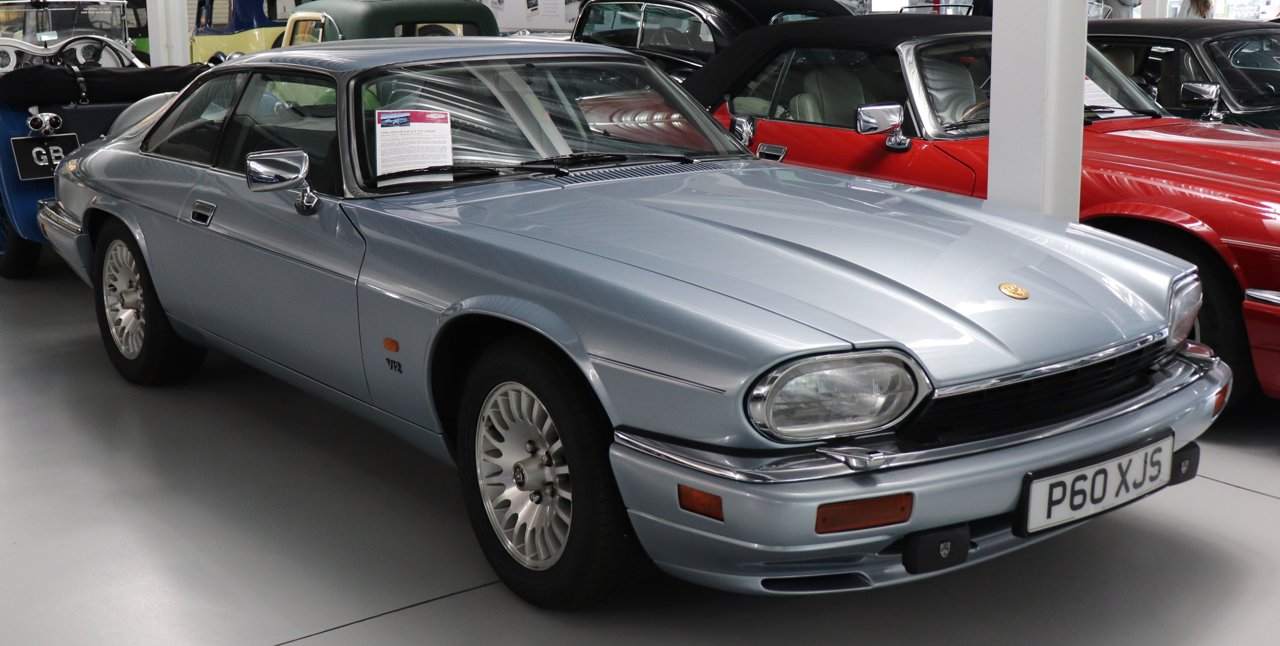
Overview
The XJS was Jaguar’s long-running grand-touring model, produced from 1975 to April 1996 and assembled at Browns Lane, Coventry, England. Introduced in September 1975 as the XJ-S, it began as a 5.3-litre V12 coupé and eventually included six-cylinder cars and two distinct open body styles. The XK8 succeeded it in 1996. JDHT’s final coupé record and Browns Lane run-out account.
This is a model-level record covering both spellings. XJ-S and XJS do not identify separate model lines. Nor is this car the pillarless XJC: that coupé belongs to the XJ saloon family. The XJ-S followed the E-Type in Jaguar’s range but pursued a more explicitly luxurious touring role. Jaguar’s XJC and XJ-S history.
Development, design and engineering
Jaguar traces the programme to the 1960s, with early work by Malcolm Sayer and development leadership by William Heynes. Its retrospective credits Doug Thorpe with completing the design. The result retained Sayer’s aerodynamic influence and William Lyons’s involvement, most visibly in the long, low body and rear flying buttresses. Jaguar’s development account.
Underneath, a shortened XJ saloon floorpan and related suspension and chassis components brought Bob Knight’s emphasis on ride, handling and refinement into a different body. The initial V12 cars were predominantly automatics, although a small number had manual gearboxes. The distinctive oval headlamps were developed by Cibié. These features describe the original car; they are not a specification for every later XJS. JDHT’s 1975 show-car record.
American safety expectations influenced the launch body choice. Concern about possible future rollover requirements helped stop the proposed open version, leaving a closed coupé at introduction. This was anticipation of regulation, not evidence that all convertibles were actually banned in the United States. Convertible development history, Jaguar World, May 2018.
Engines and the expanding range
The original engine was Jaguar’s 5.3-litre V12. The HE phase followed in 1981; the initials mean High Efficiency. It retained twelve cylinders rather than introducing a new displacement or a separate model. Geoffrey Green’s specialist overview explains the revised combustion system and its economy objective. XJS Data model guide and JDHT change-point register.
In 1983 Jaguar added the 3.6-litre AJ6 straight-six, offered with a Getrag five-speed manual gearbox. The six-cylinder option and new cabriolet broadened the range beyond the original V12 coupé. AJ6 identifies an engine family; it should not be confused with the older XK six used in earlier Jaguar sports cars and saloons. JDHT’s 1983 six-cylinder coupé record.
Coupé, cabriolet and convertible
The closed coupé’s 2+2 layout was followed by the XJ-SC cabriolet, introduced in 1983 with removable roof panels. The cabriolet retained a crossbrace hoop and a folding rear roof section; it was normally a two-seater. V12 cabriolets followed the six-cylinder version. A specially equipped car with rear seats, such as Princess Diana’s, does not establish the normal production seating specification. 1983 introduction, cabriolet record and model overview.
The factory full convertible arrived in 1988, initially with the 5.3-litre V12 and two seats. Its fully folding powered roof required structural reinforcement and development with Karmann. Rear seats followed in 1993. Earlier Hess & Eisenhardt conversions sold through American Jaguar dealers were a separate conversion programme, not the same body as Jaguar’s later factory convertible. Jaguar World convertible history.
Facelift and final production years
The 1991 revision brought changed rear lamps, conventional instruments and the shorter XJS spelling. The six-cylinder engine became a 4.0-litre AJ6. Those changes should not be bundled with the later AJ16 engine or standard 6.0-litre V12. Jaguar World facelift account.
JDHT’s chassis guide separates the subsequent milestones:
| Calendar period | Change recorded by the archive |
|---|---|
| April 1992 | 4.0-litre convertible introduced |
| May 1993 | Standard 6.0-litre model introduced as the XJR-S 6.0 was discontinued |
| Approximately May 1994 | AJ16 engine introduced; precise VIN not established |
| May 1995 | 4.0-litre cars designated Celebration |
| April 1996 | Final 4.0 convertible and final 6.0 V12 coupé |
These are approximate production change points, not universal market launch dates. The same guide places the start of the 1994 model year in September 1993. Its manufacturing caveat means individual cars still need their build records checked. JDHT Research Guide 001N, issue 3, pages 1–2.
Markets, sporting derivatives and legacy
Destination matters when identifying an XJS. The specialist illustrated catalogue distinguishes UK lighting without front side markers from American lighting arrangements. Its model-year groupings also differ from calendar-year archive dates. A photograph, registration year or badge alone is therefore insufficient to assign a complete specification. XJS Data model catalogue.
The TWR-developed XJR-S road derivative appeared in 1988. It belongs within the XJS family, but its tuning and engine chronology should not be applied to standard cars. Competition machines were another distinct application: TWR’s XJ-S programme brought Tom Walkinshaw the 1984 European Touring Car Championship and victory with Win Percy at Spa that year. JDHT’s model and competition summary.
Jaguar Heritage identifies P60 XJS, the 6.0-litre coupé pictured here, as the final XJS built. The model’s significance lies in that long evolution: a controversial V12 touring coupé became a broader family whose open cars and revised engines sustained Jaguar’s grand-touring offering until the XK8 arrived. Final-car record.