Jaguar E-Type
Jaguar's sports car of 1961–1974, combining a competition-derived structure and distinctive body with XK six-cylinder and later V12 engines.
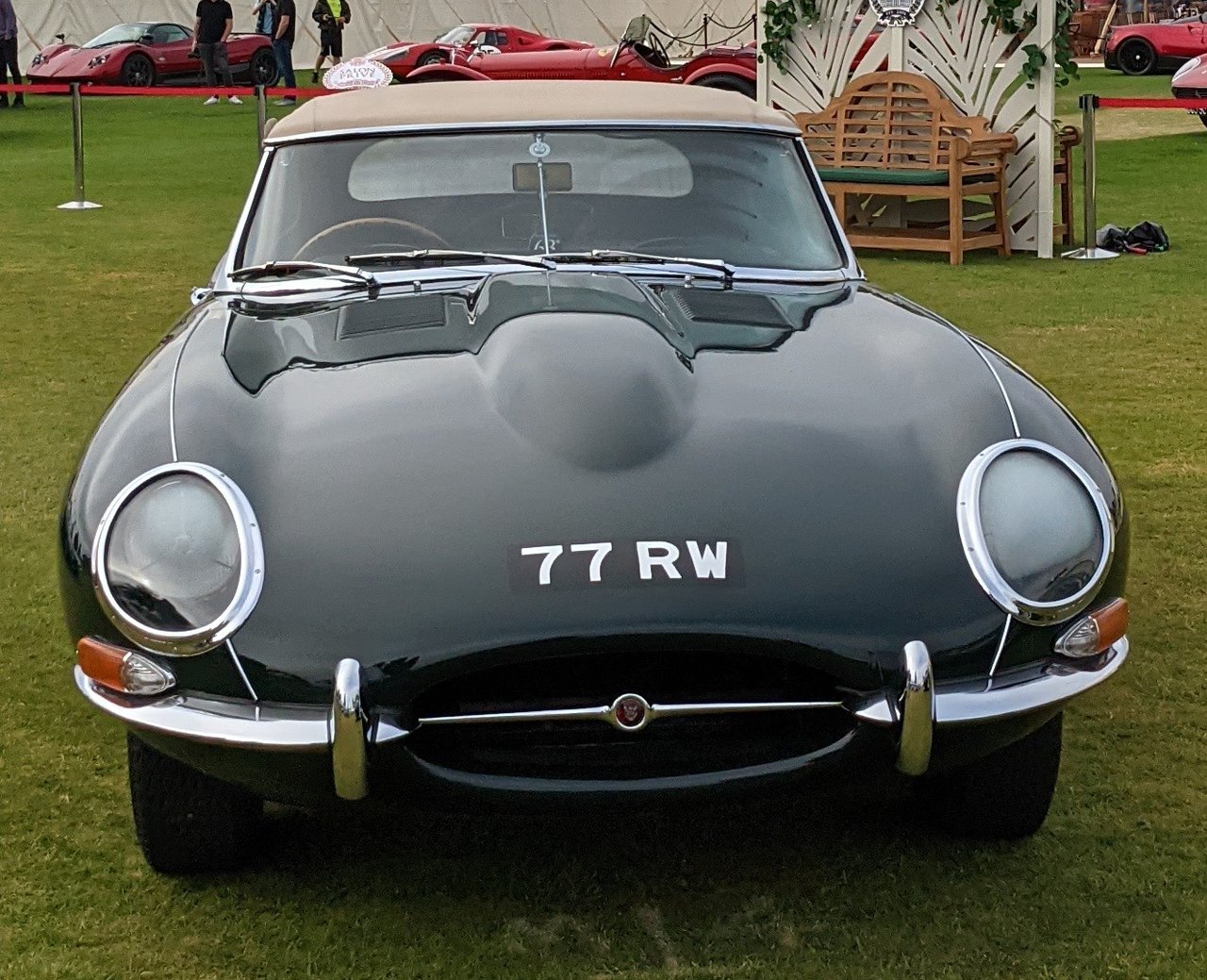
Overview
The E-Type was Jaguar’s sports-car and grand-touring model produced from 1961 to 1974. It replaced the XK150 in the road-car range, while drawing on the marque’s competition engineering. Its Geneva unveiling on 15 March 1961 introduced a shape that became closely associated with British motoring in the 1960s. Jaguar Daimler Heritage Trust’s E-Type exhibition history.
The range developed from two-seat six-cylinder cars into longer 2+2 and V12 versions. Its combination of appearance, performance and price helped Jaguar reach sports-car buyers, especially in America. Series, body style and engine specification identify different aspects of the same model line. JDHT’s original E-Type history.
Production and place
E-Types were built at Browns Lane, Coventry, England. The factory history connects the end of E-Type production in June 1974 with the end of body manufacture at Browns Lane. Jaguar’s manufacturing network also included Radford, where the production V12 was built; final vehicle assembly and engine manufacture should therefore be distinguished. JDHT’s Browns Lane history.
The last E-Type, retained by Jaguar and now in the Heritage Trust collection, was built on 12 June 1974 and registered on 5 February 1975. JDHT’s certificate catalogue nevertheless lists Series 3 under 1971–1975. This record uses 1974 as the production endpoint, supported by the surviving final car’s documented build date; a 1975 registration or broad catalogue range is not evidence of manufacture in that year. Last-car record and certificate model register.
Design and engineering origins
Malcolm Sayer’s aerodynamic body design linked the E-Type visually with the racing D-type. Beneath it, a central monocoque body and separate front subframe replaced the earlier XK road cars’ separate chassis approach. The original coupé and open car shared this basic construction. JDHT’s 77 RW history.
Development passed through the E1A and E2A prototypes. The production arrangement combined the front structure carrying the engine, steering and front suspension with independent rear suspension attached to the body through rubber mountings. The result translated racing-derived ideas into a road car rather than simply rebadging a competition chassis. JDHT’s structural evolution account.
Sayer’s contribution should sit within the wider Jaguar design and engineering effort. The Museum of Modern Art credits William Lyons, Malcolm Sayer and William M. Heynes for its E-Type Roadster, a 1963 example of the design introduced in 1961. MoMA collection record.
Series and body styles
Series 1: 1961–1968
The first cars paired the 3.8-litre XK engine with either an open two-seat body or a two-seat fixed-head coupé. The 1964 move to 4.2 litres also brought improved seats, brakes and a Jaguar gearbox replacing the Moss unit. JDHT’s original-model account.
The longer 2+2 coupé added small rear seats and made an automatic transmission available. Its chronology needs care: JDHT’s chassis guide records initial 2+2 production in September and October 1965, while its original-car history dates the public launch to 1966. The 2+2 was a body derivative, not a replacement for the two-seat coupé. Chassis and production guide, launch account and transmission history.
“Series 1½” is an unofficial retrospective label for the interim cars associated with the late-1967 safety and emissions revisions. Uncovered headlamps are a familiar feature of this transition, but the label should not imply that every change occurred simultaneously for every market. JDHT’s explanation of the interim model.
Series 2: built 1968–1970
Series 2 retained the 4.2-litre engine and all three body forms. It brought a larger front air opening, larger lamps below the bumpers, revised rear lighting, stronger Girling brakes and a cross-flow radiator with two fans. Power steering became optional. These changes went beyond the interim Series 1 revisions. JDHT’s Series 2 history.
JDHT records Series 2 production beginning in August 1968 and ending at different points in 1970 according to body and steering position. Some late US-specification cars built in 1970 were designated 1971 model year, with a 2R chassis prefix. Thus a 1971-model-year E-Type is not necessarily a V12 Series 3. JDHT’s chassis-number guide.
Series 3: launched 1971, production ending 1974
The final series used the 5.3-litre V12. Only the open two-seater and 2+2 coupé remained, both on the longer wheelbase; the short-wheelbase two-seat coupé disappeared. Manual and automatic transmissions were offered, with the automatic now available in the open car. JDHT’s final-series history.
Public introduction in spring 1971 followed earlier builds: JDHT’s surviving press-fleet V12 2+2 was made in August 1970. The production engine used one overhead camshaft per bank and four Zenith-Stromberg carburettors. It differed from the twin-cam-per-bank experimental V12 developed for the XJ13 racing project, and reached the E-Type before the XJ12 saloon. JDHT’s early Series 3 record.
Markets and specification
American regulation influenced the late six-cylinder cars’ lighting, safety equipment and emissions systems. The Jaguar Clubs of North America Series 2 guide documents the emissions-equipped twin Zenith-Stromberg carburettor installation and successive manifold and carburettor changes. Such details belong to the relevant market and engine-number range, rather than to every 4.2-litre E-Type. JCNA Series 2 judging guide, engine compartment section.
Engine displacement alone therefore cannot define a car’s full specification. Nor do left-hand drive, registration year or a restored car’s present equipment establish its original market configuration. The archive’s separate chassis runs for body style and steering position provide the appropriate starting point for identifying an individual car. JDHT production guide.
Competition and legacy
Competition E-Types formed a distinct branch of the model: Jaguar built twelve Lightweight cars in 1963–1964, while the later Group 44 V12 programme achieved an SCCA Group B championship in 1975. These racing cars should not supply specifications for ordinary production road models. JDHT competition history.
The E-Type’s significance extends beyond competition. Its long bonnet, compact cabin and flowing body made mechanical packaging part of its visual identity. MoMA’s inclusion of the roadster in its Architecture and Design collection recognises the car as an industrial-design object as well as transport. Within Jaguar’s history, the progression from the early two-seat six-cylinder car to the longer V12 illustrates the range’s movement towards grand touring without losing its recognisable form. MoMA E-Type record.