Jaguar XJ
Jaguar's flagship saloon family of 1968–2019 evolved from the XK-powered XJ6 through V12 and V8 models to aluminium-bodied luxury cars.
Overview
The XJ was Jaguar’s flagship luxury-saloon family, introduced as the XJ6 in September 1968 and ending production in July 2019. It carried the marque’s combination of comfort and sporting character into successive engineering eras. XJ is the model line; XJ6, XJ12 and XJ8 identify engine-related versions within it, rather than three unrelated models. Jaguar’s early XJ history and Jaguar Daimler Heritage Trust’s final XJ record.
This record covers the production saloon family and its Series 2 coupé. The XJ-S/XJS grand tourer belongs to a separate model line despite its shared ancestry. Series names and development codes provide more useful boundaries than a single generation count: the Series 1–3 cars evolved one design, while XJ40, X300 and X308 also shared a continuing architectural lineage. Jaguar’s XJ-S account and JDHT’s X300 development history.
Original XJ: Series 1 and 2
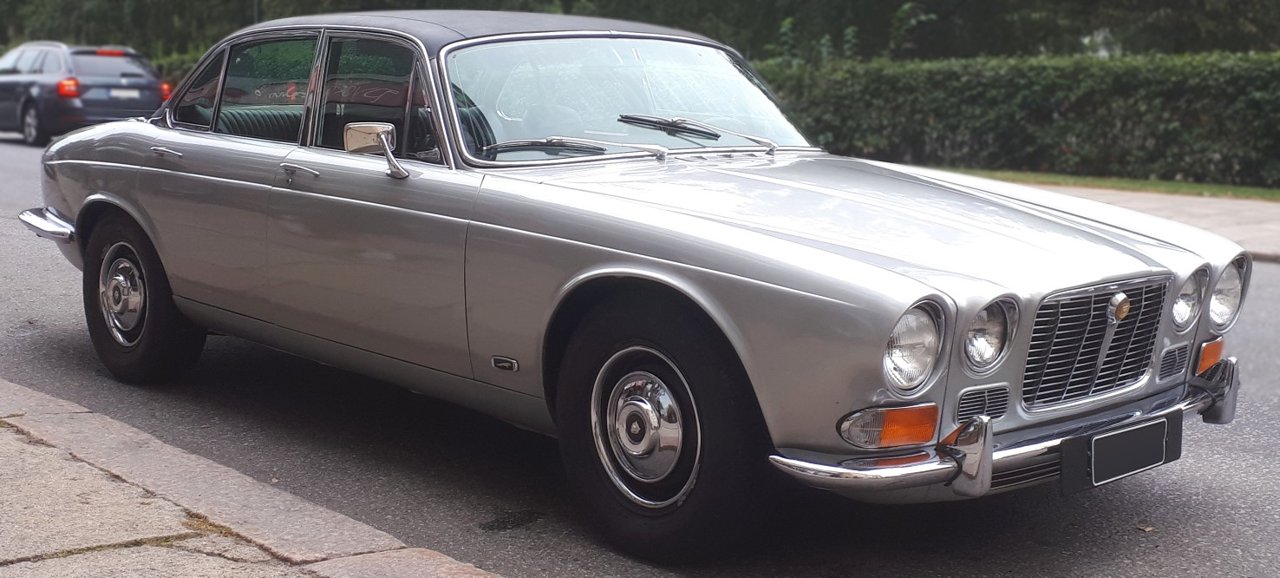
William Lyons shaped the original XJ’s appearance; Bob Knight’s suspension development helped reconcile responsive handling with passenger comfort. The September 1968 XJ6 offered 2.8- and 4.2-litre XK straight-sixes. The 5.3-litre XJ12 followed in 1972, and a longer-wheelbase saloon increased rear accommodation. Series 2 arrived in 1973 with revised bumpers and grille; from 1974 its saloons used the longer wheelbase. Jaguar’s Series 1 and 2 history.
The pillarless two-door XJC used the short-wheelbase floorpan. Shown in 1973, it reached sale in 1975 and ended production in 1977. Buyers could choose the 4.2-litre six or 5.3-litre V12. It was a body derivative of Series 2, not the XJ-S. Jaguar’s coupé history.
Series 3 and the overlapping successor
Launched in March 1979, Series 3 received a Pininfarina revision with a new roof and glasshouse, deeper curved side windows and revised exterior fittings. It retained six- and twelve-cylinder versions while the replacement XJ40 remained under development. JDHT’s Series 3 history.
The dates require qualification. JDHT’s general register lists the Series 3 XJ6 as 1979–1986, but its individual last-car record identifies a final six-cylinder Sovereign built in April 1987. This page therefore retains the documented run-out beyond the XJ40’s 1986 introduction. V12 Series 3 cars continued until 1992 because the new car initially lacked a twelve-cylinder version. Model register, last six-cylinder car and last Series 3 Daimler.
XJ40: 1986–1994
Proposed in 1972 and introduced in 1986, the XJ40 brought an angular new body, electronic systems and the J-gate automatic selector. Its AJ6 engine family replaced the XK six in the new saloon: initial 2.9- and 3.6-litre versions were followed by 3.2- and 4.0-litre units. The later 6.0-litre XJ12 is dated to 1993 in JDHT’s XJ40 history and model register. It must not be confused with the older 5.3-litre Series 3 sold during the overlapping period. XJ6, Sovereign and related Daimler versions belonged to the same new architecture. JDHT’s last XJ40 record and model register.
X300 and X308: traditional form, new powertrains
The X300, introduced in September 1994, extensively revised the XJ40 with softer body shapes and a return to a four-headlamp Jaguar face. Its AJ16 straight-six developed the AJ6, in 3.2- and 4.0-litre forms. The XJR added a supercharged six, while the XJ12 retained a 6.0-litre V12. JDHT’s X300 account.
The X308 transition in 1997 replaced these six- and twelve-cylinder engines with 3.2- and 4.0-litre AJ-V8 units. JDHT groups the XJ8/X308 under 1997–2003, including supercharged versions. Similar styling should not obscure the powertrain break: an X300 XJR and a V8 XJR are different engine applications. JDHT’s powertrain chronology and model register.
X350 and X358: aluminium construction
Unveiled in 2002 ahead of the 2003 production range, X350 retained recognisably traditional proportions while adopting a substantially new aluminium structure assembled using bonding and riveting. A larger cabin and reduced structural weight marked a more fundamental change than its appearance suggested. JDHT-hosted history of the X350 show cars.
Across the 2003–2009 family, engine offerings included a 3.0-litre petrol V6, petrol V8s including a supercharged 4.2, and a 2.7-litre V6 diesel. These were alternatives whose availability depended on period and market. X358 denotes the 2007 facelift, with revised grille, bumpers and side vents, rather than an unrelated platform. SNG Barratt’s X350/X358 catalogue, introduction and JDHT model register.
X351: unveiled 2009, production 2010–2019
The final XJ adopted Ian Callum’s newer design language and a primarily aluminium body architecture. Its London unveiling on 9 July 2009 preceded production in March 2010 and sales from May. Launch engines included a 3.0-litre V6 diesel and naturally aspirated or supercharged 5.0-litre petrol V8s. Supercharged V6 and turbocharged four-cylinder petrol options followed in 2012; JDHT identifies the latter as aimed principally at China. The XJR returned in 2013 with a supercharged V8. These choices were not a universal specification offered in every country. JDHT’s X351 history.
JDHT dates the end of XJ production to 5 July 2019. Its preserved diesel Portfolio is specifically the last UK right-hand-drive production example, not evidence that every final-market car had that engine or trim. Final-car record.
Manufacturing and market identity
British XJ production was associated first with Browns Lane, Coventry, and later with Castle Bromwich, Birmingham. Body manufacture and final assembly were separate operations: JDHT records Castle Bromwich supplying bodies to Browns Lane, where the final car assembled on 1 July 2005 was an XJ. Castle Bromwich subsequently built the final XJ generation. Browns Lane factory history and X351 production history.
Badges also changed meaning. Sovereign transferred from Daimler to Jaguar in 1983. North American Vanden Plas branding could identify cars comparable to Daimler specifications elsewhere; late Series 3 V12 availability differed between the United States and Canada. Daimler was a related marque, not simply an engine option. JDHT’s Daimler and North American naming account.
For an individual XJ, identify the series or project code, body and wheelbase, engine, destination market and build date before applying specifications. Calendar-year launches, model-year labels and first registrations can fall in different years. Even the archive’s broad date ranges need comparison with surviving chassis records, as the Series 3 run-out demonstrates.
Historical significance
Read alongside the earlier Mark 2 saloon and contemporary E-Type, the XJ shows how Jaguar extended its sporting identity into its luxury flagship. Its history joins the long-lived XK engine, V12 refinement, supercharged performance and aluminium construction within one model name. That continuity of purpose matters more than treating every XJ as the same engineering design.