Jaguar Mark 2
Jaguar's compact sporting saloon of 1959–1967 combined a light-filled four-door body, XK six-cylinder engines and disc brakes with a successful touring-car racing career.
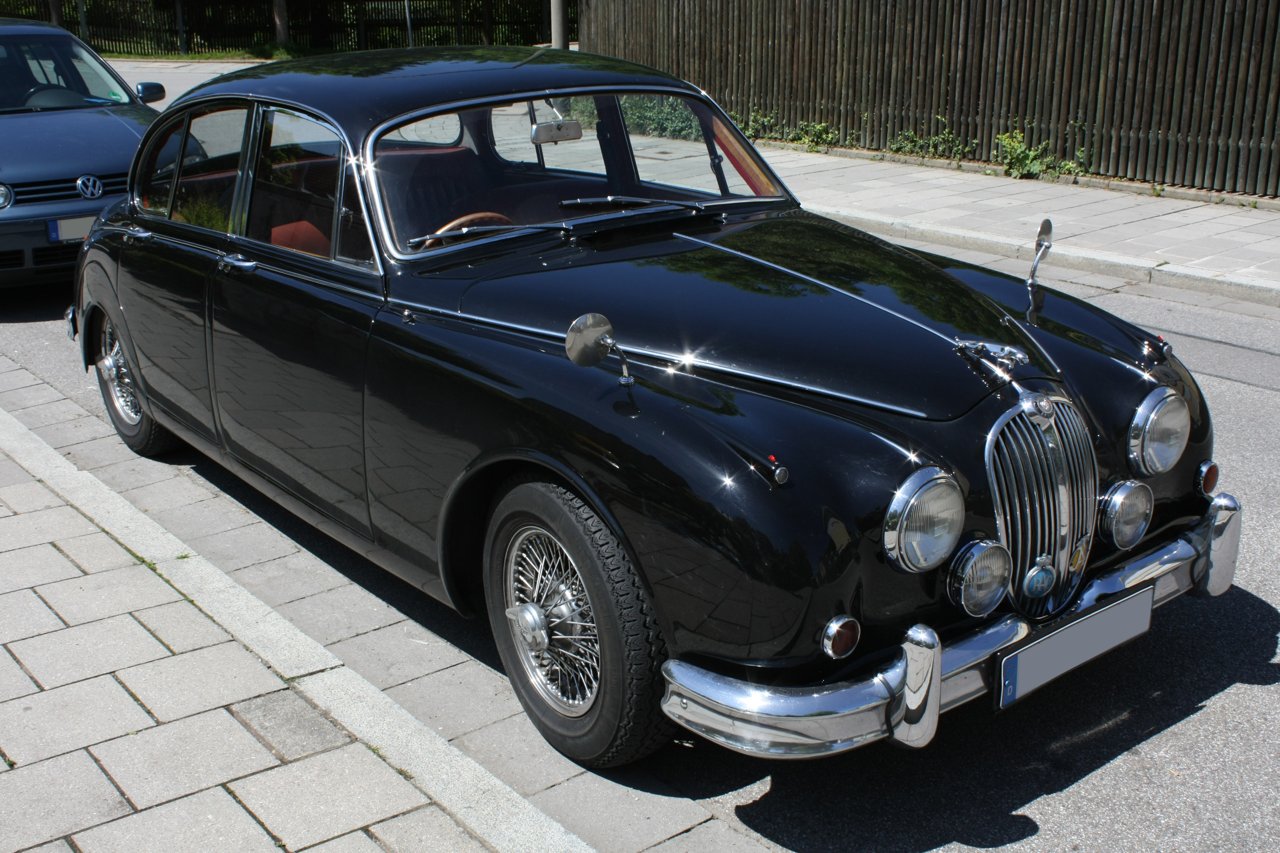
Overview
The Mark 2 was Jaguar’s compact four-door sporting saloon, succeeding the 2.4 and 3.4 Litre cars commonly known retrospectively as the Mark I. Mark 2 and Mark II name the same model: the brochure uses the numeral; the heritage archive uses Roman numerals. Engine choices are variants, not generations. Jaguar’s contemporary brochure and JDHT model register.
The archive records 1959–1967 for the Mark II, 1967–1969 for the 240 and 1967–1968 for the 340. The latter two continued the compact-saloon line under revised names; their years should not silently extend Mark 2 production to 1969. JDHT model register.
Development and design
The principal visual change from the earlier compact saloon was above the waistline. A revised upper body and greater glass area made the cabin brighter and improved visibility. The familiar rounded wings and upright grille remained, giving the Mark 2 a recognisable relationship to its predecessor. Jaguar’s historical account.
The steel, five-seat saloon used integral construction. Its early specification included leather upholstery, walnut dashboard, folding rear-passenger tables and main instruments directly ahead of the driver. Period brochure, specification and interior pages.
Engines and chassis
All three capacities belonged to the twin-overhead-camshaft XK six-cylinder family:
| Sales designation | Displacement |
|---|---|
| 2.4 Litre | 2,483 cc |
| 3.4 Litre | 3,442 cc |
| 3.8 Litre | 3,781 cc |
The early 3.4/3.8 specification lists twin SU HD6 carburettors, a four-speed manual, optional overdrive or Borg-Warner automatic, and a limited-slip differential on the 3.8. Independent coil-sprung front suspension accompanied a leaf-sprung rear axle, with servo-assisted Dunlop disc brakes and recirculating-ball steering. This describes the early brochure specification; later equipment could differ. Jaguar brochure, 3.4/3.8 specification and engine pages.
Production and chronology
The Mark 2 was manufactured at Browns Lane, Coventry, England. It was a major contributor to Jaguar’s expansion: JDHT records that most of the company’s output in 1960 consisted of Mark II saloons. Following Jaguar’s acquisition of Daimler that year, Radford became the main Jaguar engine-assembly plant. Vehicle assembly and engine manufacture therefore need not identify the same factory. JDHT’s Browns Lane history.
| Date or period | Development |
|---|---|
| July–September 1959 | First recorded Mark II builds, with different starting months for each engine and steering configuration. |
| 30 September 1959 | Jaguar’s press-release catalogue records the announcement of the Mark II range and its 3.8-litre option. |
| 1963 | The S-type joined the range alongside the Mark II. |
| July–September 1967 | Last Mark II chassis entries, depending on engine and steering position. |
| September 1967 | The 240 and 340 were announced for the 1968 season. |
Sources: JDHT chassis guide and press-release catalogue, 1959, 1963 and 1967 entries.
The chassis guide also records initial 240/340 builds before their September announcement. Its dates are explicitly approximate. Calendar-year manufacture, public introduction, the advertised sales season and first registration are separate events; an individual car’s build record takes precedence over a broad year label. JDHT chassis guide.
Markets and identification
Both right- and left-hand-drive Mark IIs appear in Jaguar’s production records. The archive’s identification guide defines A or B chassis prefixes for South African assembly, P for power steering, and DN and BW suffixes for overdrive and automatic transmission respectively. These codes describe assembly or equipment, not generations. JDHT chassis guide.
North American advertising could emphasise displacement rather than the Mark 2 name. Jag-lovers catalogues Jaguar’s 1966 United States brochure as Jaguar 3.8 Sedan, separately from the contemporary 3.8 S Sedan. The latter is the S-type: the similar names should not be used to transfer specifications between them. Period-brochure catalogue.
Related saloons and the 240/340 transition
The Daimler 2½ Litre V8, announced in 1962, used the Mark II body with a distinct Daimler V8 powertrain. It was a related Daimler model, not a Jaguar XK engine option. Likewise, Jaguar’s September 1963 announcement explicitly placed the S-type alongside the Mark II rather than replacing it. JDHT press-release catalogue.
The 1967 rationalisation brought slimmer bumpers and revised equipment to the 240/340 range, including Ambla upholstery as standard and leather as an option. Regular production of the 3.8-litre Mark II ended; Jaguar’s retrospective mentions a small number of specially requested 3.8-engined 340s, which should not be treated as a normal three-engine successor range. Jaguar subsequently concentrated on the XJ saloons. Jaguar’s account of the transition.
Historical importance
Competition gave substance to the Mark 2’s sporting image. Jaguar’s archive records 3.8-litre Mark IIs taking the first four places in the Silverstone touring-car race in May 1962, and privately entered cars finishing first and second in the Nürburgring six-hour touring-car race the following month. These results belong to competition cars, rather than establishing the performance of every showroom saloon. JDHT press-release catalogue, 1962 entries.
Alongside the contemporary XK150 and E-Type, the Mark 2 illustrates the breadth of Jaguar’s sporting identity: a practical saloon could share the marque’s emphasis on performance while retaining a distinctly luxurious cabin.