Jaguar XK150
The final development of Jaguar's original XK sports-car family combined revised bodywork, disc braking and 3.4- or 3.8-litre engines before the E-Type era.
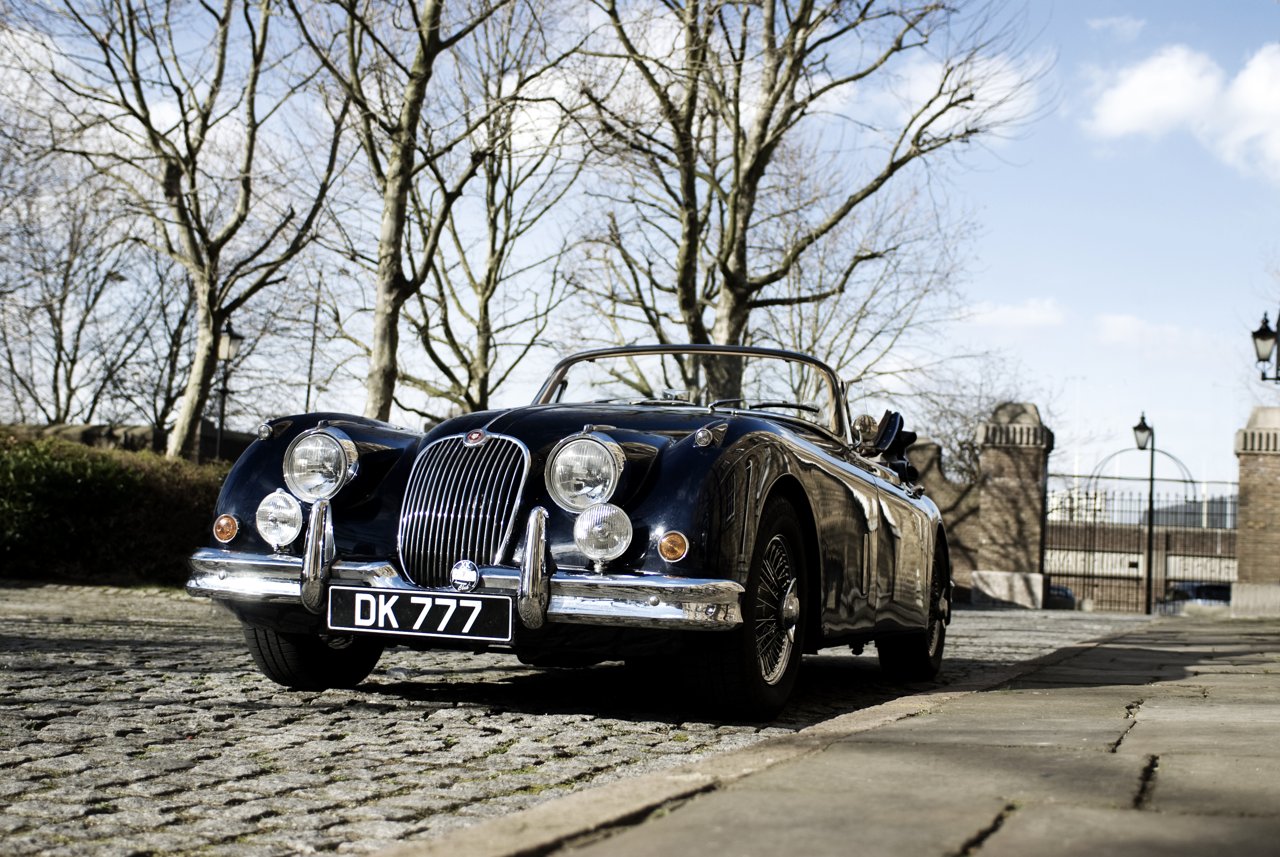
Overview
The XK150 was Jaguar’s final development of the sports-car family begun by the XK120, succeeding the XK140. Introduced in May 1957, it initially offered fixed-head and drophead coupé bodies. Disc braking and a broader engine range marked its development. Jaguar Daimler Heritage Trust’s model history.
This is a model-level record: body styles, SE equipment and S engine specifications belong within the XK150 range. The Trust catalogues the model as 1957–1961, although its detailed chassis guide ends the recorded builds in 1960, as explained below. JDHT model catalogue and chassis guide.
Design and body styles
The XK150 replaced the earlier split windscreen with a curved, one-piece screen. A straighter wing line and wider bonnet changed its proportions, while slimmer doors improved interior space. These revisions gave the last of the original XKs a more accommodating touring character. Twyford Moors’ XK history.
| Body | Place in the range |
|---|---|
| Fixed-head coupé (FHC) | Enclosed, permanent-roof body, offered at introduction. |
| Drophead coupé (DHC) | Folding-roof coupé, also part of the initial range. |
| Open two-seater (OTS), or roadster | Later open body; Jaguar’s brochure describes a hood concealed behind the seats when folded and winding side windows. |
The roadster’s winding windows are an important distinction from the simpler weather equipment of earlier XK open cars. Body names describe different configurations, not successive generations. JDHT body chronology and Jaguar’s roadster brochure, printed December 1958.
Engineering and engine choices
Jaguar’s roadster brochure specifies rack-and-pinion steering, independent wishbone-and-torsion-bar front suspension and a leaf-sprung rear axle. It lists a four-speed manual gearbox, an overdrive alternative and a Borg-Warner automatic; the S version in this brochure is restricted to manual transmission with overdrive. Period specification, final page.
The launch engine was the twin-overhead-camshaft 3,442 cc XK six, generally called 3.4 litres. The same brochure distinguishes three specifications:
| 3.4-litre specification | Advertised engine equipment and output |
|---|---|
| Standard | Twin SU carburettors; 190 bhp. |
| Special Equipment (SE) | B-type cylinder head and twin HD6 SU carburettors; 210 bhp. |
| S | Straight-port cylinder head and three HD8 SU carburettors; 250 bhp. |
These are period advertised figures for the stated configurations, not modern measurements. Jaguar roadster brochure.
From October 1959, the 3.8-litre option added quoted outputs of 220 bhp, or 265 bhp in S form. It was a larger XK-family engine, not a new vehicle generation. JDHT engine chronology.
Four-wheel discs became a defining XK150 feature. However, JDHT distinguishes the catalogue’s drum-braked, disc-wheel standard car from SE cars with wire wheels and discs; it believes virtually all production followed the SE specification. Catalogue availability should therefore not be treated as evidence of substantial drum-braked production. JDHT equipment account.
Production and chronology
The XK150 belongs to Jaguar’s Browns Lane, Coventry, England, manufacturing period. The factory brought together XK body manufacture, paint, engine machining and assembly, and final vehicle assembly. JDHT’s Browns Lane history.
The Trust’s chassis guide records left-hand-drive coupés from March 1957, before the public launch. It lists an initial left-hand-drive roadster in September 1957, followed by the next chassis in 1958; the right-hand-drive roadster sequence starts in October 1958. These build entries should not be mistaken for simultaneous retail introductions. JDHT chassis guide, page 2.
The S chronology also needs care. Although JDHT’s short history dates its introduction to early 1959, Jaguar service bulletin 254 already describes an S open two-seater in November 1958. The December 1958 roadster brochure likewise includes it. The evidence establishes the S roadster by late 1958 without assigning that date to every S body style. John Elmgreen’s digest of Jaguar service bulletins and period brochure.
For the end date, the chassis guide places the last cars in October or November 1960, depending on body and steering position. The broader 1957–1961 catalogue span remains useful for identifying the model’s era, but is not proof of 1961 manufacture for an individual car. Build date, dispatch, model-year designation and first registration require separate evidence. JDHT chassis guide and model catalogue.
Markets and identification
The roadster was initially an export, left-hand-drive offering, chiefly for the United States. JDHT export account. Market equipment could differ: bulletin 263 of April 1959 describes special short-lug wire-wheel hub caps for Germany. Bulletin 252 records a change to fresh-air heating in September 1958 at specified chassis numbers. Such running changes should not be recast as a single universal facelift or model-year package. Service-bulletin digest.
SE and S are not interchangeable. The archive guide assigns chassis prefix S to Special Equipment and T to the S model, while noting exceptions among S cars. Engine prefixes V, VS, VA and VAS distinguish 3.4, 3.4 S, 3.8 and 3.8 S respectively; numerical suffixes indicate compression ratio. Identification requires the engine and build record as well as the badge. JDHT identification guide.
Historical place
The E-Type succeeded the XK150 in 1961. The XK150’s significance lies in completing the original XK family’s development: roomier revised bodywork, disc braking and more powerful engine options brought the 1950s sports car toward the next decade’s expectations. Twyford Moors’ account of the model’s development and replacement.