Jaguar XK120
Unveiled in 1948 and produced from 1949 to 1954, the XK120 introduced Jaguar's XK engine in a sports car that built the marque's export and competition reputation.
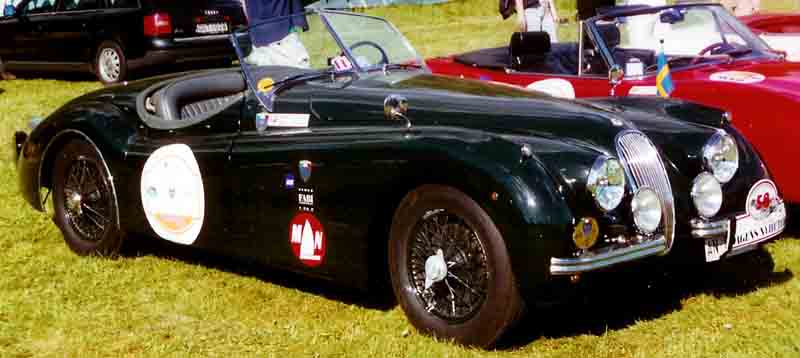
Overview
The XK120 was Jaguar’s post-war two-seat sports car, unveiled at the 1948 London Motor Show and produced from 1949 to 1954. Initially an open two-seater, it became a range with fixed-head and drophead coupé bodies. Intended to demonstrate the new XK engine before its use in the Mark VII saloon, the sports car attracted demand beyond Jaguar’s original limited-production expectations. Jaguar Daimler Heritage Trust’s model history.
Jaguar identifies it as its first sports car since the pre-war SS100. The XK120 is a model in its own right: the subsequent XK140 and XK150 belong to the related XK sports-car family, while aluminium construction, steel construction and different roofs identify versions within the XK120. Jaguar’s design history and JDHT’s XK model register.
Design and development
William Lyons shaped the XK120’s body. Its low bonnet, sweeping wings and oval grille gave Jaguar a recognisable post-war sports-car identity. Jaguar’s own design account describes the car as both a styling exercise and a demonstration of its twin-cam engine; the road car’s design credit should not be confused with Malcolm Sayer’s later competition bodywork. Jaguar’s design history.
Early bodies were aluminium, but demand justified steel body tooling in 1950. The change did not introduce another model or generation. Underneath was a separate chassis derived from a shortened Mark V arrangement, with torsion-bar independent front suspension. JDHT’s XK120 history.
The more conventional rear end used a leaf-sprung live axle, and braking was by drums. A Moss manual gearbox demanded deliberate gear changes. These features help explain the car’s character: advanced engine design was combined with running gear rooted in the immediate post-war period. Paul Wager’s road test of the preserved OOF 748, hosted by JDHT.
Production and body styles
XK120s were made in Coventry, England, initially at Foleshill and subsequently at Browns Lane. Jaguar’s transfer between the factories was gradual and completed in November 1952. Browns Lane housed XK body manufacture, painting, engine machining and assembly, and final car assembly. It would therefore be misleading to describe all XK120s as Browns Lane-built, or to assign the whole factory move to one launch date. JDHT’s factory history.
All three principal body styles had two seats:
| Body style | Character and place in the range |
|---|---|
| Open two-seater (OTS), also called roadster | The original open form, with a simple fabric hood and removable side screens. |
| Fixed-head coupé (FHC) | An enclosed body with winding windows, wood and leather furnishings, and a curved rear window above the flowing tail. |
| Drophead coupé (DHC) | An openable body with a padded, lined hood and winding windows, giving greater weather protection than the OTS. |
The distinction between the two open cars is functional, not simply alternative terminology for the same roof. JDHT’s fixed-head coupé record and OOF 748 body-style comparison.
Introduction and build dates need separating. JDHT’s chassis register starts the open-car runs in June 1949 and lists fixed-head production from July 1951 for left-hand drive and November 1951 for right-hand drive. This detailed register supports a 1951 coupé production start, although the Trust’s shorter OOF 748 history says 1952. The drophead was publicly introduced in 1953, while the register includes an early right-hand-drive example in January 1952. These are calendar-year build entries, not universal model-year designations. The register ends fixed-head production in July 1954 and the open and drophead runs in August. JDHT register, reproduced by Jaguar Rules, JDHT summary history and Bruce Carnachan’s marque history.
Engine and specification development
The XK120 used the 3.4-litre XK six-cylinder engine, with twin overhead camshafts. JDHT quotes 160 bhp for the ordinary road-car specification in its model account; that figure should not be applied indiscriminately to tuned or competition engines. JDHT’s XK120 engine summary.
Twin SU carburettors supplied the engine. Compression ratios and equipment differed: Carnachan records 8:1 as standard in the United States and Canada and 7:1 in Britain, Australia and other lower-octane markets. Identification should still follow the individual engine and build record rather than nationality alone. His account also explains that the Special Equipment (SE) cars were called M, for Modified, by US dealers; wire wheels and performance equipment distinguished this specification. Carnachan’s XK120 reference.
Jaguar’s service-bulletin chronology provides a better guide to changes than a single specification sheet. Bulletin 109 announced Special Equipment cars in September 1952, identifying them through chassis and engine-number markings. Earlier competition modifications included high-lift camshafts, a lighter flywheel and exhaust and suspension changes. The April 1953 bulletin offering a C-type cylinder-head assembly concerned separately available equipment, not proof that every SE car received that head. Gearbox and front-brake revisions also occurred during production. John Elmgreen’s annotated digest of Jaguar service bulletins.
Markets and identification
Most XK120s went to America, helping establish Jaguar as an imported sports-car marque. JDHT’s export account. The archive records separate chassis sequences for each body and steering position; a left-hand-drive car, a fixed-head body and an SE specification describe different aspects of a vehicle. JDHT chassis register.
A sale or registration year can be later than manufacture, particularly after overseas shipping. Restored appearance is also insufficient to establish original specification: wheels, exhausts and cylinder heads could be changed after delivery. Calendar build date, market designation and present equipment should therefore remain distinct in an individual vehicle record. Carnachan’s notes on registration and equipment.
Competition and legacy
Ian and Patricia Appleyard’s privately campaigned NUB 120 demonstrated the model’s rallying ability. Its Alpine Rally performances in 1950–1952 earned the Gold Cup after three successive penalty-free runs; the car also won the RAC and Tulip rallies in 1951. JDHT’s account credits its strong chassis, engine reliability and light alloy body, while recording brake wear and fade as weaknesses. These achievements belong to that particular competition car. JDHT’s NUB 120 record.
A specially prepared fixed-head coupé, LWK 707, completed seven days and nights at Montlhéry in August 1952 at an average exceeding 100 mph. That endurance demonstration is not an ordinary showroom-car performance specification. JDHT’s LWK 707 record.
The XK120 also helped establish the engineering route to Jaguar’s dedicated racers. Experience at Le Mans in 1950 encouraged a lighter tubular-frame competition car, the XK120C or C-type, with Sayer’s aerodynamic body. Despite its original name, the C-type was structurally distinct from the road-going XK120. That competition lineage later contributed to the E-Type. JDHT’s structural evolution account.
The XK120’s lasting importance lies in bringing Jaguar’s new engine, striking styling and export ambitions together in a successful sports car. Its historical identity includes the roadster and both coupés, while the later XK140 and XK150 carry the family story forward as successor models.