Ford 351 Cleveland V8 (1970–1973 Mustang Mach 1)
The 351 Cleveland brought a distinct engine design to the Mustang Mach 1 for 1970. Its two-barrel, four-barrel and specialist performance versions served through the final model years of the first-generation Mustang.
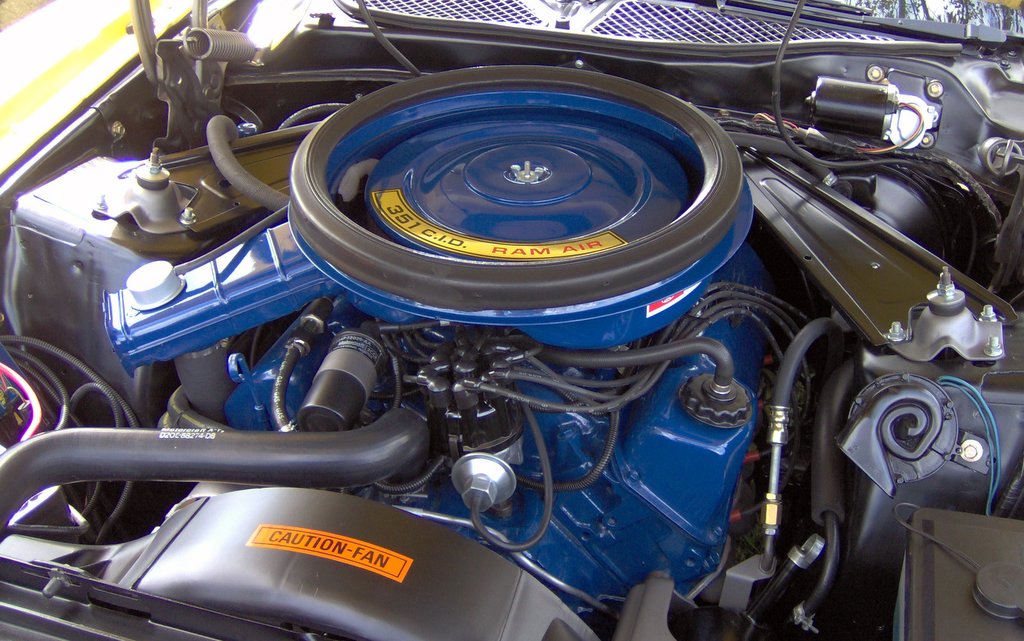
The Cleveland in the Mach 1
The 351 Cleveland was a carburetted V8 offered in the Ford Mustang Mach 1 during the 1970–1973 model years. It followed the 351 Windsor used in the 1969 Mach 1, sharing its nominal displacement but using a different engine design. Ford’s retrospective identifies the change to Cleveland power as a principal mechanical development for the 1970 Mustang. Ford Mach 1 historical introduction.
This record concerns the engine’s North American Mach 1 application. The dates are model years, not exact calendar-year manufacturing boundaries or the lifespan of the entire engine family. Ford Racing identifies the Cleveland Engine Plant as the origin of the name and gives 1970–1974 as the 351C’s production period in its engine history. Ford Racing engine history.
Engineering and induction
The 351’s nominal displacement was approximately 5.8 litres, with a 4.00-inch bore and 3.50-inch stroke. Ford’s period terminology distinguished 2V and 4V induction: two- and four-barrel carburettors, rather than numbers of valves per cylinder. 1970 Mustang brochure, engine specifications.
Canted valves distinguished the Cleveland cylinder heads. Early 2V heads used open combustion chambers and smaller ports; early performance 4V heads combined larger ports with quench chambers. Later four-barrel engines also used open chambers, so a 4V designation alone does not identify the chamber design. Ordinary versions used hydraulic lifters, while specialist Boss and H.O. derivatives used mechanical valve gear. Ford Racing engine history.
The Cleveland also differed from the Windsor in its block-front construction and coolant routing. Ford’s technical account describes coolant leaving the Cleveland heads through the block, rather than following the Windsor route through the intake manifold. Equal displacement therefore does not establish mechanical identity or unrestricted parts interchangeability. Ford Racing engine history.
1970: two distinct 351 choices
Ford’s 1970 Mustang brochure advertised the 351 2V at 250 horsepower and the 351 4V at 300 horsepower. These were period gross ratings. Its specifications paired the 2V with a 9.5:1 compression ratio and regular fuel, and the 4V with 11.0:1 compression and premium fuel. These figures describe the listed 1970 configurations and should not be carried forward to later Cleveland engines. 1970 Mustang brochure.
The Cleveland did not make the Mach 1 a single-engine model. The larger 428 Cobra Jet remained another 1970 engine choice. Ford Mach 1 historical introduction.
1971: the larger Mustang and Cobra Jet development
The redesigned 1971 Mach 1 remained a SportsRoof model, but its standard engine was now a 302 2V. Cleveland engines were optional. The Canadian-market Ford brochure reproduced here lists the optional 351 2V at 240 gross horsepower and the 351 4V at 285 gross horsepower; those figures belong to that brochure’s specification and market. 1971 Ford Mustang brochure.
Ford Racing dates the introduction of the 351C Cobra Jet to 1971 and identifies four-bolt main-bearing caps among its features. It was a development within the Cleveland family, not another name for every 351 4V. Ford Racing engine history.
The 1971 Boss 351 was a separate Mustang variant. Its special engine specifications must not be assigned to a Mach 1 merely because both used Cleveland-family engines. Ford’s brochure lists the Boss separately from the Mach 1 and its optional engines. 1971 Ford Mustang brochure.
1972–1973: later Cleveland applications
The Cleveland range continued to evolve beyond the original high-compression four-barrel specification. Ford Racing describes the 1972 351C-4V with open-chamber heads. Ford Racing engine history.
A separate 351-4V H.O. was available for 1972. Ford’s contemporary Shop Tips explicitly describes availability across the Mustang range and identifies mechanical lifters, a high-lift camshaft, four-bolt main bearings and forged aluminium pistons. This establishes a distinct H.O. specification rather than making every 1972 four-barrel Cleveland a Boss engine. Ford Shop Tips, Volume 10.
For 1973, Ford’s Mustang sales literature continued to offer 351 2V and 351 4V engines above the Mach 1’s standard 302. It also specified regular-grade petrol for the listed engines, with a minimum of 91 octane by the Research Method; that historical measurement should not be confused with a modern North American pump-octane number. 1973 Mustang brochure.
Engine specifications should always be matched to model year, market and the applicable document revision. Gross and net horsepower figures describe different test conditions and cannot establish a percentage change in installed performance by simple subtraction. This record consequently does not combine the early gross ratings with later figures into a single performance comparison.
Historical place
The Cleveland application spans the last four model years of the first-generation Mustang, including the transition from the 1970 body to the larger 1971–1973 cars. Its Mach 1 history ended with that generation. The 1974 Mustang II initially offered four- and six-cylinder power, including in its new Mach 1 form. Ford Mach 1 historical introduction.
Taken together, the period specifications show why the Cleveland deserves treatment as an engine family within the Mach 1 story: the shared 351 designation covered materially different induction systems and performance derivatives, rather than one unchanged specification.
Sources and image credit
- Ford Racing — engine history, small-block V8 sections
- Ford — 2021 Mustang Mach 1 Supplement, historical introduction
- Ford — 1970 Mustang sales brochure
- Ford Motor Company of Canada — 1971 Mustang sales brochure
- Ford — Shop Tips, Volume 10, 1972 Mustang engine overview
- Ford — 1973 Mustang sales brochure
- Stephen Foskett — 1973 Mach 1 Cleveland 2V Ram Air engine photograph; CC BY-SA 2.5
