Ford 428 Cobra Jet V8 (1969–1970 Mach 1)
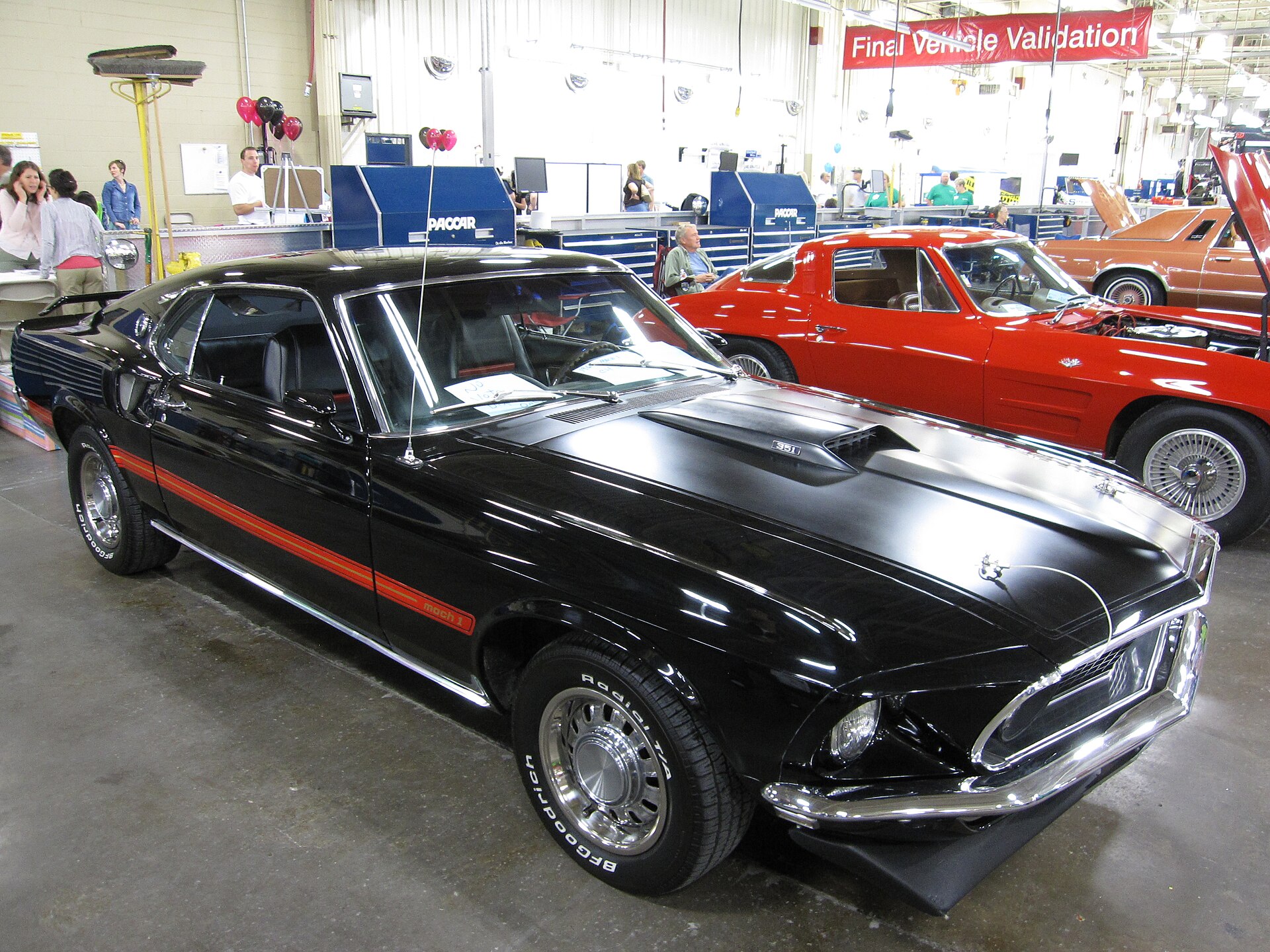
The 7.0-litre FE-series big-block that placed the early Mach 1 near the top of the Mustang performance range.
Overview
The 428 Cobra Jet was an FE-family V8 offered in the 1969–1970 Mustang Mach 1. Ford’s period literature lists four-barrel induction with a choice of non-ram-air or functional ram-air equipment. See the 1969 Performance Buyer’s Digest and 1970 Mustang brochure.
Ford advertised 335 hp at 5,200 rpm and 440 lb-ft at 3,400 rpm. These are published engine ratings, rather than measurements from a particular car or road test. Ford’s 1970 Mustang engine specifications describe the output as brake horsepower; the cited table does not explicitly identify an SAE gross or net test standard.
Architecture
Engine construction
The 428 used a cast-iron block and cylinder heads, with a 90-degree V8 layout and pushrod-operated overhead valves. Ford’s 1970 Mustang engine-specification table lists hydraulic lifters and a 4.13-inch bore × 3.98-inch stroke for the 428 four-barrel engine. Its nominal displacement was 428 cubic inches, approximately 7.0 litres.
Q-code versus R-code induction
For the 1969–1970 Mustang 428 application, Q identifies the non-ram-air four-barrel engine and R identifies the ram-air version. These codes describe induction, not a separate Super Cobra Jet designation. See Ford’s 1969 vehicle-identification table and Shop Tips engine-code table covering 1970.
The functional Shaker scoop supplied outside air to the carburettor. Ford’s 1969 digest describes this arrangement at full throttle. Ram-air equipment alone does not establish Super Cobra Jet specification; the qualifying axle and engine equipment must also be identified.
Cobra Jet and Super Cobra Jet
1969 ordering
Kevin Marti’s account of Ford ordering records distinguishes the equipment from its later package name. A 428 Cobra Jet ordered with a 3.91:1 or 4.30:1 Traction-Lok axle received the Super Cobra Jet specification before the Drag-Pack name appeared. Marti dates the invoicing change to February 20, 1969, and reports that the equipment was unchanged by that change in terminology. He also distinguishes Canadian pricing treatment, so this date should not be treated as a universal production-change date. See The Marti Report: What a Drag!.
1970 ordering
Ford’s U.S. Mustang brochure, revised January 1970, calls the option Drag Pack. It specifies either a 3.91:1 Traction-Lok axle or a 4.30:1 Detroit Locker differential and explicitly allows both non-ram-air and ram-air 428 four-barrel engines. These are the documented choices in that brochure, not evidence that every production car necessarily received the advertised combination. See the 1970 brochure’s Drag Pack footnote.
Mechanical equipment versus induction
The same 1970 footnote lists an engine-oil cooler, connecting rods with cap-screw fasteners, and changes to the crankshaft, flywheel and damper. This equipment distinguishes the Super Cobra Jet specification from ordinary Cobra Jet equipment; it is a separate question from Q-code versus R-code induction. The cited Mustang material does not establish a separate option named Super Drag Pack for these applications, so that name is not used here as a 1969–1970 ordering rule.
Key specifications
- Configuration: Naturally aspirated, 90-degree overhead-valve V8
- Engine family: Ford FE
- Displacement: Nominally 428 cu in, approximately 7.0 litres
- Bore × stroke: Published as 4.13 × 3.98 in
- Induction: Single four-barrel carburettor; non-ram-air or functional ram-air version
- Valve gear: Pushrod-operated overhead valves with hydraulic lifters
- Compression ratio: Published as 10.6:1
- Advertised output: 335 hp at 5,200 rpm
- Advertised torque: 440 lb-ft at 3,400 rpm
- Mach 1 application: 1969–1970
The dimensions, compression ratio and advertised output and torque appear in Ford’s 1969 digest, 428 CID V8 description. Ford’s 1970 Tech Talk, Mustang engine-specification table, corroborates those figures and identifies hydraulic lifters. Its horsepower heading specifies brake horsepower but does not explicitly state an SAE gross or net standard. No modern net-power equivalent or separate higher Super Cobra Jet output is inferred.
Sources
- Ford V8 engine history — Ford Performance
- Mustang Mach 1 history — Ford Motor Company
- 50 Years of Ford Mustang Milestones — Ford Motor Company
- 1969 Performance Buyer’s Digest — Ford; Mach 1 specifications and 428 CID V8 description
- 1970 Mustang sales brochure — Ford; revised January 1970, engine specifications and Drag Pack footnote
- Tech Talk, volume 2, number 1 — Ford; 1970 Mustang engine specifications
- The Marti Report: What a Drag! — Kevin Marti; 1969 axle ordering and Drag-Pack invoicing
- 1969 Ford shop manual, volume one — vehicle identification and engine codes
- Ford Shop Tips — 1970 engine-code table