Ford Mustang first generation (1965–1973)
An overview of the 1965–1973 model years, covering hardtop, convertible and fastback body styles, successive redesigns and selected Shelby, Mach 1 and Boss performance variants.
Overview
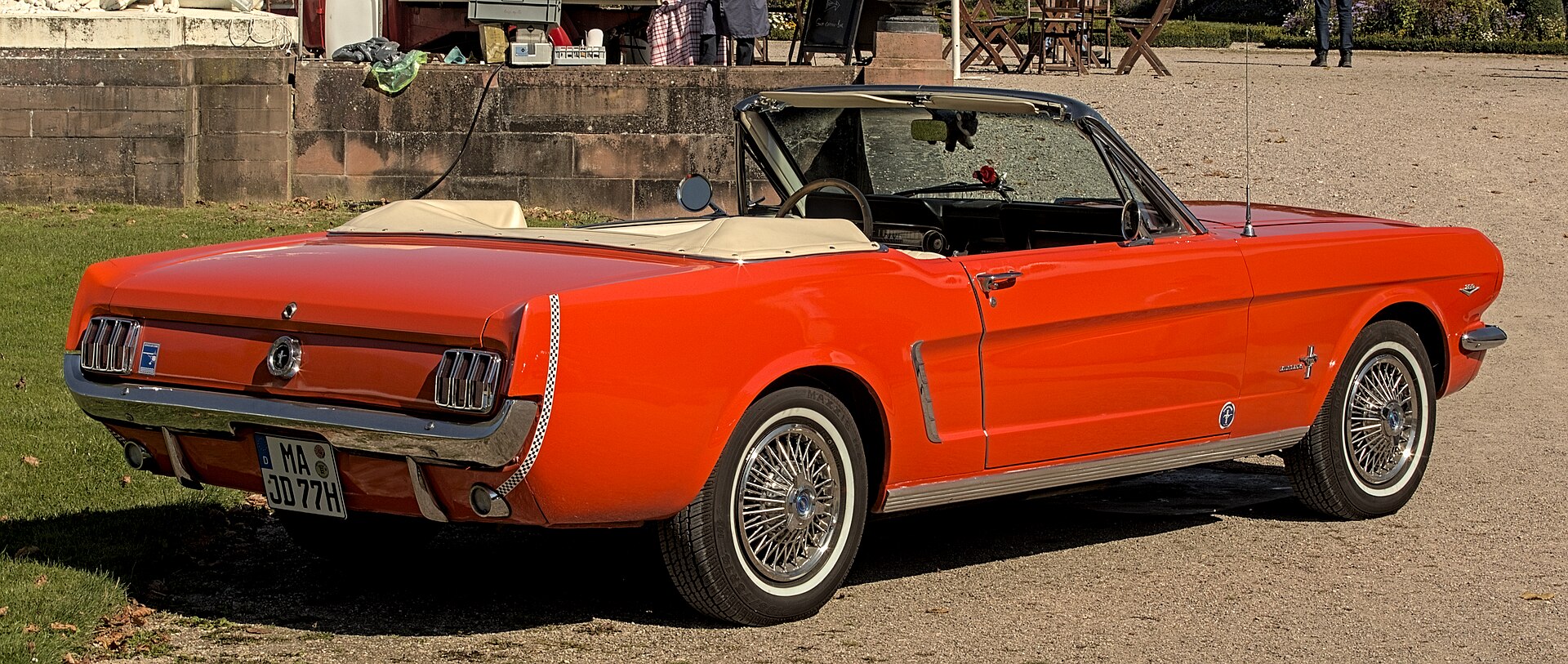
The first-generation Ford Mustang spans the 1965–1973 model years. Ford revealed the production Mustang at the New York World’s Fair on 17 April 1964 and sold it as a 1965 model. Its long bonnet, short rear deck and four-seat cabin created the pattern for the American pony car, while components related to the compact Falcon helped keep it affordable. Ford records a launch price of $2,368.
The first cars were notchback hardtops and convertibles. A fastback, marketed as the 2+2, joined during the 1965 model year; that model-year designation does not establish a calendar introduction date. Buyers could begin with an inline-six or choose from a growing selection of small- and big-block V8 engines, transmissions and appearance packages. That breadth made the Mustang both an accessible personal car and a foundation for serious performance models.
Development
The original shape evolved substantially over nine model years. The 1967 redesign made room for larger engines and gave the body a broader, more muscular appearance. Another restyle followed for 1969, when Ford offered six distinct body and trim lines and introduced the Mach 1, Boss 302 and Boss 429.
For 1971 the Mustang became longer, wider and heavier. The final 1973 cars retained hardtop, SportsRoof and convertible body styles, but that model year closed both the original Falcon-derived generation and the Mustang convertible’s first production run.
Performance models
Carroll Shelby’s GT350 arrived for 1965 with a modified 289-cubic-inch V8 and a sharper chassis. The GT500 followed for 1967 with big-block power. Ford’s own late-1960s and early-1970s performance catalogue included the 428 Cobra Jet, Mach 1 and competition-minded Boss models, extending the Mustang from showroom personal car to road-racing and drag-racing contender.
Selected performance variants
The linked GT350, Mach 1 and Boss 302 are a selection of this generation’s performance variants. They are not a complete catalogue; the generation also included the GT500 and Boss 429 discussed above.
Key milestones
Model-year entries identify the model range concerned, not an independently established calendar introduction date.
- 17 April 1964 (calendar date): Production Mustang unveiled and officially placed on sale as a 1965 model.
- 1965 model year: Fastback 2+2 joins the range; Shelby GT350 introduced.
- 1966 (calendar year): Cumulative Mustang sales pass one million.
- 1967 model year: Mustang redesigned; Shelby adds the GT500 performance variant.
- 1968 model year: 428 Cobra Jet engine introduced.
- 1969 model year: Mach 1, Boss 302 and Boss 429 appear.
- 1971 model year: Mustang body grows longer, wider and heavier.
- 1973 model year: Final model year of the first generation.
Sources
- 50 Years of Ford Mustang Milestones — Ford Motor Company
- 50 Years of Mustang timeline — Ford Motor Company
Browse related records
3 records
Ford Mustang Boss 302 (1969–1970)
Ford's high-revving Trans-Am homologation Mustang, pairing a specialised 302 V8 with competition-oriented chassis tuning.
VariantFord Mustang Mach 1 (1969–1973)
The 1969–1973 Mustang Mach 1 was a V8-powered SportsRoof variant combining distinctive exterior and interior equipment with engine and chassis specifications that changed by model year.
VariantShelby GT350 (1965–1970)
Carroll Shelby's road-racing interpretation of the Mustang fastback, developed for sharper performance on road and track. The 1965–1970 model-year scope includes final carryover cars from the 1969 production run sold as 1970 models.
Variant
No matching records.