Shelby GT350 (1965–1970)
Carroll Shelby's road-racing interpretation of the Mustang fastback, developed for sharper performance on road and track. The 1965–1970 model-year scope includes final carryover cars from the 1969 production run sold as 1970 models.
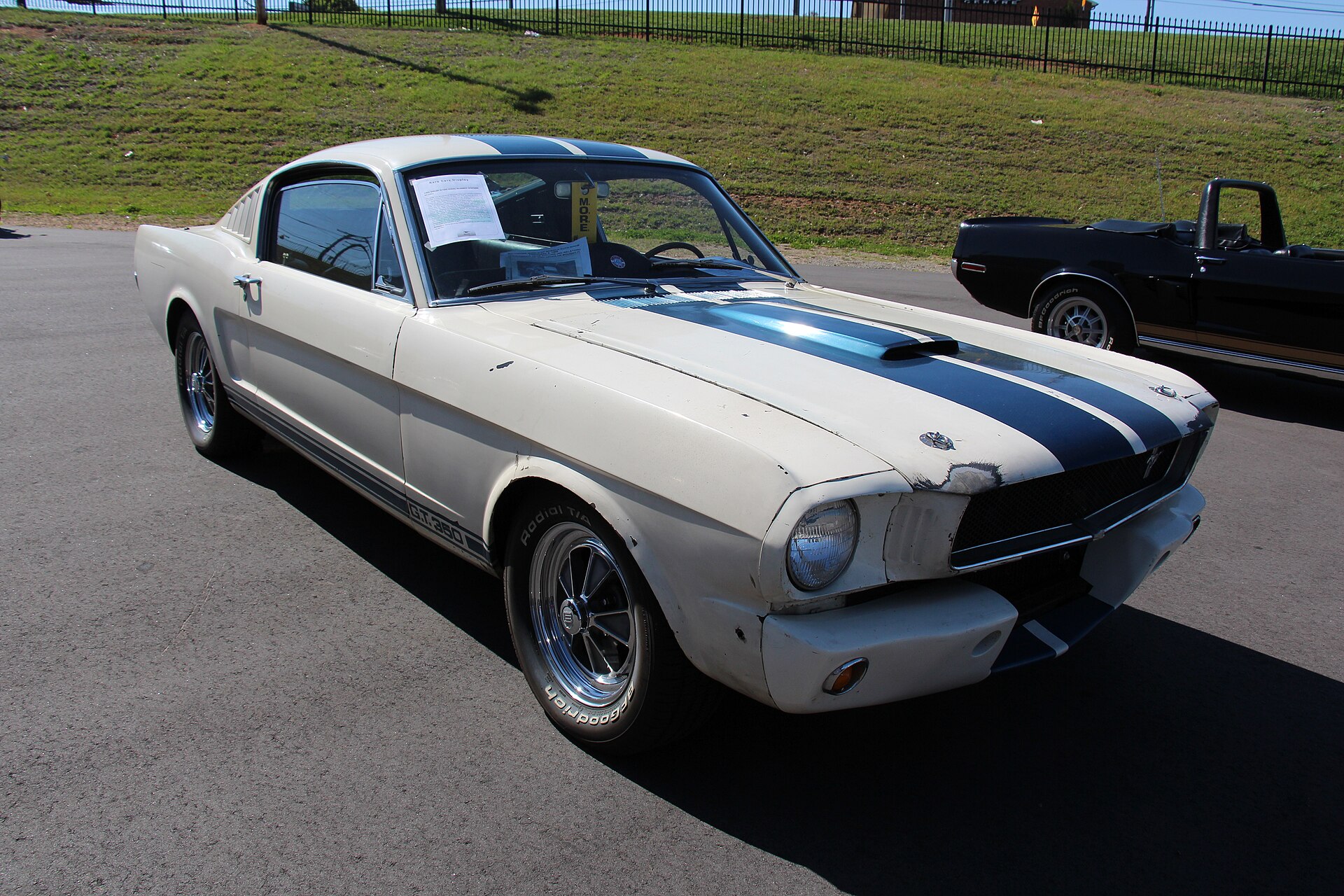
Overview
Ford asked Carroll Shelby to give the successful new Mustang a credible competition identity. Shelby American began with the 1965 Mustang 2+2 fastback in high-performance K-code form and reworked it into the GT350, a road car designed to support homologation—approval to compete under the applicable racing rules—for Sports Car Club of America racing. Ford’s racing-history account confirms the programme’s SCCA homologation purpose.
The early cars were assembled at Shelby’s California facility. Their combination of lower weight, stronger engine performance and more disciplined handling established a new upper edge for the Mustang range and linked Ford’s pony car with Shelby’s successful Cobra racing programme.
This record covers the 1965–1970 model years. Its final 1970 models were carryover cars from the 1969 production run; the date range should not be read as continuous manufacture through 1970.
1965 specification
The 1965 road GT350’s 289-cubic-inch V8 had revised induction and exhaust, increasing advertised output from the K-code Mustang’s advertised 271 horsepower to 306 horsepower. A four-speed manual was standard. Suspension changes included revised front geometry, firm adjustable dampers, a larger front anti-roll bar and rear traction arms. The rear seat was removed. These details are supported by Car and Driver’s contemporary test.
The previous account also specified a larger carburettor and firmer springs; those particular comparisons remain unverified here. Although the contemporary test confirms SCCA B-Production approval, the claim that rear-seat deletion specifically secured two-seat eligibility still requires the applicable period rules or homologation documentation.
The road cars were finished in Wimbledon White, with blue striping becoming the model’s enduring visual signature. This specification describes 1965 road cars, not every later GT350 or the competition-only GT350R.
GT350R competition history
The more specialised GT350R removed further weight and added racing equipment, body modifications and a more highly tuned engine. These competition changes should be distinguished from the 1965 road-car specification above. Ford’s 2015 heritage introduction, on page 1, describes the original 1965 Competition model as lighter and more powerful, with developed suspension; it does not provide an itemised specification for every racing modification.
GT350s secured the 1965 SCCA B-Production championship and went on to win the category for three consecutive seasons, as recounted in Ford’s racing-history article, in its passage on the 1965 SCCA B Production Mustang GT350.
Road-model development
For 1966 the road model became more accommodating and gained a wider choice of colours; a batch of GT350H cars was also supplied to the Hertz rental fleet. Later GT350s followed the Mustang’s 1967 and 1969 body revisions, becoming more refined and visually elaborate, while Shelby production operations shifted away from their original California setting.
The cataloged engine chronology is the 289 for 1965–1967, the 302-cubic-inch V8 for 1968, and the 351 Windsor V8 for the 1969–1970 model years. The 1969 engine transition therefore forms a separate step after the 1968 change to the 302. These links establish the catalog’s coverage; they do not extend the early advertised horsepower figure to the later engines.
The final cars sold as 1970 models were carryover examples from the 1969 production run. The Coralsnake’s production research, based on Ford records, reports that regular production ended in July 1969 and lists both 1969 and 1970 GT350 model totals. This supports the distinction between production dates and model years, although that page does not document the individual carryover conversions. The GT350 name then disappeared from new-car catalogues until Ford revived it decades later.
The three originally listed Ford reference URLs now redirect to general pages. Their bibliography entries and citations are retained, but they cannot serve as newly verified support for all of the development details above.
Key milestones
- 1965: GT350 and competition-focused GT350R introduced.
- 1966: More colours and the GT350H rental programme broaden the range.
- 1967: Restyled GT350 is joined by the big-block GT500.
- 1968: A 302-cubic-inch V8 replaces the earlier 289 in the cataloged engine chronology.
- 1969: The cataloged GT350 engine changes to the 351 Windsor V8. Regular production ends during 1969.
- 1970 model year: Carryover cars from the 1969 production run close the original GT350 programme, retaining the cataloged 351 Windsor engine coverage.
The engine links above supply the cataloged year scopes. The Coralsnake’s production research supports the 1969 production endpoint and the separate 1970 model-year designation. The original references for the remaining road-model milestones require restoration or replacement before those details can receive verified claim-level citations.
Sources
- 50 Years of Ford Mustang Milestones — Ford Motor Company
- Shelby GT350R heritage — Ford Motor Company
- Mustang racing heritage — Ford Motor Company
- 1965 Shelby GT350 contemporary road test — Car and Driver, May 1965 issue
- Mustang GT3 Champion Spirit Livery — Ford racing-history article at its current location
- Shelby GT350R Mustang — Ford press release, 12 January 2015, PDF copy
- The Best 1969 Shelby Production Figures — The Coralsnake
Back to first-generation Ford Mustang
Browse related records
3 records
Ford 302 V8 (1968 Shelby GT350)
The 1968 Shelby GT350 used Ford’s 302-cubic-inch V8, with important differences between advertised equipment, original installations and subsequent intake-manifold revisions.
EngineFord 351 Windsor V8 (1969–1970 Shelby GT350)
Ford’s 351 Windsor powered the final original-series Shelby GT350s, introduced for 1969 and carried into the 1970 model year through updated unsold cars.
EngineShelby GT350 289 High Performance V8 (1965–1967)
Shelby American's modified 289-cubic-inch (approximately 4.7-litre) Ford High Performance V8, used in the 1965–1967 GT350. Road-engine specifications are distinguished from GT350R competition preparation and unresolved model-year differences.
Engine
No matching records.