Ford Mustang Boss 302 (1969–1970)
Ford's high-revving Trans-Am homologation Mustang, pairing a specialised 302 V8 with competition-oriented chassis tuning.
Overview
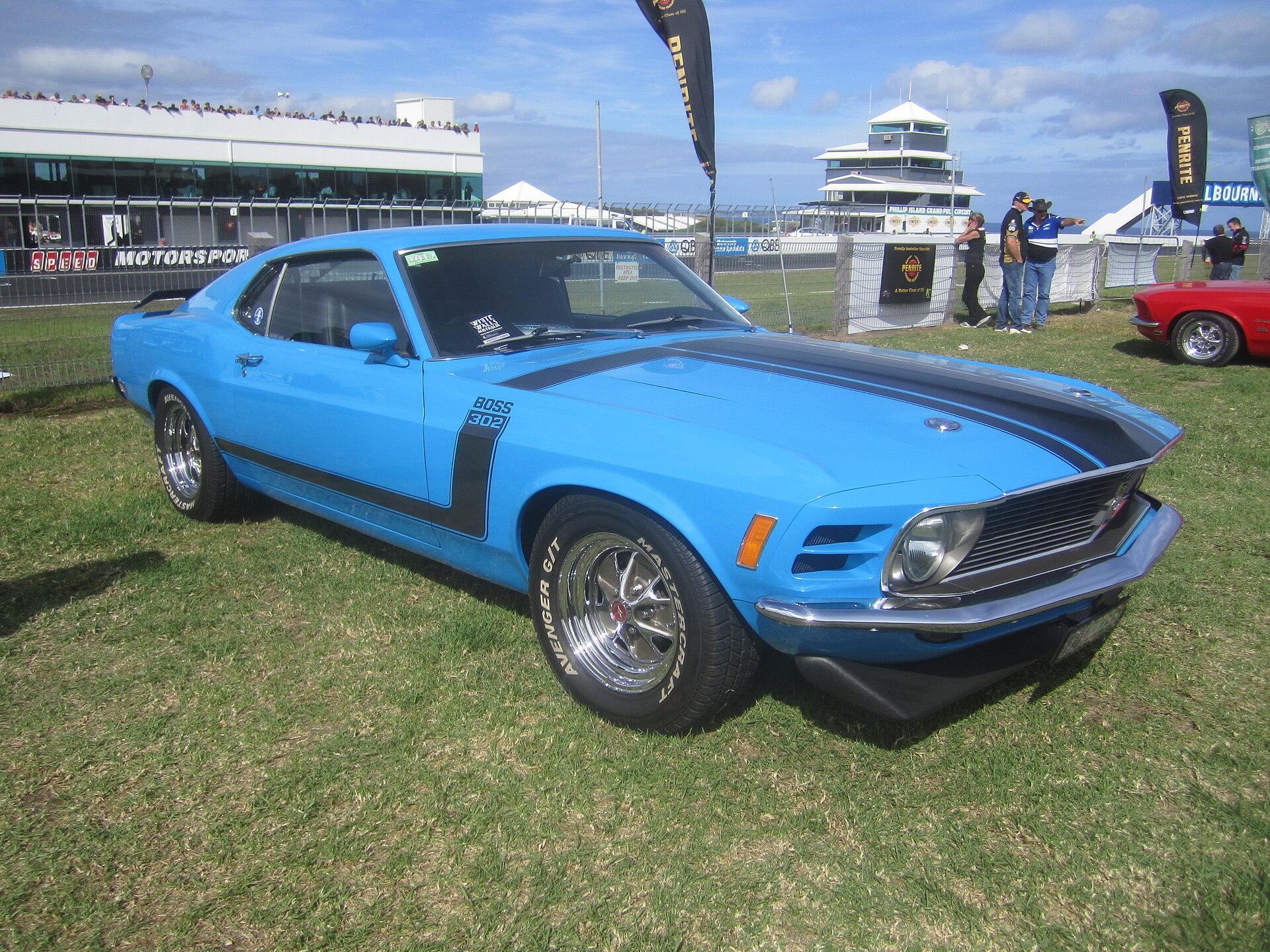
The first-generation Ford Mustang Boss 302 was produced for the 1969 and 1970 model years. It was developed for Trans-Am homologation: meeting the eligibility requirements for racing through a production model. The series’ five-litre engine limit shaped its specialised small-block V8.
Introduced during the 1969 model year, the Boss 302 combined that engine with road-racing chassis changes and SportsRoof bodywork. Ford’s retrospective describes the original car’s development and handling emphasis in its Mustang Boss history, “1969–70 Boss 302”.
Engine
Design and development
1969
Stylist Larry Shinoda gave the 1969 Boss 302 a simple side C-stripe, blacked-out bonnet and front spoiler while deleting the regular Mustang’s simulated rear-quarter scoops. An optional rear spoiler and rear-window slats strengthened the competition appearance. Ford’s historical overview credits Shinoda and describes the new-for-1969 car’s stripes, bonnet treatment and spoilers.
1970
The 1970 facelift moved the headlamps into the grille and brought the model’s familiar reflective hockey-stick side stripes. The production car continued to underpin Ford’s Trans-Am programme.
Racing
Ford won the 1970 Trans-Am manufacturers’ title with the Boss 302. Bud Moore’s factory-supported team contributed six race victories: five by Parnelli Jones and one by George Follmer. The drivers’ contributions should be distinguished from the manufacturers’ championship awarded to Ford. See Trans Am’s history, “Donohue Dominance” for Ford’s title and George Follmer’s biography for the drivers’ race wins.
Key milestones
- 1969: Boss 302 enters production and joins the Trans-Am campaign.
- 1970: Facelift introduces inboard headlamps and hockey-stick graphics.
- 1970: Bud Moore’s team wins six Trans-Am races: five with Parnelli Jones and one with George Follmer. George Follmer biography.
- 1970: Ford secures the Trans-Am manufacturers’ title with the Boss 302. Trans Am history, “Donohue Dominance”.
Sources
- 50 Years of Ford Mustang Milestones — Ford Motor Company
- Ford V8 engine history — Ford Performance
- Mustang racing heritage — Ford Motor Company
- 2012 Mustang Boss 302 press materials — Ford Motor Company; historical 1969–70 Boss 302 section, PDF pages 40–41
- Trans Am history — Donohue Dominance
- George Follmer biography — George Follmer Motorsports
Back to first-generation Ford Mustang
Browse related records
1 records
Ford Boss 302 V8 (1969–1970)
The high-revving 302-cubic-inch small-block developed for Ford's Trans-Am programme: approximately 4.9 litres, commonly described in rounded terms as five litres.
Engine
No matching records.