Ford Boss 302 V8 (1969–1970)
The high-revving 302-cubic-inch small-block developed for Ford's Trans-Am programme: approximately 4.9 litres, commonly described in rounded terms as five litres.
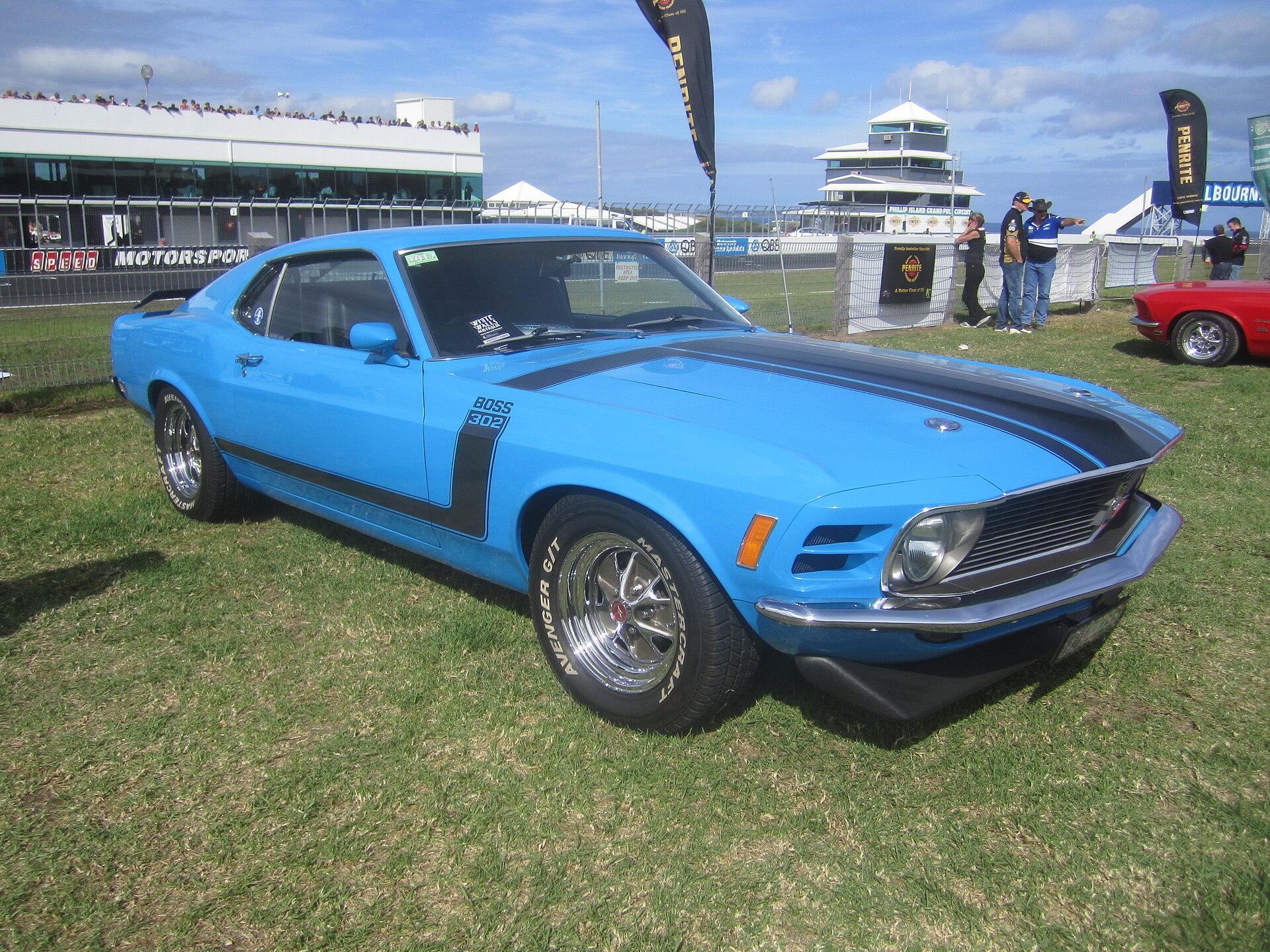
Overview
Ford created the Boss 302 engine to give the Mustang a competitive foundation for the Sports Car Club of America’s Trans-American Sedan Championship. Its 302-cubic-inch displacement is approximately 4.9 litres; the familiar five-litre description is rounded terminology for the same capacity, not a different engine size.
It combined the compact dimensions and short stroke of the Windsor small-block with large-port cylinder heads derived from the new Cleveland engine family. Their canted valves—valves set at differing angles rather than in a parallel arrangement—formed part of the engine’s emphasis on breathing at high engine speeds.
The production road engine was advertised at 290 horsepower. Its mechanical, or solid, lifters transmit camshaft motion through the pushrods without hydraulic clearance compensation. This valve gear and the large four-barrel carburettor supported the engine’s high-revving character. Ford’s engine history, in the original “302 BOSS” section, describes its competition role and principal internal components.
Architecture
The cast-iron block used a 4.00-inch bore and 3.00-inch stroke. Ford’s engine history, PDF page 3, identifies four-bolt main bearing caps at journals 2, 3 and 4, a forged crankshaft, heavy-duty connecting rods and forged pistons. It also records a mechanical camshaft, stamped rocker arms, threaded adjustable rocker studs and pushrod guide plates.
The large ports and canted-valve heads served the engine’s high-speed breathing requirements. The same Ford history groups the 1969 and 1970 engines together; it does not provide a year-by-year account of cylinder-head revisions or valve diameters. Exact changes between those production years have not been established from the material verified here. No year-specific valve dimensions are therefore given, and the shared architecture should not be read as evidence that every cylinder-head detail was identical.
Road and competition use
The production Boss 302 paired the engine with a four-speed manual transmission, as recorded for the 1969½ model in Ford’s AMA specifications, printed page 3, “Power Teams.” A rev limiter protected the road engine, while the Mustang also received competition suspension, quicker steering and front disc brakes to make use of its high-speed performance.
The production engine and car supplied the homologation basis—approval of a production model as eligible for a racing category—for competition. Trans-Am engines received further race preparation, so the advertised road-engine ratings below should not be treated as competition-engine output figures.
Bud Moore’s Mustangs secured Ford’s 1970 Trans-Am manufacturers’ championship. Ford’s racing history, under “1970,” credits the Bud Moore-prepared Boss 302 Mustangs and drivers Parnelli Jones and George Follmer.
Key specifications
These figures describe the advertised production road-engine specification associated with the 1969–1970 Mustang Boss 302, not a Trans-Am racing engine. Year-specific verification and the horsepower measurement basis are qualified below.
- Configuration: 90-degree, naturally aspirated overhead-valve V8
- Displacement: 302 cu in (approximately 4.9 litres; five litres in rounded terminology)
- Bore × stroke: 4.00 × 3.00 in
- Induction: Holley four-barrel carburettor
- Valve gear: Pushrod-operated overhead valves with mechanical lifters
- Compression ratio: 10.5:1, verified for the 1969½ production specification; applicability to 1970 remains unconfirmed here
- Advertised output: 290 hp at 5,800 rpm
- Advertised torque: 290 lb-ft at 4,300 rpm
- Boss 302 application: 1969–1970
Ford’s 1969½ AMA specifications, printed page 3, “Power Teams,” list the compression ratio, power and torque above. The table labels power as BHP but does not itself establish the SAE gross or net measurement standard. That basis remains unconfirmed here rather than being inferred solely from the period.
The Boss 302 row in Ford’s 1970 Performance Buyer’s Digest, “Ford power turns it on for you,” also lists 290 hp at 5,800 rpm and 290 lb-ft at 4,300 rpm, supporting those advertised ratings for both years. Its compression-ratio entry could not be reliably reconciled with the 1969½ specification during this review, so 10.5:1 is not asserted here as independently verified for both years. Neither table establishes the output of a prepared competition engine.
Sources
- Ford V8 engine history — Ford Performance
- 50 Years of Ford Mustang Milestones — Ford Motor Company
- Mustang racing heritage — Ford Motor Company
- 1969½ Mustang Boss 302 AMA Specifications — Ford Motor Company; scan hosted by Over-Drive Magazine
- 1970 Performance Buyer’s Digest — Ford Motor Company; scan hosted by XR793
- The Ford Racing Legacy — Ford Racing, 1970 entry