Audi A3
Audi's compact model family introduced in 1996, developing from a three-door hatchback into Sportback, saloon, convertible and performance derivatives across four generations.
Overview
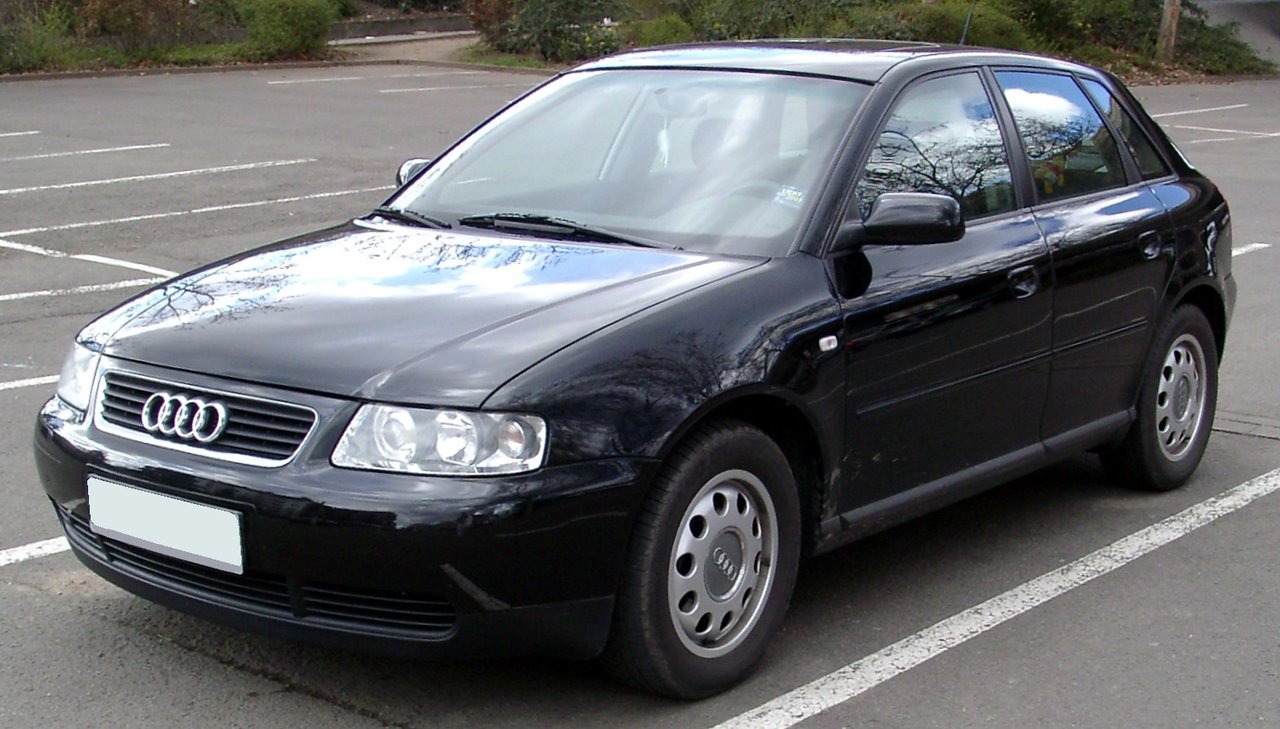
The A3 is Audi’s compact passenger-car family, introduced in 1996. It brought the marque’s premium positioning to a practical hatchback sharing its underlying platform with the fourth-generation Volkswagen Golf, which followed in 1997. Audi presented the A3 at the 1996 Paris motor show; its initial three-door form subsequently gained a five-door companion. Origins — Audi Tradition, Anniversary Dates 2026, page 5.
Across later generations, the A3 name covered hatchbacks, a saloon and a convertible, alongside distinct performance and alternative-fuel derivatives. This record covers the whole model line: a Sportback is a body designation within that line, while S3 and RS 3 identify performance derivatives. Body and powertrain families — Audi model documentation.
Generations and development
- 1996 — First generation introduced. German production ended in June 2003; Brazilian manufacture continued until October 2006. Audi Tradition chronology.
- 2003 — Second generation introduced. Audi lists the three-door as 2003–2012, the Sportback as 2004–2013 and the Cabriolet as 2008–2013. Audi body-specific model cycles.
- 2012 — Third generation introduced. The three-door debuted at Geneva and reached customers in late summer; the new Sportback was presented that September. Audi Third Quarter Report 2012, pages 5–6.
- 2020 — Fourth generation introduced. Production of the new Sportback and saloon began in Ingolstadt in the first half of the year. Audi Half-Year Financial Report 2020, page 8.
These introductions do not imply uniform worldwide production periods.
First generation: 1996–2003 in Germany, continuing to 2006 in Brazil
The original A3 established the family as a compact hatchback. Attraction, Ambition and Ambiente were equipment lines, offered alongside petrol and diesel engines; they were not separate generations. A five-door version joined the three-door in March 1999. German production ended in June 2003, but Brazilian manufacture continued until October 2006. A single worldwide end date would therefore obscure a real production overlap with the successor. First-generation chronology — Audi Tradition, page 5.
The S3 arrived in 1999 with a turbocharged 1.8-litre four-cylinder engine using five valves per cylinder. Quattro also reached the A3 range in the late 1990s. Audi’s 2016 retrospective dates its introduction to September 1998, while a later quattro history says 1999; those accounts do not establish one unambiguous market-delivery date. S3 and September 1998 account — Audi Media, reproduced by AudiWorld, 1999 account — Audi.
Second generation: 2003–2013, depending on body style
The second generation broadened the body range. Audi’s model documentation groups the three-door cars as 2003–2012, the five-door Sportback as 2004–2013 and the Cabriolet as 2008–2013. These different intervals explain why a new three-door generation and an older Sportback or convertible could appear in the same calendar year. Body-specific model cycles — Audi.
The Sportback adopted Audi’s prominent Singleframe grille, while the Cabriolet used a folding fabric roof. The 2005 US launch documentation describes front MacPherson struts, independent four-link rear suspension and electromechanical steering. It also offered a twin-clutch DSG transmission, an important step in the A3’s progression from a conventional compact hatchback towards a wider range of premium-car technology. Sportback design and chassis — Audi of America, May 2005, pages 2–4, Cabriolet roof — Audi Media retrospective.
Third generation: introduced in 2012, model family extending to 2020
The third-generation three-door debuted at Geneva in 2012 and reached customers in late summer. Audi showed the new Sportback at Paris that September; its market introduction followed in February 2013. The saloon added a separate boot to the A3 formula, with volume production beginning in Győr in June 2013. These were successive body introductions within one generation. 2012 presentations — Audi Third Quarter Report, pages 5–6, Sportback launch and saloon production — Audi Interim Financial Report 2013, pages 6 and 9.
This A3 was the Volkswagen Group’s first market introduction based on MQB, its modular system for transverse-engined cars. MQB standardised major engineering interfaces while allowing different wheelbases, tracks and body designs. The A3 therefore participated in a change to the group’s development and manufacturing methods, beyond a simple restyling. MQB development — Volkswagen Newsroom.
Audi’s documentation also identifies a third-generation Cabriolet and model-family coverage through 2020. A 2016 update brought revised technology, including an optional digital instrument display; that update did not create a fourth generation. Body coverage — Audi, 2016 changes — Audi Media retrospective.
Fourth generation: introduced in 2020
Production of the new Sportback and saloon began in Ingolstadt in the first half of 2020. Audi’s April saloon announcement described a driver-oriented dashboard with digital instruments and a central touchscreen. Its reference to the saloon’s “second generation” counts that body style, whereas the wider A3 family had reached its fourth. Production transition — Audi Half-Year Financial Report 2020, page 8, Saloon design and launch — Audi.
The 2024 facelift revised the exterior, equipment and digital services. It also introduced the A3 allstreet, a crossover derivative with a higher seating position and more ground clearance than the Sportback. In June 2026 Audi announced another update, centred on a redesigned cockpit, with dealer availability scheduled for mid-September 2026. This was an announced range update, not a fifth-generation launch. 2024 facelift and allstreet — Audi, June 2026 announcement — Audi.
Engines, transmissions and derivative names
The A3 has no single specification valid across its production history. The following examples show the range’s development without treating different markets, bodies or powertrains as interchangeable.
Selected historical launch specifications
Each example applies to the stated market, date and derivative. In particular, the September 2020 Sportback 40 TFSI e example does not describe every later TFSI e.
| Application | Powertrain and transmission | Scope | Supporting source |
|---|---|---|---|
| Second-generation A3 2.0T FSI | Turbocharged, direct-injection 2.0-litre four-cylinder petrol; six-speed manual or six-speed DSG; front-wheel drive | US launch range, May 2005, sold as model year 2006 | US petrol and gearbox combinations — Audi of America, pages 1–2 |
| Fourth-generation A3 Sedan 35 TFSI | 1.5-litre direct-injection petrol; six-speed manual or seven-speed S tronic | European 2020 launch; the S tronic version added a 48-volt mild-hybrid system | European saloon engines — Audi |
| Fourth-generation A3 Sedan 2.0 TDI | 2.0-litre diesel with seven-speed S tronic | European 2020 launch specification | European saloon engines — Audi |
| Fourth-generation A3 Sportback 40 TFSI e | 1.4-litre four-cylinder petrol plus an electric motor integrated with a six-speed S tronic; front-wheel drive | Plug-in hybrid announced for Europe in September 2020 | European plug-in hybrid — Audi Australia, reporting the international announcement |
Guide to derivative names
- Sportback is a body designation within the A3 model line, rather than a separate generation. Body and powertrain families — Audi model documentation.
- S3 and RS 3 identify performance derivatives. The S3 arrived in 1999 with a turbocharged 1.8-litre four-cylinder engine using five valves per cylinder; the RS 3 Sportback, introduced in 2011, used a turbocharged five-cylinder engine. S3 and RS 3 — Audi Media retrospective, reproduced by AudiWorld.
- e-tron and TFSI e, in the examples described here, identify plug-in hybrids. The third-generation Sportback e-tron combined a 1.4 TFSI petrol engine with an electric motor. The fourth-generation Sportback 40 TFSI e announced for Europe in September 2020 continued the plug-in-hybrid approach, with an externally chargeable traction battery. This differs from the 48-volt mild-hybrid system described for the 2020 saloon. Sportback e-tron — Audi Media retrospective, Plug-in configuration — Audi Australia, Mild-hybrid configuration — Audi.
- g-tron, in the third-generation example, identifies the derivative supporting natural gas and petrol. Alternative fuels — Audi Media retrospective, reproduced by AudiWorld.
Neither TFSI nor TDI alone identifies an engine family, capacity or output; an exact specification needs the generation, market and particular derivative.
Production geography and market differences
Ingolstadt, Germany, has been a central A3 production base, but the model’s manufacturing history extends beyond it. By 2016, Audi identified Győr, Hungary, with saloon and Cabriolet production and Foshan, China, with Sportback and saloon manufacture for the Chinese market. Production network in 2016 — Audi Media retrospective.
Audi’s 2020 report records A3 production beginning in Qingdao, China, that year, listing the Sportback and A3 L Sedan. This Chinese-market saloon designation belongs to a regional derivative, rather than a new global generation. Qingdao production — Audi Report 2020, page 38.
Market-year labels need equal care. Audi of America introduced the A3 in May 2005 as a 2006 model, initially with the 2.0T petrol engine and front-wheel drive. Its release scheduled a 3.2-litre six-cylinder quattro/DSG version for early 2006. That announcement does not establish the availability of every European engine in America, and “2006 A3” alone does not identify a worldwide launch date. US introduction and planned range expansion — Audi of America, pages 1–2.
Historical significance
The A3 helped make the compact hatchback an enduring part of Audi’s premium identity. Its development also illustrates how shared engineering could support distinct products: first through its Golf-related platform, then through MQB’s more flexible architecture. The latter connection makes it significant in the history of vehicle production as well as Audi’s model range. Original platform — Audi Tradition, page 5, MQB’s manufacturing role — Volkswagen Newsroom.
Within this library, the Audi A2 provides a related compact-car history focused on aluminium construction and efficiency, while the TT follows Audi’s compact coupé and roadster line. The A3’s own history centres on the expansion of a practical hatchback into a broad passenger-car family.
Sources and reference notes
- Audi Tradition, Anniversary Dates 2026 — origins and first-generation chronology. Reference verification required: existing prose links specify page 5, while the registered source title is “Early range and its successor — Audi Tradition, Anniversary Dates 2026, pages 9–12”. Verify the locator before changing either reference; neither page reference is confirmed here.
- Audi model documentation — body and powertrain families, including body-specific model cycles.
- Audi Media, 2016 A3 retrospective, reproduced by AudiWorld — three generations, S3 and RS 3, alternative-fuel derivatives, production locations and the September 1998 quattro account.
- Audi quattro history — the account dating A3 quattro to 1999; retained alongside the differing September 1998 retrospective account.
- Audi of America, May 2005 A3 launch release, hosted by AudiWorld — US model-year 2006 introduction and powertrains, pages 1–2; Sportback design and chassis, pages 2–4.
- Audi Third Quarter Report 2012, pages 5–6 — third-generation three-door and Sportback presentations.
- Audi Interim Financial Report 2013, pages 6 and 9 — Sportback market introduction and saloon production in Győr.
- Volkswagen Newsroom, MQB tenth-anniversary account — modular architecture, the A3’s introduction and manufacturing significance.
- Audi Half-Year Financial Report 2020, page 8 — new-generation Sportback and saloon production in Ingolstadt.
- Audi, April 2020 A3 Sedan launch announcement — saloon design, European launch engines, transmissions and the 48-volt mild-hybrid system.
- Audi Australia, reporting the September 2020 international plug-in-hybrid announcement — European A3 Sportback 40 TFSI e configuration.
- Audi Report 2020, page 38 — Qingdao production of the Sportback and Chinese-market A3 L Sedan.
- Audi, 2024 A3 and A3 allstreet announcement — facelift changes and the allstreet derivative.
- Audi, June 2026 A3 update announcement — redesigned cockpit and scheduled dealer availability.