Audi TT
A compact sports-car line whose production began with the Coupé in 1998, followed by the Roadster in 1999, and ended in November 2023, combining distinctive geometric design with Volkswagen Group engineering across three generations.
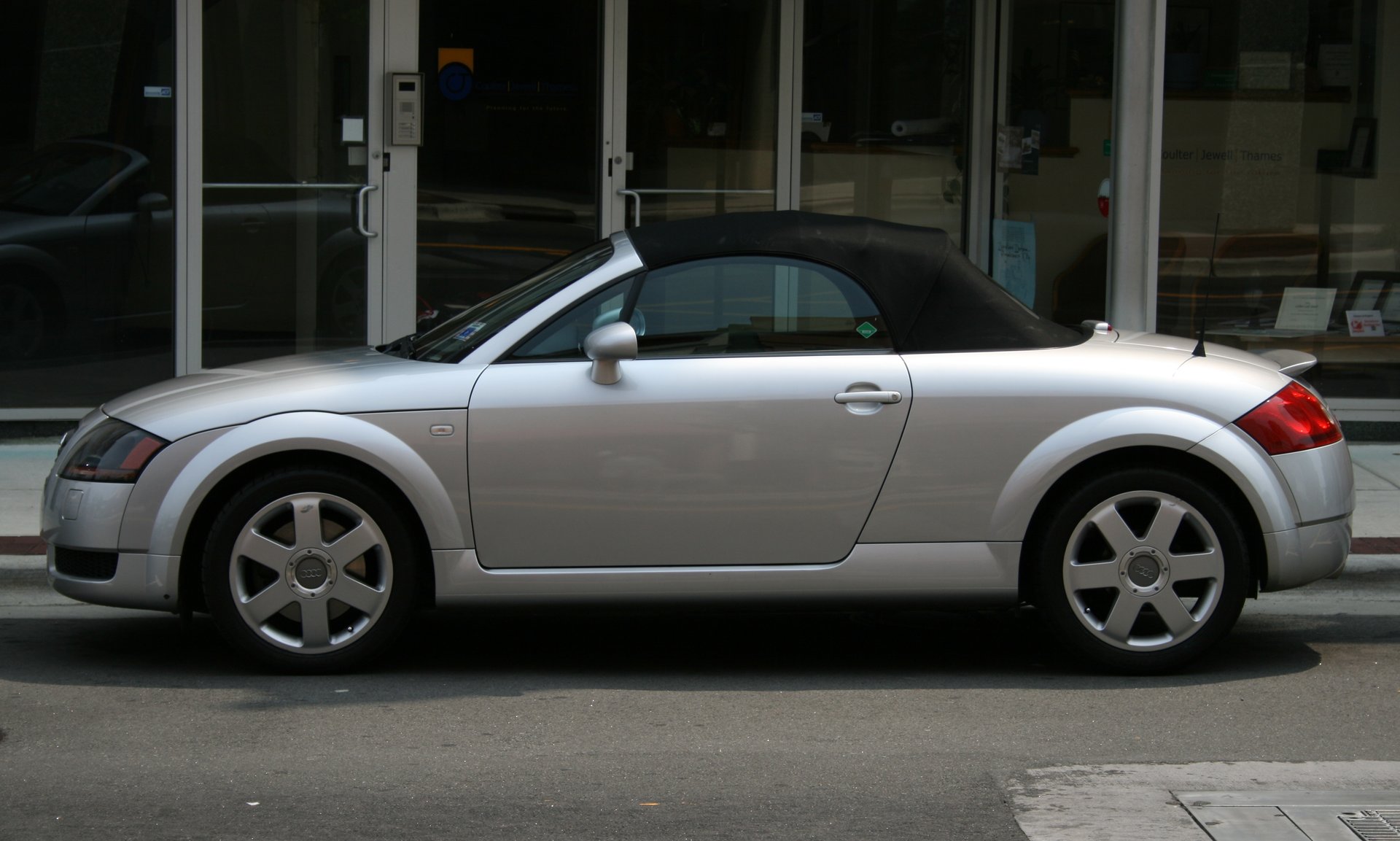
Overview
The TT was Audi’s compact sports-car model line, produced across three generations from 1998 to November 2023. It paired a front-mounted transverse engine with coupé or roadster bodywork, using front-wheel drive or quattro all-wheel drive according to version. Its significance lay in translating a distinctive concept-car design into series production, then preserving that identity through substantial changes in construction, powertrains and cabin technology.
The normal Coupé configuration was a 2+2 with small rear seats and a lifting tailgate; the Roadster had two seats and a folding fabric roof. TTS and TT RS were performance derivatives within the line, rather than separate generations. The TT name also recalled the earlier NSU TT, but the Audi was a new model with different mechanical origins.
Development and design
Audi showed the TT Coupé concept at Frankfurt in September 1995 and an open TTS concept at Tokyo that November. Audi credits Freeman Thomas with the coupé study under design chief Peter Schreyer, and Torsten Wenzel with helping adapt its exterior for production. Approval for series manufacture came in December 1995. The production car gained rear side windows and revised proportions while retaining the study’s rounded silhouette.
Circular wheel arches, the arched roof, round fuel flap and circular interior details gave the TT a coherent visual theme. Audi describes its functional, geometric approach as Bauhaus-inspired. The initials referred to the Isle of Man Tourist Trophy and the motorcycle heritage of DKW and NSU, as well as NSU’s sporting road cars. The 1995 TTS show-car name should be distinguished from the production TTS derivative introduced in 2008. Design and naming history — Audi, concept-car chronology — Audi.
Generations and engineering
The periods below are calendar production spans for the generations. Body-style introductions and national model years did not always coincide with those boundaries.
- 1998–2006 — First generation: shared transverse-engine platform with the contemporary Audi A3 and fourth-generation Volkswagen Golf.
- 2006–2014 — Second generation: Audi Space Frame construction combining aluminium and steel.
- 2014–2023 — Third generation: Volkswagen Group’s MQB transverse-engine architecture.
First generation (1998–2006)
The original TT, known as Type 8N, entered series production as a Coupé in 1998; the Roadster followed in 1999. It shared its transverse-engine platform with the contemporary Audi A3 and fourth-generation Volkswagen Golf. Both body styles remained in production until 2006.
The range centred on 1.8-litre turbocharged petrol four-cylinder engines, later joined by a 3.2-litre six-cylinder. Audi’s North American 2004 Coupé documentation illustrates the differences between derivatives:
- North American 2004 TT Coupé, 180 hp: front-wheel drive and Tiptronic automatic transmission.
- North American 2004 TT Coupé quattro, 225 hp: quattro all-wheel drive and a six-speed manual transmission.
- North American 2004 TT Coupé 3.2 quattro, 250 hp: quattro all-wheel drive and a dual-clutch Direct Shift Gearbox (DSG).
These are the market’s quoted horsepower ratings. The same documentation identifies a Haldex multi-plate coupling for quattro and different rear suspension layouts for front-wheel-drive and quattro cars. A single specification therefore cannot describe every early TT. Audi 2004 TT Coupé technical and equipment sheets — preserved by AudiWorld.
Early handling revisions are an essential part of the model’s history. Audi’s campaign 99V-300 addressed directional stability in fast turns and abrupt lane changes. Its documentation for affected 2000-model-year cars specifies revised suspension components and a rear spoiler. The NHTSA-hosted file is a November 2008 revision of the earlier campaign paperwork; that revision date is not the date the handling issue first arose. Audi recall correspondence and repair circular — NHTSA.
Second generation (2006–2014)
The second TT introduced a larger body using Audi Space Frame construction combining aluminium and steel. Steel at the rear helped balance axle loads, and an extending rear spoiler replaced the original car’s fixed-spoiler approach. Audi’s 2006 Swedish launch material described 2.0-litre TFSI four-cylinder and 3.2-litre six-cylinder petrol engines, six-speed manual and S tronic dual-clutch transmissions, and optional magnetic ride adaptive damping. S tronic was Audi’s later name for its dual-clutch transmission. The Roadster reached the market in 2007. Second-generation launch and construction — Volkswagen Group Sweden.
The line broadened in 2008 with the 2.0-litre turbocharged TTS and a 2.0 TDI quattro diesel. In 2009 the TT RS added a 2.5-litre turbocharged inline-five, connecting the compact sports car with Audi’s five-cylinder performance tradition. These were additions within the second generation, not replacements for the whole range. Powertrain and derivative chronology — Audi.
Third generation (2014–2023)
The third TT adopted Volkswagen Group’s MQB transverse-engine architecture and a revised aluminium-and-steel body structure. Its sharper exterior retained the earlier car’s recognisable proportions, while the virtual cockpit digital instrument display brought driving information and infotainment into the driver’s instrument cluster. At its European introduction the range included 2.0-litre TFSI petrol and TDI diesel engines; the TDI ultra combined a manual gearbox with front-wheel drive. The TTS used a higher-output 2.0-litre petrol engine. Audi’s 2014 launch dossier — reproduced by AudiWorld.
The five-cylinder TT RS returned in 2016. A facelift announced in 2018 revised exterior details, equipment and powertrains within the existing generation. Audi Denmark’s announcement, for example, described petrol particulate filters and six-speed manual or seven-speed dual-clutch gearboxes in the updated TT offering. That market announcement does not establish the equipment of every earlier or export-market car. TT RS chronology — Audi, 2018 facelift announcement — Audi Denmark.
Markets and model years
Audi Hungaria identifies Germany, Britain, the United States, France and Japan among the principal destinations for TT production. National ranges differed in engines, transmissions, body styles and equipment.
The US 2016-model-year brochure provides a clear example:
- US 2016-model-year TT Coupé: 220 hp 2.0-litre petrol engine, with six-speed S tronic and quattro all-wheel drive as standard.
- US 2016-model-year TT Roadster: 220 hp 2.0-litre petrol engine, with six-speed S tronic and quattro all-wheel drive as standard.
- US 2016-model-year TTS Coupé: 292 hp, with six-speed S tronic and quattro all-wheel drive as standard.
Those figures and combinations should not be substituted for the European launch range, which included front-wheel-drive and diesel choices. Likewise, the brochure’s 2016 model-year designation does not move the third generation’s calendar introduction from 2014 to 2016. Audi of America 2016 TT/TTS brochure, specifications on printed pages 50–51.
Production and legacy
The TT began Audi Hungaria’s vehicle-assembly history in Győr, Hungary. For the original car, painted bodies travelled by rail from Ingolstadt, Germany, for final assembly in Győr. Audi Hungaria dates the second generation’s production to 2006–2014. From 2014, the third generation was manufactured through the full production process at the expanded Hungarian vehicle factory, which had opened in 2013. Describing the TT simply as German-built misses this division of work. TT manufacturing history — Audi Hungaria.
Audi Hungaria announced on 13 November 2023 that series production had ended during the preceding week, and that the final Coupé would join the Audi Tradition collection. This record uses November 2023 as the production endpoint rather than treating the announcement date as the build date. End of TT production — Audi Hungaria.
The TT’s lasting contribution was to give shared compact-car engineering an unusually distinct visual identity. Successive generations carried that identity into mixed-material construction, broader engine choices and a digital cabin, while Győr developed from an assembly partner into the model’s complete manufacturing base.
Source guide
- Audi manufacturer history — TT design, naming and derivative chronology
- Audi manufacturer history — concept-car chronology
- Audi Hungaria manufacturing history — TT production in Győr
- Audi Hungaria — November 2023 announcement of the end of TT production
- North American 2004 Audi TT Coupé technical and equipment sheets — preserved by AudiWorld
- Audi recall correspondence and repair circular — November 2008 revision of campaign 99V-300 paperwork for affected 2000-model-year cars, hosted by NHTSA
- Swedish 2006 second-generation launch material — construction and powertrains, Volkswagen Group Sweden
- Audi 2014 European launch dossier — third-generation engineering and powertrains, reproduced by AudiWorld
- Audi of America US 2016 TT/TTS brochure — specifications on printed pages 50–51
- Audi Denmark 2018 facelift announcement — market-specific equipment and powertrain changes