Audi A2
Audi's aluminium-bodied compact hatchback, presented in 1999 and sold from 2000, combining space-efficient design with petrol and diesel power until production ended in 2005.
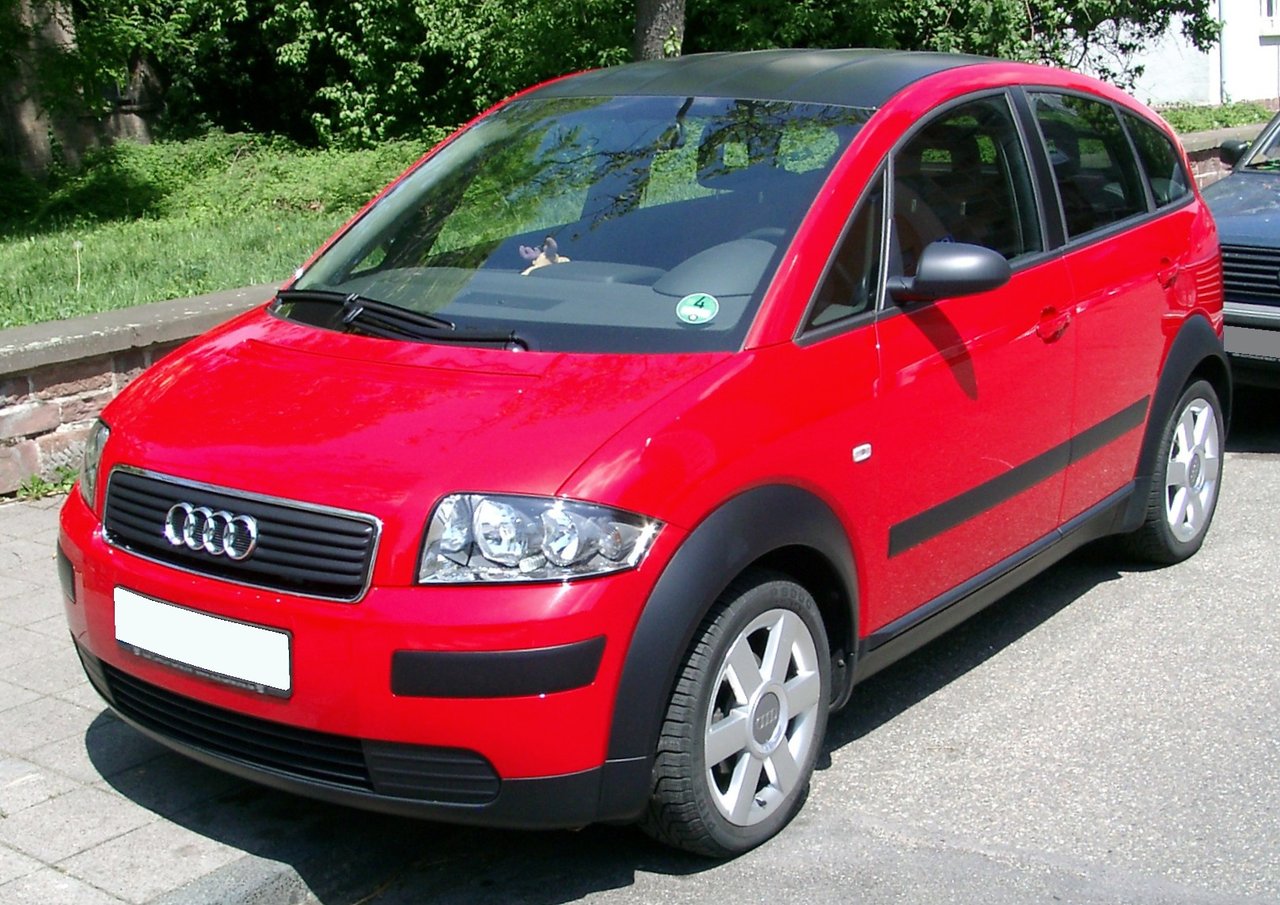
Overview
The original A2 was Audi’s premium compact hatchback, built in Neckarsulm, Germany. Its tall, five-door body brought aluminium construction to a small passenger car. This record covers the petrol and diesel production line presented in 1999, launched onto the market in 2000 and discontinued in 2005. Model history — Audi Tradition, pages 7–8.
Development and production chronology
Audi’s lightweight compact-car project produced the Al2 studies shown at Frankfurt and Tokyo in 1997. The Tokyo version had three doors, a roll-top roof and flexible load space; that concept body should not be confused with the five-door production A2. Audi unveiled the production design at Frankfurt in September 1999. Development history — Audi Tradition, Anniversary Dates 2025, pages 7–8.
The dedicated Neckarsulm facilities opened on 15 November 1999. Audi dates the market launch to 30 June 2000: factory opening, public presentation and customer availability are separate milestones, rather than interchangeable model-year dates. Factory and launch dates — Audi Tradition.
The range expanded through the following calendar milestones:
- 2000: Launch with 75 PS petrol and diesel engines.
- March 2001: Market introduction of the economy-focused 1.2 TDI.
- 2002: Addition of the 1.6 FSI direct-injection petrol engine.
- 2003: Introduction of colour.storm, a colour and trim edition, and the stronger 90 PS 1.4 TDI.
- July 2005: End of production; Audi records 176,377 cars built at Neckarsulm.
Audi’s anniversary history dates the 90 PS diesel’s introduction to November 2003; its later statistics table says 2001–2005. This record follows the narrative introduction date, retaining the discrepancy rather than assuming 2001 customer availability. Chronology — Audi Tradition, pages 7–8, contrasting statistics — Audi Tradition, page 3.
Body, design and engineering
The A2 extended Audi Space Frame (ASF) technology from the luxury A8 into a smaller car designed for more automated manufacture. Its structure combined aluminium sheet, extruded sections and cast components, joined using riveting and welding, including laser welding. Larger multifunctional castings and fewer components simplified the structure compared with the earlier A8 approach. Aluminium was therefore fundamental to the body engineering, rather than merely an outer-panel substitution. Body construction — Audi Self-study Programme 239, pages 14–25.
The high cabin and short nose gave it unusual proportions. Audi’s Space Floor arrangement placed equipment between two floor layers at the front and provided lower rear footwells for passenger legroom. A service flap at the nose gave access for oil and washer-fluid checks and topping up; the bonnet could be removed for fuller access. An optional Open Sky roof increased the glazed area. Packaging and access — Audi Self-study Programme 240, pages 6–8.
The running gear used front struts, a torsion-beam rear axle and electrohydraulic power steering. Audi’s launch technical documentation also identifies ABS and electronic stability control as standard. These chassis choices accompanied the unusual body construction without requiring an equally unconventional suspension layout. Chassis overview — Audi Self-study Programme 240, page 5.
Engines and transmissions
The model’s five engine offerings must be distinguished by fuel, cylinder layout, output and introduction date. The figures below use metric horsepower (PS), not imperial brake horsepower. The table covers offerings introduced across the production run, not a single launch-year or universally available range. Audi UK’s April 2004 range included the 1.4 petrol, 1.6 FSI and both 1.4 TDI outputs, but excluded the 1.2 TDI.
| Version | Engine layout and fuel | Rated output | Transmission | Introduction milestone |
|---|---|---|---|---|
| 1.4 | Four-cylinder petrol | 55 kW / 75 PS | Five-speed manual | 2000 launch |
| 1.6 FSI | Four-cylinder direct-injection petrol | 81 kW / 110 PS | Five-speed manual | Added in 2002 |
| 1.4 TDI | Three-cylinder turbo diesel | 55 kW / 75 PS | Five-speed manual | 2000 launch |
| 1.4 TDI | Three-cylinder turbo diesel | 66 kW / 90 PS | Five-speed manual | November 2003 in Audi’s anniversary narrative; conflicting statistics give 2001–2005 |
| 1.2 TDI | Three-cylinder turbo diesel | 45 kW / 61 PS | Five-speed electrohydraulically automated gearbox | March 2001; excluded from the April 2004 UK range |
Range overview — Audi Tradition, pages 2–3, 1.4 petrol and TDI specifications — Audi Self-study Programme 247, pages 4–6, manual-transmission range — Audi UK, April 2004 price list, pages 4–5.
The introduction milestones follow Audi’s anniversary history. For the 90 PS diesel, that narrative gives November 2003, while Audi’s later statistics table says 2001–2005. This record retains the disagreement and follows the narrative introduction date rather than assuming 2001 customer availability. Chronology — Audi Tradition, pages 7–8, contrasting statistics — Audi Tradition, page 3.
The diesels used pump-nozzle direct injection. The 1.2 TDI combined additional weight reduction, narrow tyres and aerodynamic changes with electrohydraulic clutch operation. 1.2 TDI engineering — Audi Tradition, page 2.
Audi quoted average fuel consumption of 2.99 litres/100 km for the 1.2 TDI, explaining the “three-litre car” label: this describes fuel use, not engine capacity. The supplied account does not specify the test cycle or equipment configuration for that figure, so it should not be read as typical real-world consumption. That economy claim belongs to the specialised version, not every A2. 1.2 TDI output, injection and economy — Audi TDI Tech Workshop 2014, page 34.
Body configuration and market equipment
Audi UK’s April 2004 list offered standard, SE and Sport specifications across the 1.4 petrol, 1.6 FSI and both 1.4 TDI outputs; it did not list the 1.2 TDI. These trim names identify UK equipment combinations, not generations or separate engine families. Sport included sports seats, larger wheels and sports suspension.
That UK range had two individual folding, removable rear seats as standard, with an optional rear bench providing a third rear seating position. Four-seat and five-seat descriptions can therefore both be correct when tied to equipment. The same list offered Colour Storm as a package for standard and SE cars, illustrating why national packaging should be checked separately from the broader colour.storm edition history. UK range, seating and packages — Audi UK, April 2004 price list, pages 4–5 and 8–15.
Historical significance
The A2 demonstrated how aluminium construction could serve compact-car efficiency and passenger space. Its contribution to Audi’s engineering history complements the larger Audi 100 and the design-led TT. The ASF manufacturing programme also connected lightweight design with changes in factory joining and assembly methods. Manufacturing context — Audi Self-study Programme 239, pages 14–25.
Commercially, Audi acknowledges that sales fell below expectations. The model’s later enthusiast following reflects the enduring appeal of its unusual engineering. Legacy — Audi Tradition.
Bibliography
- Audi Tradition, Anniversary Dates 2025, A2 history, pages 7–8
- Audi Tradition, Leading light: 25 years Audi A2 — factory and launch dates, legacy, engine range and 1.2 TDI engineering; range and engineering, pages 2–3; contrasting 90 PS diesel statistics, page 3
- Audi Self-study Programme 239 — body construction and manufacturing context, pages 14–25
- Audi Self-study Programme 240 — chassis overview, page 5; packaging and access, pages 6–8
- Audi Self-study Programme 247 — 1.4 petrol and TDI specifications, pages 4–6
- Audi UK, April 2004 price list — manual-transmission range, pages 4–5; UK equipment, seating and packages, pages 4–5 and 8–15
- Audi TDI Tech Workshop 2014 — 1.2 TDI output, injection and economy, page 34