Volkswagen Passat
The water-cooled family car that helped lead Volkswagen beyond its air-cooled era and developed through nine generations.
Overview
This B1–B9 account focuses on the European Passat lineage; its chronology and availability descriptions should be read in that context.
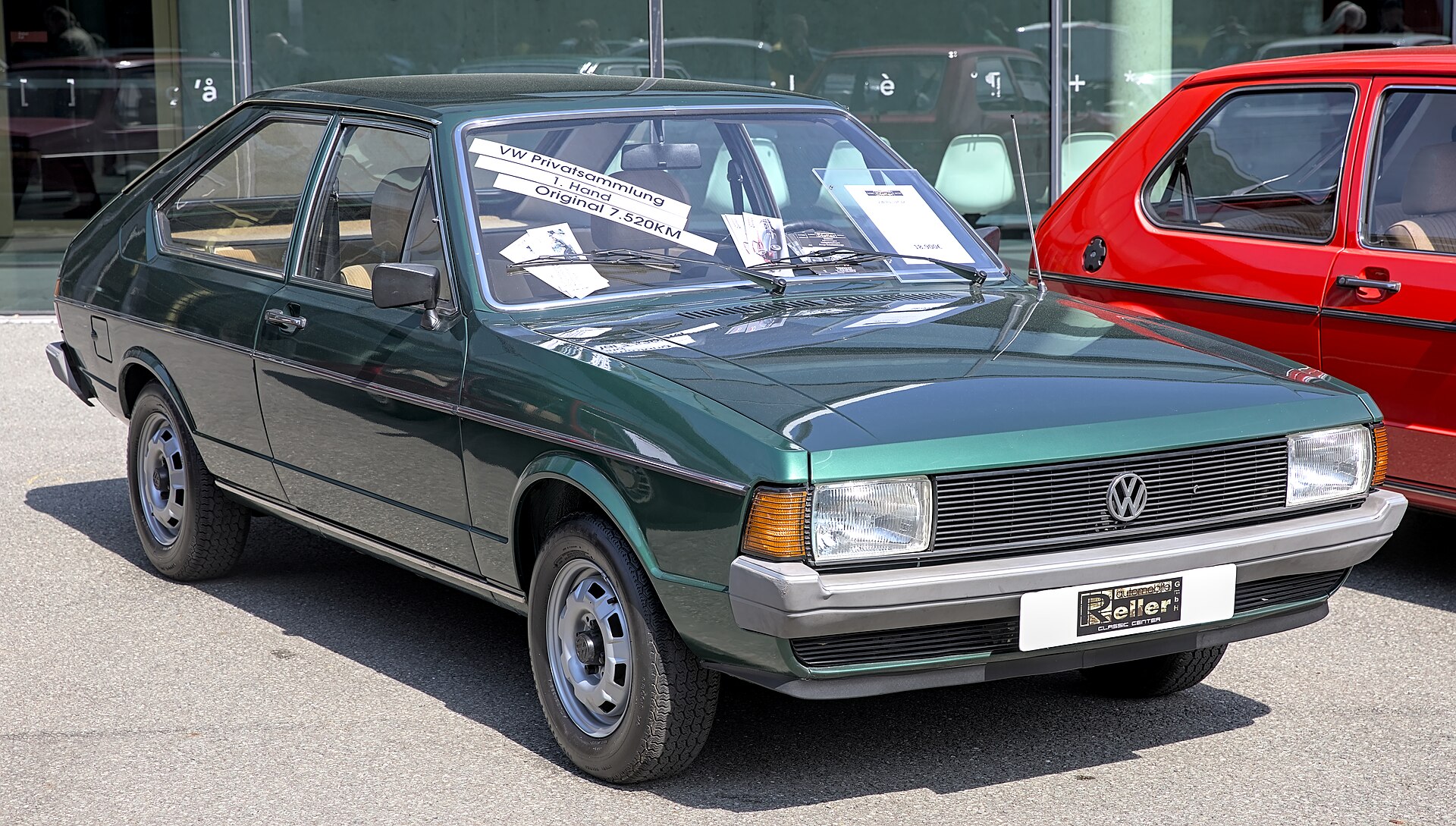
Volkswagen began series production of the Passat on 14 May 1973. The front-engined, water-cooled family car helped move the company beyond the rear-engined, air-cooled layout associated with the Beetle. Styled by Giorgetto Giugiaro, the first Passat used a longitudinal engine and front-wheel drive and was closely related to the Audi 80. Volkswagen’s anniversary account documents the production date, designer and Audi relationship. Source: Volkswagen’s 50-year retrospective.
The original two- and four-door fastback saloons had a sloping rear profile but a small boot lid: the rear window stayed fixed when the boot opened. Variant is Volkswagen’s estate designation; the five-door Passat Variant joined the range in January 1974. The hatchback followed in January 1975, with a larger tailgate that lifted the rear window as well. Volkswagen’s retrospective distinguishes these openings and dates. Source: B1 saloon and estate histories.
Passenger space, load capacity and restrained styling became central to the model’s identity. Later European generations alternated between longitudinal and transverse engine layouts and expanded the available technology to include diesel engines, all-wheel drive, turbocharging, direct injection and plug-in hybrid power. The ninth generation, introduced for 2024, made the European Passat range estate-only. Volkswagen’s July 2023 preview announced a first-quarter 2024 launch for the new Variant. Source: ninth-generation launch preview.
Generations
The following subsections trace the European lineage. The grouped periods are B1–B2 (1973–1988), B3–B4 (1988–1997) and B5–B7 (1996–2014); these ranges are not individual generation production dates.
B1
The B1 established the front-wheel-drive formula and the hatchback and Variant body styles described above.
B2
The larger B2 arrived in October 1980 with four- and five-cylinder petrol engines and a diesel; a turbo diesel followed later. Volkswagen’s B2 history records a start-stop function for the Formula E version, while its anniversary retrospective describes this as anticipating later start-stop systems. These accounts support that description without establishing fully automatic operation. The Passat syncro introduced all-wheel drive in 1984. Source: Volkswagen’s B2 history, introduction and model updates. Notchback versions were also sold as the Santana in many markets.
B3
The third generation adopted a transverse engine and a distinct grille-less nose. Volkswagen offered it as a four-door saloon or estate, with the supercharged G60 syncro at the top of the early range.
B4
The B4 was a substantial development of the B3’s structure, adding a conventional grille and revised body panels, safety equipment and interiors.
B5
The B5 returned to a longitudinal layout and shared its underlying architecture with the Audi A4. It introduced a fully galvanised body and offered four-, five-, six- and eight-cylinder engines across its lifespan. Volkswagen’s B5 history documents the initial engine range and subsequent V6 and W8 additions; this coverage describes the generation over time, rather than a single launch specification. Source: Volkswagen’s B5 history and engine updates.
B6
The transverse-engined B6 followed in 2005.
B7
The B7 of 2010 comprehensively revised the B6 platform and expanded its driver-assistance and efficiency technology.
B8 (2014–2023)
Built on Volkswagen’s modular transverse matrix, the B8 reduced weight while increasing cabin space. Saloon and Variant bodies were joined by the raised Alltrack estate, and the GTE combined a turbocharged petrol engine with a rechargeable electric drive system.
B9 (2024–present)
The ninth-generation European Passat range is exclusively a five-door Variant estate. Its longer wheelbase accompanies increased rear-seat and luggage space. For this European generation, Volkswagen’s July 2023 preview announced a first-quarter 2024 launch and described petrol, diesel, mild-hybrid petrol and plug-in hybrid powertrains. This is the announced range, rather than a statement that every powertrain was available in every European market at launch. Source: ninth-generation preview, launch announcement, rear space and powertrain sections.
Sources
- Volkswagen celebrates 50 years of the Passat — Volkswagen; early production and body-style dates, design origins and Formula E context
- Passat model archive — Volkswagen; image archive, not blanket evidence for the historical prose
- Passat B2 history and vehicle data — Volkswagen; introduction, engine range, Formula E start-stop function and syncro
- Ninth-generation Passat Variant — Volkswagen; July 2023 preview of the planned 2024 launch, space and powertrains
- Passat B5 history — Volkswagen; Audi A4 relationship, galvanised body and engine coverage across the generation