Audi 80
Audi's compact family-car line of 1972–1995, developed through four B-series generations before the A4 continued its place in the range.
Overview
The Audi 80 was Audi’s compact family-car line below the larger 100. Its four generations, B1 to B4, span 1972–1995. The A4 continued the lineage as the B5. Model-line history — Audi.
This record covers the B-series family. An earlier Audi 80, introduced in 1966, was an 80 PS derivative of the F103 range that revived the Audi marque. The Audi 75 replaced that version in 1968; the newly developed 1972 car reused its name. The F103 is therefore a predecessor, not a B-series generation. Earlier use of the name — Audi.
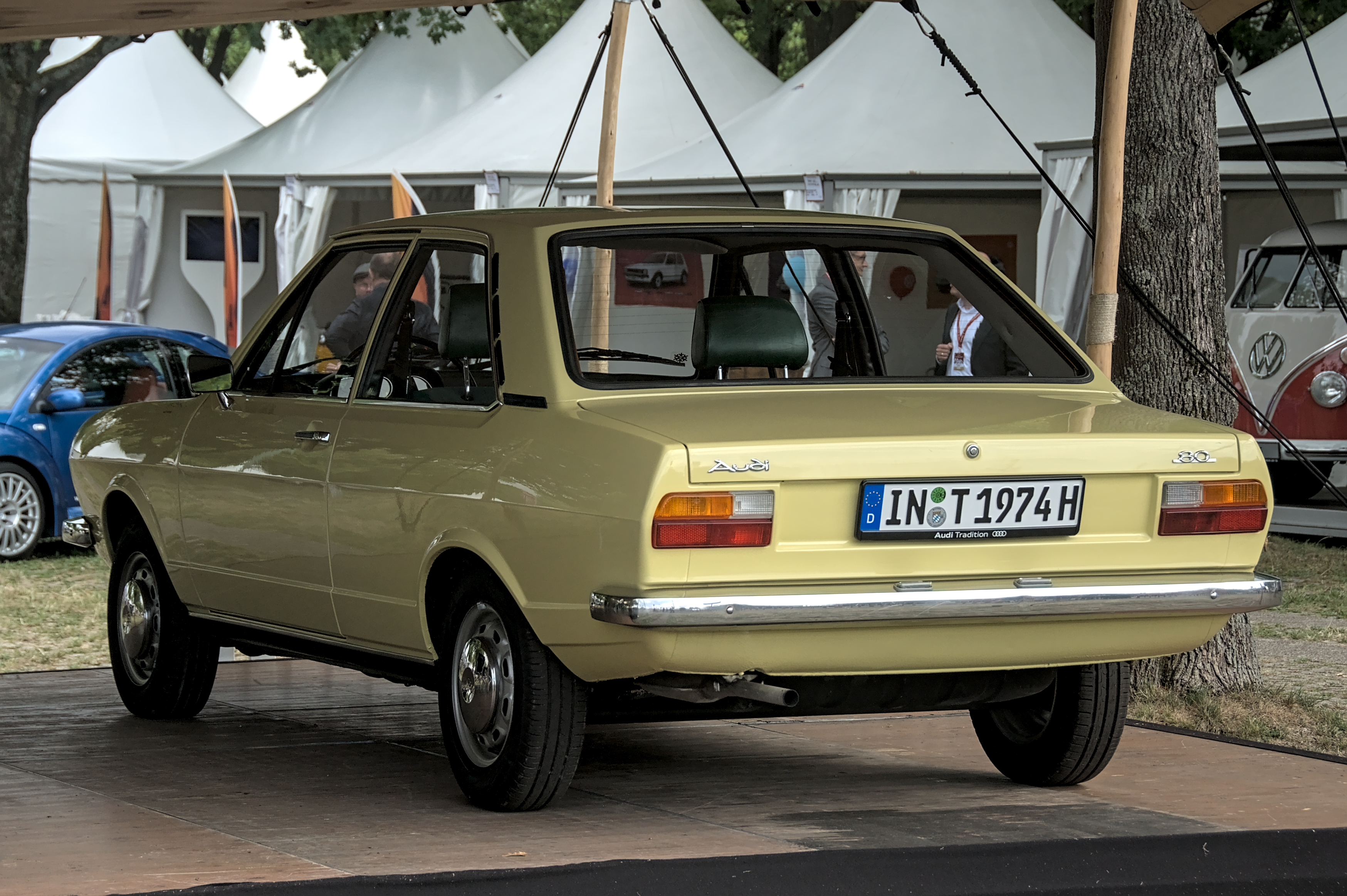
B1: the lightweight family saloon (1972–1978)
Ludwig Kraus’s team prioritised low weight and economical operation. The B1 used a longitudinal four-cylinder petrol engine driving the front wheels, with MacPherson-strut front suspension and diagonally divided hydraulic brake circuits. Its overhead-camshaft EA 827 engine concept subsequently spread through the Volkswagen Group.
Audi presented the car to the press in July 1972 and dealers in September. German production centred on Ingolstadt, with Wolfsburg and Emden contributing when demand exceeded capacity. Over a million B1s were built.
The angular saloon gained GT and fuel-injected GTE versions in 1973 and 1975 respectively. A 1976 update brought larger rectangular headlights; this remained the B1. In the United States it was sold as the Audi Fox. B1 development, production and updates — Audi.
B2: broader engines and quattro (introduced 1978)
The second generation retained an angular appearance, with styling developed in collaboration with Giorgetto Giugiaro. Diesel and five-cylinder engines broadened the range, while permanent quattro all-wheel drive joined in 1982. These were separate choices within the family; an ordinary front-wheel-drive 80 did not share every component or specification with an 80 quattro. B2 development — ABT Sportsline, page 1.
The 1984 B2 facelift also brought the more highly equipped Audi 90, moving five-cylinder versions upmarket. North America used Audi 4000 for the corresponding 80/90 family. Those names identify market and range positioning rather than extra B-series generations. Engine output, equipment and transmission availability must consequently be checked against the particular national specification. B2 90 and 4000 naming — Jalopy, using information supplied by Audi UK.
B3: aerodynamics and corrosion protection (introduced 1986)
The B3 replaced the angular body with a rounded, aerodynamic form and fully galvanised bodywork. Ingolstadt received substantial production investment, including a new paint shop. Audi’s European range account distinguishes the four-cylinder 80 from the better-equipped, five-cylinder 90; naturally aspirated and turbocharged diesels were also offered. Selected 80s had quattro. B3 engineering and manufacture — Audi Tradition, Anniversary Dates 2021, page 10.
B4: the final generation and Avant
The B4 arrived in September 1991. A longer wheelbase, wider track and redesigned rear axle enabled saloon load-through provision and an estate. The 80 Avant followed in August 1992. Audi treats B4 as a fourth generation, although ABT describes its origins as an extensive B3 facelift. B4 structure and launch — Audi Tradition, page 8, classification context — ABT Sportsline.
Six-cylinder engines expanded the range, and S2 performance versions encompassed the saloon and Avant alongside the related Coupé. These performance derivatives should be distinguished from the ordinary 80. Six-cylinder and S2 development — ABT Sportsline, pages 1–2.
Five-cylinder petrol power also continued: Audi identifies the naturally aspirated 2.3E in the B4 from 1991. It was distinct from the turbocharged five-cylinder performance engines. 2.3E applications — Audi.
The 1.9 TDI debuted in the 80 in 1991, bringing the direct-injection turbo diesel concept into this smaller model line after the 100’s earlier five-cylinder TDI. It should not be confused with preceding diesel versions or the later, more powerful A4 application. TDI chronology — Audi Netherlands.
The RS2 Avant of 1994–1995 was the specialised estate developed with Porsche. Its 2.2-litre turbocharged five-cylinder engine, quattro drivetrain and Porsche-assisted chassis development created a particularly influential performance estate. Assembly took place at Porsche’s Zuffenhausen works using Audi-supplied bodies and components. That production arrangement belongs to the RS2, not the entire 80 range. RS2 development and assembly — Porsche.
Body styles and production endpoints
| Branch | Calendar chronology |
|---|---|
| B4 saloon | Production ended in summer 1994. |
| B4 80 Avant estate | Production continued until August 1995. |
The related Coupé-based Cabriolet continued until July 2000. These separate production endpoints are calendar dates, not national model years or registration dates. Body-style chronology — Audi Tradition, pages 5 and 8.
Historical significance
Across the 80’s life, Audi broadened a lightweight family saloon into a range incorporating diesel economy, quattro traction and high-performance estates. Its development illustrates the marque’s movement towards the compact executive market. The A4 name changed the badge while preserving the B-series succession; the RS2 helped establish a separate RS performance identity. 80-to-A4 development — ABT Sportsline, RS2 legacy — Porsche.