Audi A4
Audi's compact executive model family, introduced in 1994 as the successor to the Audi 80 and developed through five generations of saloons, Avants and related derivatives.
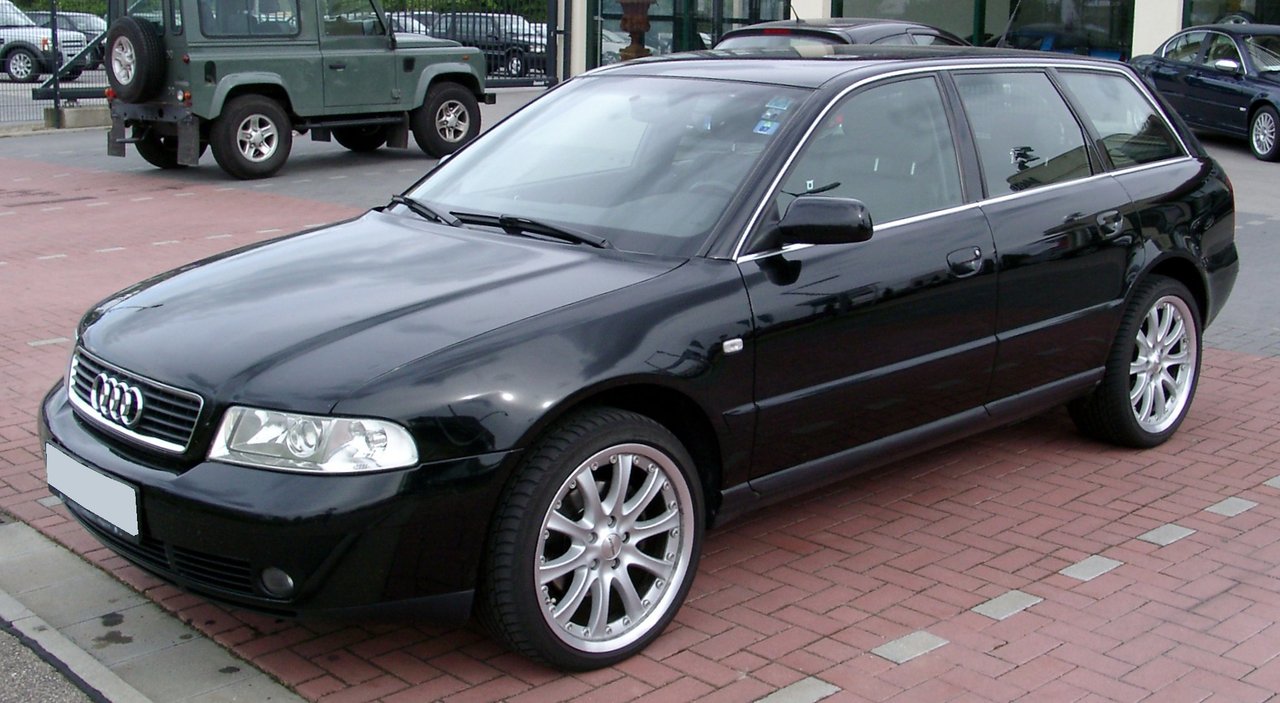
Overview
The A4 is Audi’s compact executive car family, introduced in 1994 to replace the Audi 80. It became a central volume model for the marque, combining everyday saloon and estate practicality with Audi’s premium positioning. The first cars were built in Ingolstadt, Germany; manufacture subsequently extended to other German and overseas plants. Audi’s 2019 anniversary account identifies five generations and describes the A4 as its best-selling model worldwide during 2018. Origins and significance — Audi Netherlands.
This record covers the model family. B5, B6, B7, B8 and B9 distinguish generations; Avant denotes the estate body, and Cabriolet the convertible. A registration year, engine badge or equipment package alone does not identify the generation. The A4 continues the 80’s B-series sequence, so B5 is the first A4, not the fifth A4. Lineage — Audi Japan, New Audi A4 Technology Magazine, pages 15–18.
Generations and development
The dates below identify calendar introductions and the principal generation sequence. They are not universal model-year ranges or simultaneous production cut-offs for every body and country.
| Generation | Introduction | Main developments |
|---|---|---|
| B5 | 1994 | New A4 saloon with multi-link front suspension; Avant announced in 1995. Audi’s historical timeline extends this generation to 2001. |
| B6 | 2000 | New saloon, followed by Avant in 2001; lighter aluminium suspension components and the multitronic transmission were among the developments. |
| B7 | 2004 | Singleframe grille and revised engineering; saloon and Avant announced together. The historical timeline runs to 2008. |
| B8 | 2007 | Modular longitudinal architecture, repositioned front axle and new proportions; the timeline runs to 2015. |
| B9 | 2015 | New saloon and Avant, reduced weight and expanded driver assistance and digital instrumentation. |
B5–B8 chronology — Audi Japan, pages 17–18, 2015 introduction — Audi Interim Financial Report 2015, page 10.
The B6 family added a Cabriolet in 2002, after the saloon and Avant introductions. An open version also formed part of the B7 range. These staggered introductions explain why a single date span cannot describe all A4 bodies accurately. Audi treats B7 as the third A4 generation in its retrospective sequence. Body styles and generation classification — Audi Poland.
The B8’s architecture put the front differential ahead of the clutch, allowing the front axle to move forward. This changed the relationship between wheelbase, front overhang and engine position. The A4 allroad quattro joined the family in 2009. B8 packaging and allroad — Audi Japan, page 18.
For B9, Audi emphasised lower mass despite increased exterior dimensions, alongside optional virtual cockpit instruments and assistance systems such as adaptive cruise control with traffic-jam assistance. The 2015 report records the saloon and Avant world premiere together and describes an autumn market introduction; this is a calendar chronology, not a worldwide model-year designation. B9 launch — Audi Interim Financial Report 2015, page 10.
The substantial 2019 update revised the body detailing and introduced a central touchscreen operating concept. It also expanded mild-hybrid availability. This was an update within B9, not the start of a sixth A4 generation. Facelift — Audi’s 2019 A4 press dossier.
Engines, transmissions and derivative names
Petrol and TDI diesel engines served different buyers within the A4 range. For example, Audi Poland’s retrospective describes B6 choices including the turbocharged 1.8-litre petrol engine, naturally aspirated petrol alternatives and 1.9- and 2.5-litre TDI diesels. This European range overview does not establish availability in North America. The A4-based S4 introduced in 1997 instead used a twin-turbocharged 2.7-litre V6. These are examples from different generations and derivatives, not interchangeable A4 specifications. Earlier engine choices and S4 — Audi Poland.
Audi’s 2019 European update documentation illustrates the later range: four-cylinder 2.0 TFSI petrol engines, four-cylinder 2.0 TDI diesels and a 3.0 V6 TDI appeared in distinct versions. Selected engines received 12-volt mild-hybrid systems. The European S4 used a 3.0 TDI with a 48-volt system, while Audi specified a 3.0 TFSI petrol S4 for markets outside Europe. Front-wheel drive, quattro, S tronic and tiptronic combinations depended on the derivative. Market-specific powertrains — Audi’s 2019 dossier, pages 7–9.
S line is an equipment designation, distinct from S4 and RS 4 performance models. The allroad quattro is an estate-based derivative with raised ground clearance and different exterior protection, rather than a name for every quattro Avant. Equipment and allroad distinctions — Audi’s 2019 dossier.
Production and regional differences
Ingolstadt was the original production centre. Audi’s 2015 report describes a flexible manufacturing arrangement between Ingolstadt and Neckarsulm, both in Germany, and also records A4 assembly in China and India. Thus the model’s German identity does not establish the assembly country of an individual car. Manufacturing network — Audi Interim Financial Report 2015, foreword.
The 2019 anniversary release identifies the overseas plants as Changchun in China and Aurangabad in India. It also highlights the long-wheelbase version developed specifically for China. The Chinese A4L belongs to a regional branch of the family; its longer body must not supply dimensions for a standard-wheelbase European saloon. That release names China, Germany and the United States as major A4 markets. Plants and Chinese-market version — Audi Netherlands.
Succession and legacy
In July 2024 Audi announced that the next combustion-engine generation would take the A5 name, with Sedan and Avant bodies built in Neckarsulm on the Premium Platform Combustion. The announcement scheduled introduction in Germany and numerous other European countries for November 2024. This documents the European model succession; it does not establish one final A4 production or sales date for every country. The successor’s platform and specifications belong to the A5 record, not to a B9 A4 facelift. A5 succession — Audi, 16 July 2024.
The A4’s historical importance lies in making Audi’s premium identity a high-volume proposition. Its progression connects the Audi 80 lineage to modular longitudinal engineering, international manufacture and increasingly digital cabins. Practical Avant bodies, regional long-wheelbase cars and performance derivatives gave the same underlying model family several distinct roles. It is best understood alongside the smaller A3 and larger A6, while keeping each generation and market specification separate.