Mazda RX-7 Third Generation (FD)
The final RX-7 generation combined a lightweight coupé body with sequential twin-turbo rotary power. Introduced in Japan in December 1991, it remained in production until 2002, beyond its shorter export-market availability.
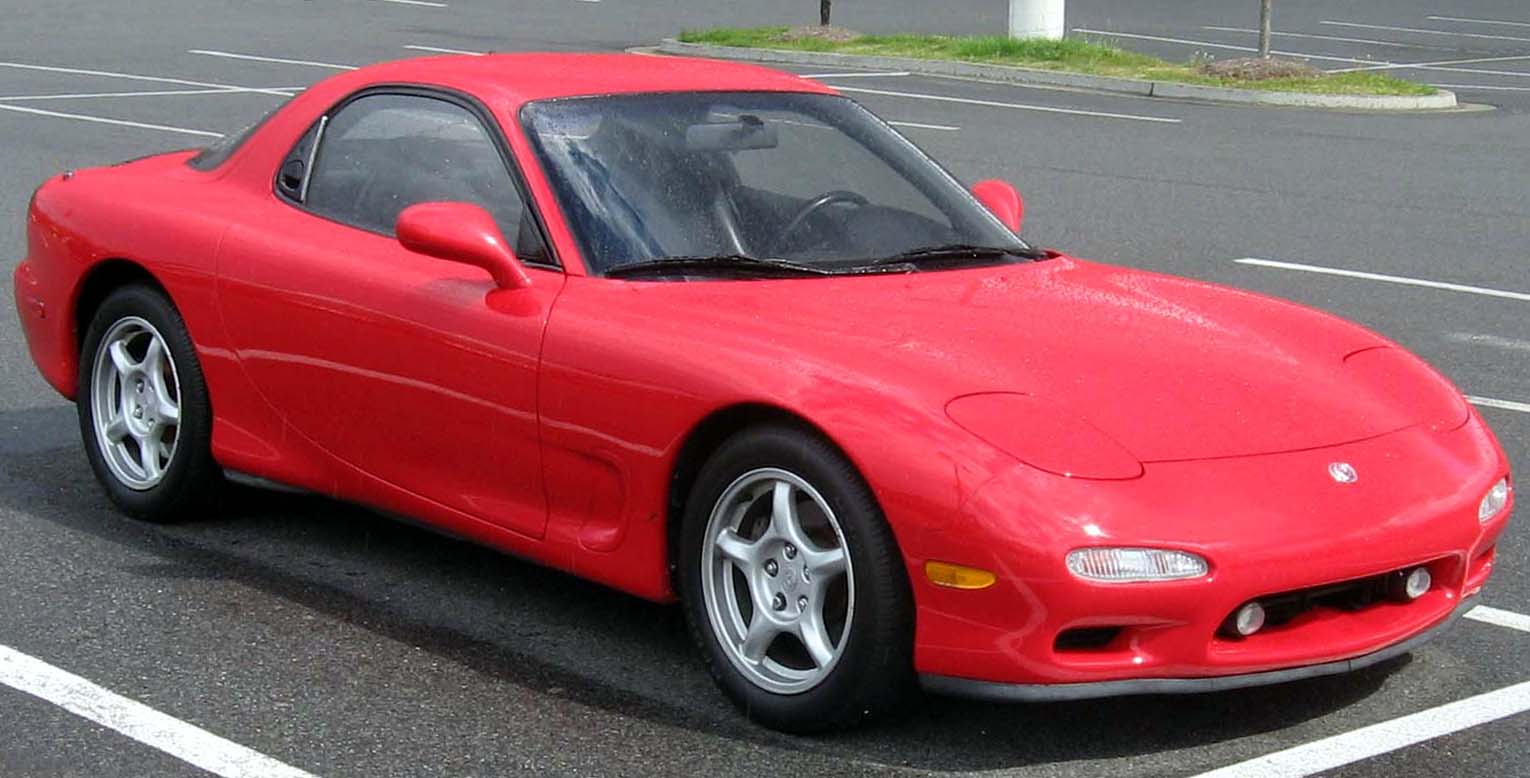
The final RX-7 generation
The FD was the third and final generation of the Mazda RX-7, succeeding the FC generation. Built in Japan, it combined a coupé body, rear-wheel drive and turbocharged rotary power. Its Japanese launch took place in December 1991 under the Anfini RX-7 name, associated with Mazda’s domestic sales channel; the earlier Savanna name was dropped. Production ended in August 2002. These dates describe the generation’s Japanese chronology, rather than a uniform worldwide model-year range. Sources: Mazda’s FD history and Consumer Guide’s U.S. record.
Development and design
Mazda presented the FD as a renewed commitment to a focused sports car. Its Plan Zero programme scrutinised components for weight savings while the powertrain gained output. Compared with the FC, the body became wider but shorter and lower, with a shorter wheelbase. Curved surfaces and pronounced front wings expressed the design theme Mazda called “Beauty in the Beast.” The result combined a compact cabin with a purposeful stance. Mazda records that the Anfini RX-7 received the 1991 RJC New Car of the Year award. Source: Great Cars of Mazda.
The engineering retained a front-midship layout and rear-wheel drive. Double-wishbone suspension at all four wheels used aluminium components to reduce unsprung weight. Source: Mazda’s Japanese development history.
Rotary power and body configuration
The FD used the 13B rotary family with sequential twin turbocharging. Its two-rotor engine distinguished it from contemporary piston-engined sports cars. Power ratings must remain attached to their markets: Mazda’s German history specifies 176 kW/239 PS for the German-market version, while Mazda’s U.S. heritage account describes its 1995 example as producing 255 horsepower. Sources: Mazda Germany and Mazda USA.
For the United States, the FD was a two-seat hatchback coupé, replacing the preceding generation’s coupé and convertible offerings. A five-speed manual or four-speed automatic was available. This seating description cannot be applied to every Japanese version: the final Spirit R range included both two-seat and four-seat cars. Sources: Consumer Guide and Mazda’s Spirit R announcement.
Launch dates and market availability
- Japan: December 1991 launch; domestic development continued through 2002. Mazda’s Japanese history supplies the original launch chronology.
- United States: Mazda’s corporate timeline places the introduction of the 1993 model in calendar 1992. The U.S. FD range covered model years 1993–1995, rather than the generation’s full Japanese lifespan. Sources: Mazda U.S. history, Mazda’s heritage account and Consumer Guide.
- Germany: Mazda records sales from 1992 until early 1996. Its retrospective also describes the generation as 1992–2002; that wording should be read alongside the Japanese archive’s explicit December 1991 launch date. Source: Mazda Germany.
A market withdrawal, a model-year designation and the end of factory production therefore represent different milestones.
Japanese evolution and the final editions
Mazda’s Japanese history identifies revisions in August 1993 and January 1996, followed by a substantial update described as January 1999. Later changes included revised lighting, larger front air openings and changes to suspension and aerodynamic equipment. These were developments within the FD generation. Source: Mazda’s FD chronology.
The Japan-only Spirit R series went on sale on 22 April 2002. Type A combined two seats with a five-speed manual; Type B paired four seats with the manual; Type C paired four seats with a four-speed automatic. Mazda specified the 13B-REW engine at 206 kW/280 PS for Types A and B, and 188 kW/255 PS for Type C. Thus even the final edition did not have one universal power output or seating arrangement. Mazda’s announcement also listed the Type R Bathurst alongside Spirit R, so Spirit R should not be treated as the name of every final-year RX-7. Source: Mazda’s contemporary Spirit R release.
Historical significance
The FD concluded the RX-7 line’s pursuit of a compact rotary sports car, combining weight reduction with greater engine output. Mazda associates the end of RX-7 production in 2002 with tighter emissions requirements. Source: Great Cars of Mazda.
Its later cultural presence extended beyond road tests and competition: Mazda’s 2024 Bremen exhibition used an FD and Gran Turismo 2 to illustrate how driving games introduced younger enthusiasts to Japanese sports cars. Source: Mazda Germany’s exhibition account.
For the wider model history, see Mazda RX-7, the first-generation SA22C and the second-generation FC.
Sources and image credit
- Mazda: The Savanna RX-7 Part 2 — development context and historical significance
- Mazda: RX-7, Chapter 3 — Japanese FD development and chronology
- Mazda USA: Mazda History — calendar 1992 introduction of the 1993 RX-7
- Mazda USA: 2017 Japanese Classic Car Show — U.S. specification and availability
- Consumer Guide: 1993–95 Mazda RX-7 — Japanese manufacture and U.S. configuration
- Mazda Germany: Bremen Classic Motorshow — German availability, power rating and legacy
- Mazda: Final Limited Edition RX-7 Spirit R — contemporary 2002 specifications
- IFCAR / Wikimedia Commons: Mazda-RX-7-FD.jpg — public-domain photograph
