Mazda
A Japanese manufacturer rooted in Hiroshima, known for commercial vehicles, practical family cars, rotary engines and the MX-5 roadster.
Historical overview
Mazda is a Japanese vehicle manufacturer whose industrial roots lie in Hiroshima. Established as Toyo Cork Kogyo in 1920, it moved from cork products into machinery and motor vehicles. The Mazda name appeared on vehicles long before the company became Mazda Motor Corporation in 1984. Its history encompasses working trucks, small passenger cars, family saloons and hatchbacks, sports cars and crossovers.
Mazda’s distinctive contribution was its sustained development of the rotary engine alongside conventional piston engines. That engineering identity should not obscure the importance of its everyday cars or commercial vehicles. The MX-5 also established a separate sports-car tradition, while overseas assembly and partnerships expanded Mazda beyond its Japanese production base. Mazda historical highlights.
From cork works to passenger cars
Toyo Cork Kogyo was founded on 30 January 1920. Jujiro Matsuda became president in 1921; the company adopted the Toyo Kogyo name in 1927. Production of the Mazda-go Type-DA three-wheeled truck began in 1931. After the atomic bombing of Hiroshima, the company accommodated prefectural government offices and resumed three-wheeled truck production in December 1945.
The R360 Coupe of May 1960 marked Mazda’s entry into series-produced passenger cars. Carol followed in 1962. The Familia range began with a van in 1963, followed by wagon and saloon versions in 1964. Luce and Bongo arrived in 1966, widening the range into larger passenger cars and vans. The new Ujina passenger-car plant in Hiroshima was completed that November. These are calendar-year milestones; overseas introductions and model-year labels could differ. Mazda chronology, 1920–1979.
Rotary development and competition
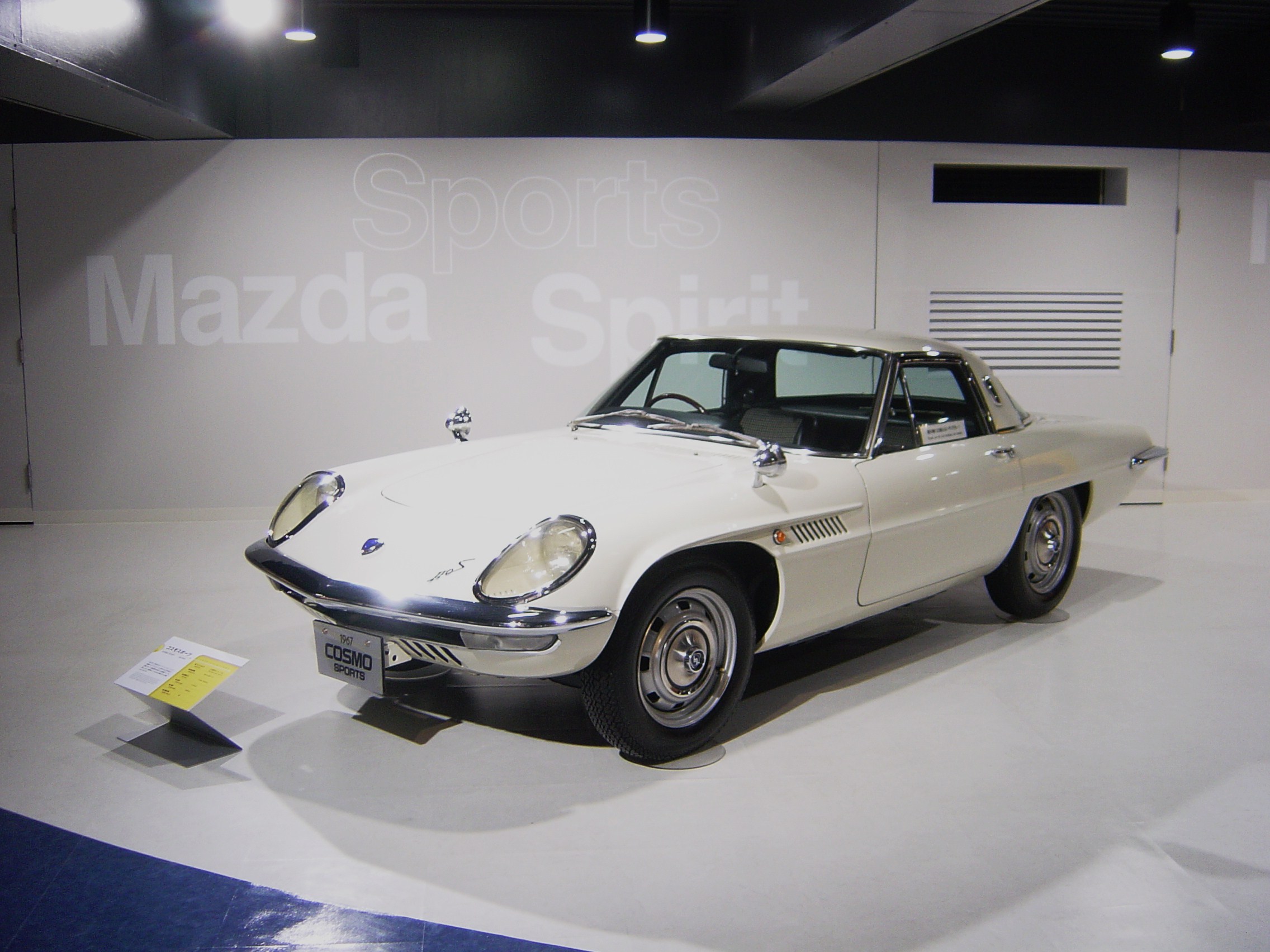
Mazda entered a technical agreement with NSU and Wankel in 1961. Its first rotary-engined production car, the Cosmo Sport, also known as the 110S, followed in 1967. Rotary power subsequently spread into the Familia Rotary Coupe/R100, Capella Rotary/RX-2, Savanna/RX-3 and Luce Rotary/RX-4 branches. Those names identify particular rotary models, not every version of the associated family-car range.
The RX-7 arrived in 1978 and became a central rotary sports-car line. The Eunos Cosmo of 1990 extended the technology to a three-rotor engine, while the RX-8 launched in 2003. RX-8 production ended in June 2012; Mazda resumed production of rotary-engined vehicles in June 2023 with the MX-30 e-Skyactiv R-EV. Mazda rotary-engine chronology.
Competition gave this work international prominence. The four-rotor R26B-powered 787B won Le Mans outright in 1991, the first Japanese car to achieve that result. It was a purpose-built Group C racing car, whose engine and construction should be distinguished from Mazda’s road-going rotary models. Mazda’s 787B archive.
Family cars, body styles and the MX-5
Mazda’s family-car engineering evolved independently of its rotary programme. The 1980 Familia adopted front-wheel drive, initially with three- and five-door hatchbacks and then a saloon. The 1987 Capella range included saloon, coupe and five-door bodies. Across the wider catalogue, estates, vans, pickups and the MPV added practical alternatives to passenger saloons and sports cars.
The MX-5 Miata was shown at Chicago in February 1989; Japanese sales began that September under the Eunos Roadster name. Its compact, open two-seat format offered a different interpretation of driving enjoyment from the RX-7. Mazda’s chronology therefore separates the international reveal from the Japanese launch, rather than assigning one date to every market. Mazda chronology, 1980–1989.
Partnerships, markets and production
Ford and Mazda entered a capital alliance in 1979. The partnership broadened manufacturing cooperation, while Hofu in Yamaguchi prefecture became another major Japanese production centre in 1982. Mazda’s expansion into multiple Japanese sales channels and premium models was followed by financial difficulties after the bubble economy collapsed. Mazda historical highlights.
Ford increased its Mazda holding from 25 to 33.4 per cent in 1996. That year Mazda also consolidated Eunos dealerships into Mazda or Mazda Anfini outlets. The separate badges and sales channels matter when identifying period Japanese-market cars. The European Ford-produced Mazda 121 introduced in 1996 is another reminder that a Mazda badge alone does not establish the vehicle’s engineering origin. Mazda chronology, 1990–1999.
Vehicle production at Mazda Motor Manufacturing USA began in 1987. Later expansion included Mazda3 assembly in Thailand and Malaysia in 2011 and mass production at the Mexican plant in January 2014. Production country and sales market must therefore be recorded separately. Mazda’s 1980s chronology and 2010–2014 chronology.
Market names also changed over time. Axela was paired with Mazda3, Atenza with Mazda6 and Demio with Mazda2 in Mazda’s international catalogue. Japan adopted the Mazda6 and Mazda2 names in 2019. Mazda entered a business and capital alliance with Toyota in 2017, beginning another phase of cooperation. Mazda chronology, 2015–2019.
Design, Skyactiv and electrification
Mazda introduced the Kodo design theme and Skyactiv technology programme in 2010. Skyactiv covered engines, transmissions, body and chassis engineering, rather than identifying one engine or trim. The CX-5 launched in 2012 brought the full programme together; the Mazda6 and Mazda3 also adopted the new design and engineering approach. Petrol Skyactiv-G and diesel Skyactiv-D units remained distinct engine families with different market applications. Mazda chronology, 2010–2014.
The MX-30 brought battery-electric production to Mazda in 2020, with a mild-hybrid version also offered in some markets. The e-Skyactiv R-EV unveiled in Europe in 2023 used a different arrangement: a rotary engine powered a generator, while an electric motor drove the wheels. It was a series plug-in hybrid, not a battery-only vehicle or a direct continuation of the RX-8 powertrain. Mazda’s European MX-30 R-EV announcement.
Legacy and catalogue relationships
Mazda’s history joins Hiroshima’s industrial development to a broad international vehicle business. Its family and commercial vehicles provided the practical foundation; rotary development, endurance racing and the MX-5 gave the marque particularly recognisable engineering and sporting identities.
Within the catalogue, Mazda is the manufacturer parent for its individual model lines. Familia, Capella, RX-7, MX-5 and CX-5 are model families, while their generations, body styles, facelifts, trims and engines require separate identification. Export names can describe related cars without guaranteeing identical specifications or production periods.
For related Japanese manufacturer histories, see Honda, Nissan and Toyota.
Models
MX-5 Miata
The compact two-seat roadster introduced in 1989, known in Japan as the Eunos Roadster and later Mazda Roadster, developed through NA, NB, NC and ND generations.