Mazda RX-7
Mazda's rotary-powered sports-car family, developed through three generations from 1978 to 2002 and known in Japan as the Savanna RX-7 and Anfini RX-7.
Historical overview
The RX-7 was Mazda’s rotary-powered sports-car family, produced from 1978 to 2002 across three generations. Assembly was in Hiroshima, Japan. Its defining combination was a compact rotary engine, rear-wheel drive and sports-car bodywork designed around the engine’s packaging advantages. Production and assembly overview.
Mazda introduced the first Savanna RX-7 in March 1978. The RX-7 carried forward the company’s rotary sports-car tradition associated with the Cosmo, while establishing a distinct model family. Mazda chronology.
First generation: 1978–1985
The original Japanese SA22C combined a low bonnet and retractable headlights with a two-rotor 12A engine. Unlike the preceding Savanna/RX-3’s relationship to a conventional passenger-car body, the RX-7 expressed a dedicated sports-car design. Mazda positioned the compact engine behind the front axle, describing this arrangement as front midship; concentrating weight toward the centre of the car supported its handling objectives. Mazda’s first-generation account and centenary profile.
Development continued within the generation. Mazda’s Japanese history records changes to emissions treatment and combustion in 1979, revised bumpers and weight reduction in 1980, and a turbocharged addition in 1983. These are Japanese-range milestones, not specifications shared by every export car. The original chassis used front struts and a located live rear axle. Mazda’s development chronology.
Second generation: FC, introduced in 1985
The FC-series Savanna RX-7 arrived in Japan in October 1985. Mazda sought a more mature sports car with improved comfort, refinement and performance. Fuller bodywork and independent rear suspension marked substantial changes from the original. The Japanese launch specification used a turbocharged two-rotor 13B engine; its twin-scroll turbocharger must not be confused with the later FD’s twin-turbo system. Mazda’s FC development history.
A cabriolet joined the Japanese range in August 1987, expanding the family beyond the closed body. Mazda revised the Japanese FC in 1989, including engine and turbocharger changes. These updates and the cabriolet are developments within the second generation. Mazda’s body-style and revision chronology.
Third generation: FD, introduced in 1991
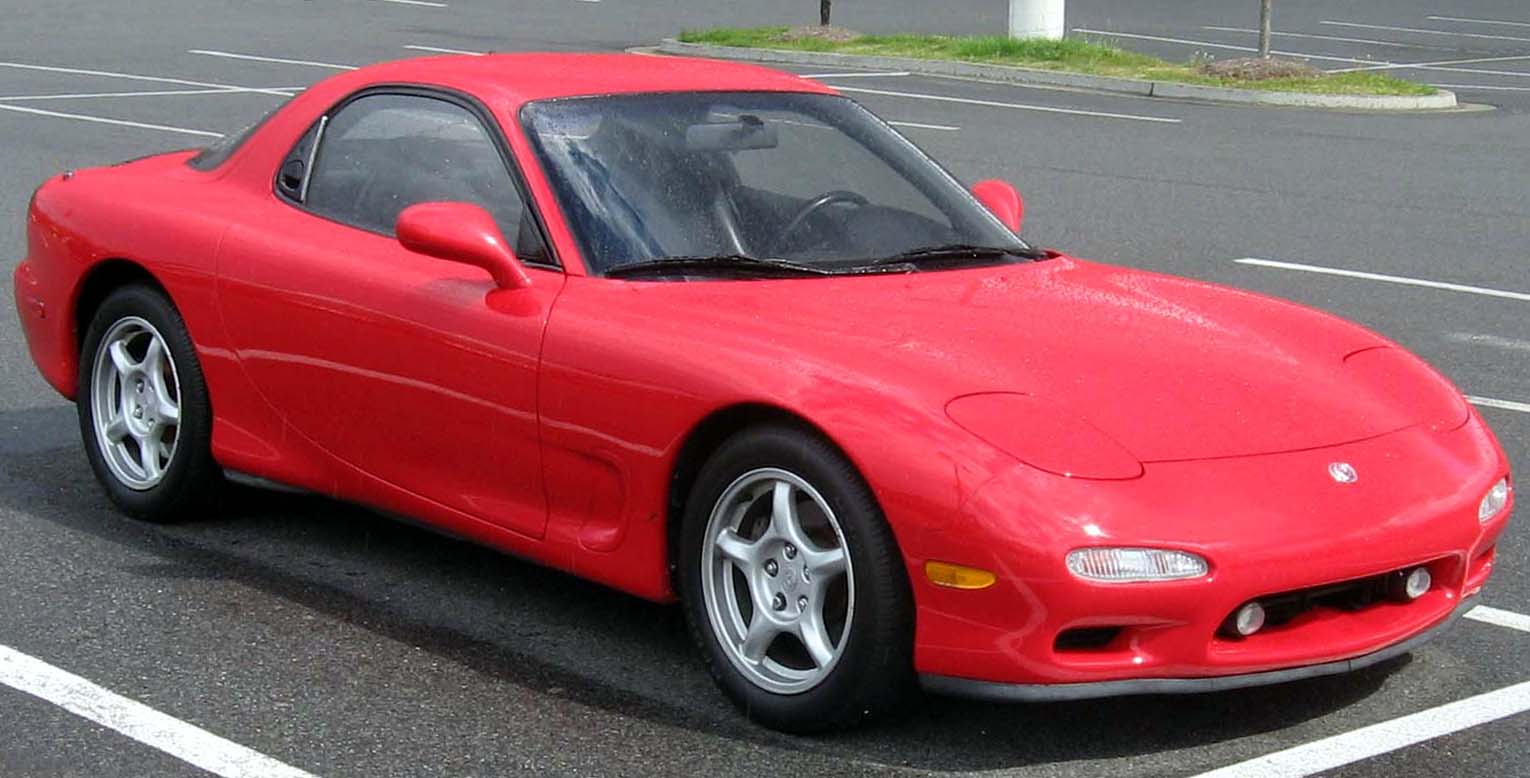
The FD went on sale in Japan in December 1991. Its development placed renewed emphasis on reducing weight and concentrating on sports-car performance. Compared with the FC, Mazda made the body wider while reducing overall length, height and wheelbase. Curved surfaces, pronounced wings and a compact cabin gave it a different visual character. Mazda’s FD development history.
The FD retained the front-midship, rear-wheel-drive arrangement. Its 13B rotary used sequential twin turbochargers, and the chassis adopted double-wishbone suspension at all four wheels. Later revisions remained within the FD generation. Production of the RX-7 ended in 2002; Mazda’s retrospective associates its withdrawal with tighter emissions requirements. FD engineering account and Mazda’s retrospective.
Savanna, Anfini and market distinctions
Savanna RX-7 was the Japanese name used for the first two generations. The third generation dropped Savanna and launched as Anfini RX-7, named for a Mazda sales channel in Japan. Mazda’s English archive uses the spelling Anfini; the name is also rendered ɛ̃fini. These names belong within the RX-7 model family. Mazda’s naming account.
There is an important earlier use of the name: Mazda offered limited ∞ (Anfini) versions of the FC beginning in August 1986. That designation identifies particular second-generation editions, whereas Anfini RX-7 at the FD’s introduction refers to its Japanese sales-channel branding. Mazda’s FC edition history.
Dates here identify calendar-year introductions and the overall production span. Overseas sales introductions, model-year designations, seating arrangements and engine specifications require market-specific identification. A generation code, body style, limited edition and engine family describe different aspects of a car and should not be treated as interchangeable names.
Historical significance
The RX-7 gave Mazda a sustained international sports-car identity built around rotary power. Its progression from the original compact car through the more refined FC to the lighter, performance-focused FD illustrates changing priorities within one model family. Mazda’s retrospective also records the RX-7’s extensive success in North American IMSA competition. Mazda’s historical assessment.
Within the manufacturer’s catalogue, the RX-7 sits alongside the separate MX-5 Miata sports-car branch. For the wider corporate and rotary-engine context, see Mazda.
Sources and image credit
- Mazda chronology, 1920–1979: March 1978 RX-7 introduction
- Mazda: Savanna RX-7, second and third generations
- Mazda: first-generation RX-7 development history, Japanese
- Mazda: FC development, Anfini editions and cabriolet, Japanese
- Mazda: FD development history, Japanese
- Mazda centenary profile: first-generation Savanna RX-7
- Wikipedia: supplementary production and assembly overview
- IFCAR: Mazda RX-7 FD photograph and public-domain declaration

Browse related records
3 records
Mazda RX-7 First Generation (SA22C)
The original RX-7 established Mazda's rotary sports-car family. Produced from 1978 to 1985, this generation includes both early SA22C cars and later versions commonly called FB.
GenerationMazda RX-7 Second Generation (FC)
The FC transformed the RX-7 into a more refined rotary sports car. Introduced in Japan in October 1985, it combined redesigned bodywork with independent rear suspension and offered coupe and convertible bodies.
GenerationMazda RX-7 Third Generation (FD)
The final RX-7 generation combined a lightweight coupé body with sequential twin-turbo rotary power. Introduced in Japan in December 1991, it remained in production until 2002, beyond its shorter export-market availability.
Generation
No matching records.