Honda
Founded in 1948, Honda entered automobile production in 1963 with the T360 and S500. This overview follows its motorcycle origins, Civic and Accord expansion, sports cars and hybrids.
Historical overview
Motorcycle origins and entry into automobiles: 1948–1963
Soichiro Honda founded Honda Motor Company in 1948. Its early business centred on engines for powered bicycles and then motorcycles. Automobile production began separately in 1963: the T360 small truck went on sale in Japan in August, followed by the S500 sports car in October. Honda’s founding history, early products and automobile history document these stages.
Civic and Accord expansion: the 1970s
The Civic was introduced in Japan in 1972 as a compact front-wheel-drive car. CVCC-equipped versions followed in Japan in December 1973. For the United States, the 1975 model-year Civic CVCC received EPA certification in November 1974 for compliance with the applicable 1975 emissions requirements under the US Clean Air Act of 1970, without a catalytic converter. This claim concerns CVCC-equipped versions, not every early Civic.
CVCC stands for Compound Vortex Controlled Combustion. It uses a small auxiliary combustion chamber to send a flame into the main chamber, helping burn a mixture containing relatively little fuel for the amount of air. The system reduced pollutants through control of combustion. See Honda’s Civic history and CVCC development history.
The larger Accord followed in 1976, initially as a three-door hatchback; a four-door saloon joined the Japanese range in 1977. Honda’s Accord history records these introductions.
Later sports cars and hybrids
Honda broadened its range with the Prelude, CRX and Legend. The mid-engined NSX, introduced in Japan in 1990, used an all-aluminium monocoque body: the body itself formed the load-bearing structure. This replaces a general claim about usability with a specific construction detail documented in Honda’s NSX history.
Later models included the S2000 roadster and the Insight petrol-electric hybrid, introduced in 1999. The Insight paired a petrol engine with an electric motor, as described in Honda’s launch announcement.
Notable model lines
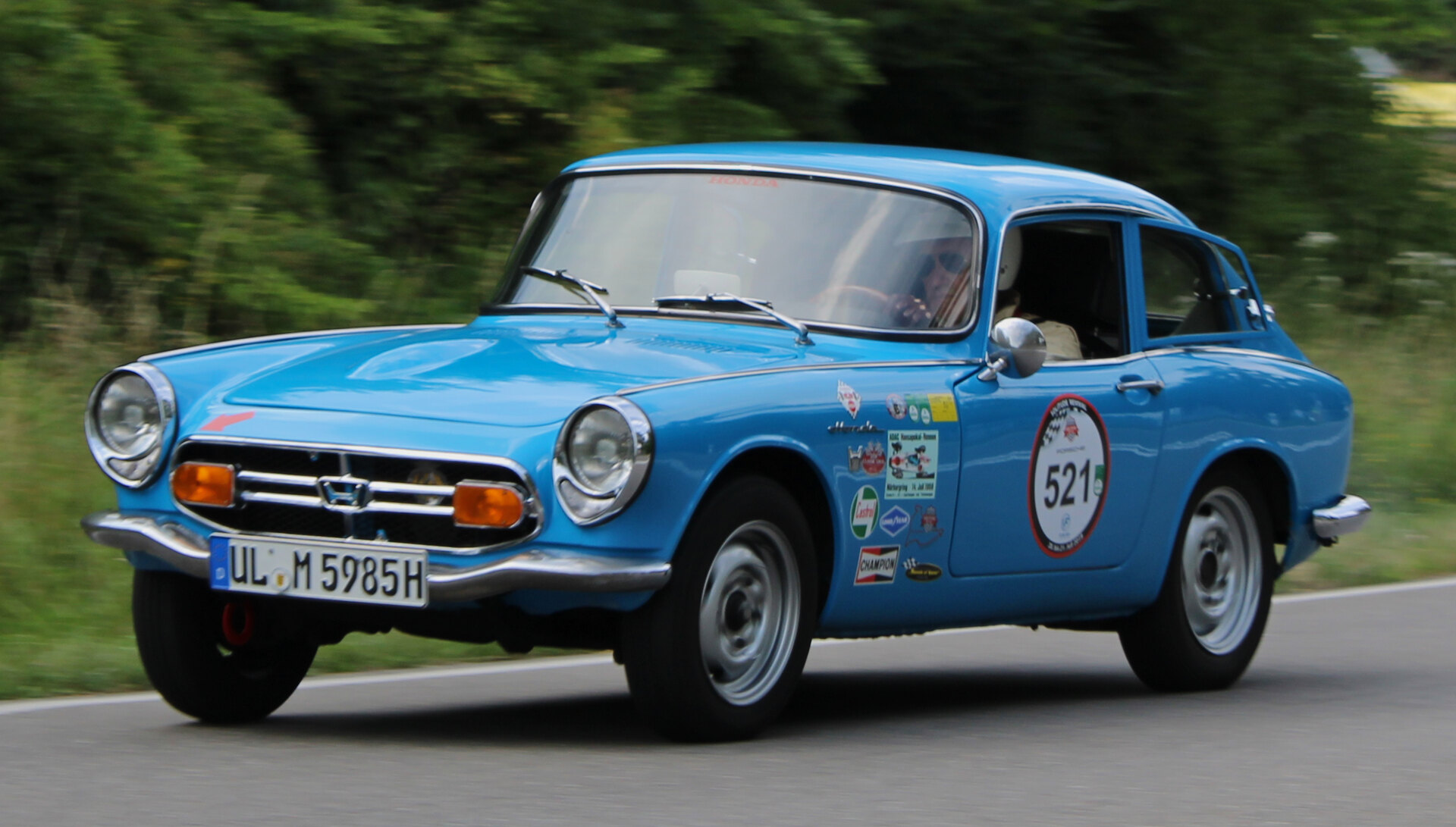
- S-series sports cars: The S500, S600 and S800 that marked Honda’s early entry into passenger-car production.
- Accord: The family-car line introduced as a hatchback in 1976 and later offered in several body styles.
- Prelude: A succession of front-wheel-drive sports coupes built from 1978.
- NSX: The mid-engined performance car first introduced in 1990.
- Insight: Honda’s dedicated petrol-electric hybrid line, launched in 1999.
Historical sources
- Honda — Do You Remember September 24, 1948? Company founding.
- Honda — Always Make Your Products Friendly. Powered-bicycle and motorcycle origins.
- Honda — The Road to Producing Automobiles. T360 and S500 launches and the S600/S800 succession.
- Honda — Announcing the Civic / 1972. Introduction and front-wheel-drive layout.
- Honda — The CVCC Engine. Combustion system, Japanese introduction and US 1975 model-year certification.
- Honda — Introducing the Accord / 1976. Hatchback launch and subsequent saloon.
- Honda — The NSX / 1990. Mid-engined layout, aluminium monocoque and Japanese launch.
- Honda — Insight launch announcement, September 6, 1999. Petrol-electric hybrid introduction.
- Honda — Prelude launch announcement, November 24, 1978. Coupe body and front-wheel-drive layout.
Browse related records
1 records
Honda Civic
Honda's Civic model, introduced in Japan in July 1972. Detailed coverage currently focuses on the first generation, 1972–1979, distinguishing the original 1.2-litre specification from later RS and CVCC developments.
Model
No matching records.