Honda Civic
Honda's Civic model, introduced in Japan in July 1972. Detailed coverage currently focuses on the first generation, 1972–1979, distinguishing the original 1.2-litre specification from later RS and CVCC developments.
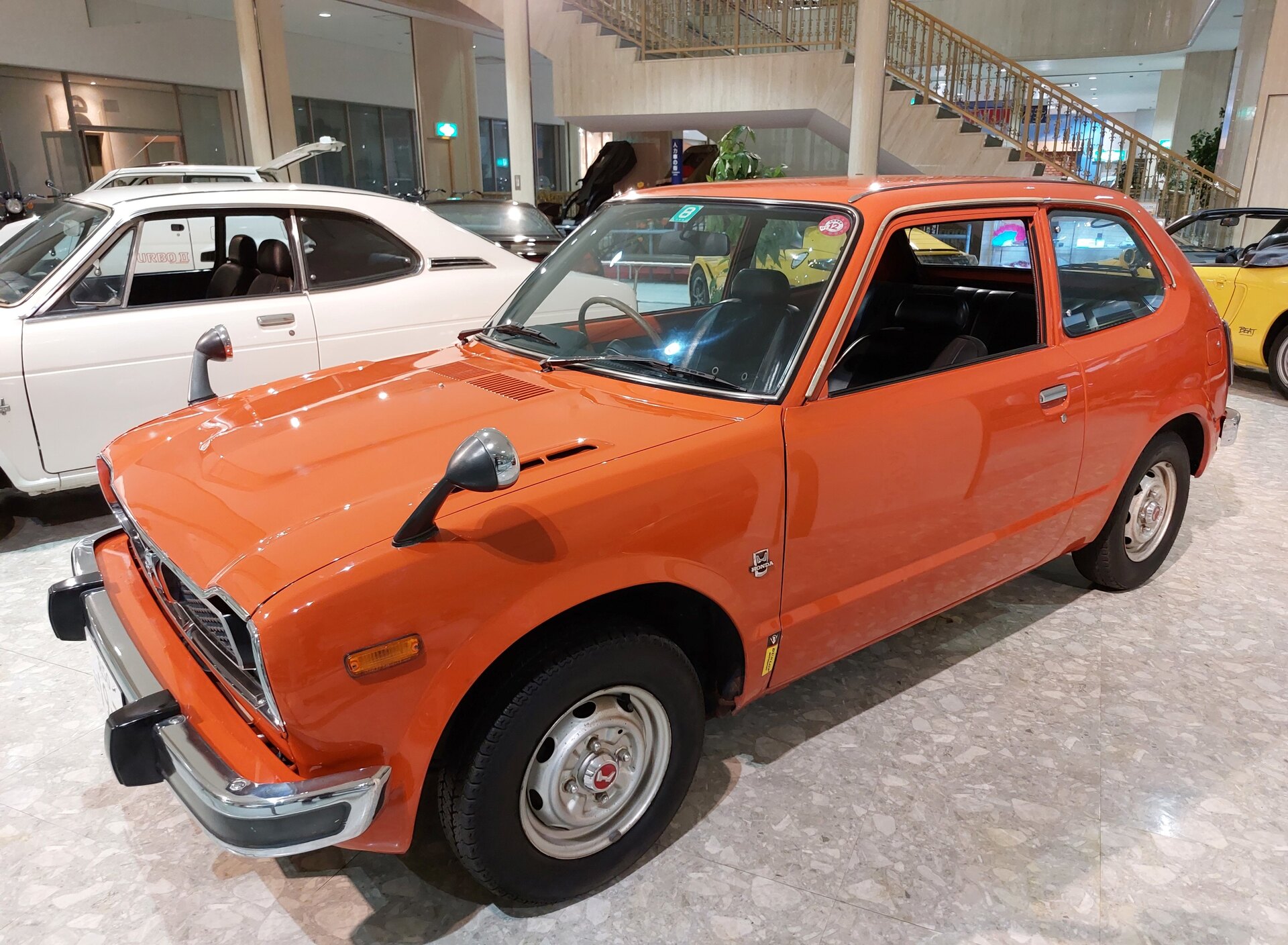
Overview
Honda introduced the Civic in Japan in July 1972 as a compact two-door car. The Japanese launch specification listed a water-cooled 1.2-litre inline-four (1,169 cc) and independent suspension at both ends. These specifications describe the original Japanese range, rather than every first-generation Civic. Honda’s launch announcement.
The engine was transversely mounted—positioned across the car—and front-wheel drive delivered power to the front wheels. Honda developed this arrangement to provide useful passenger space within compact dimensions. A three-door GL hatchback followed in Japan in September 1972. Honda’s development history.
Later additions broadened the range. The 1.5-litre four-door Civic CVCC launched in Japan in December 1973, separately from the original 1.2-litre specification. Honda’s CVCC history. Honda’s Japanese product archive records the Civic RS addition to the Civic 1200 series in October 1974. Honda’s Civic product archive.
CVCC stands for Compound Vortex Controlled Combustion. It uses a small auxiliary combustion chamber whose flame ignites the mixture in the main chamber, supporting lean combustion. Honda records that a CVCC engine tested in a Nissan Sunny passed EPA testing against the 1975 requirements of the U.S. Clean Air Act of 1970 in December 1972. This preceded certification of the production Civic CVCC: Honda dates that vehicle’s EPA certification to November 1974 for the 1975 model year. The CVCC application met those emissions requirements without a catalytic converter; this claim does not apply to every early Civic or its original 1.2-litre engine. Honda’s account of CVCC development and certification.
Sources
- Civic 50th anniversary history — Honda Motor Co.
- Honda Civic celebrates its 50th anniversary — Honda Motor Co.
- HONDA CIVIC 新発売 — Japanese launch announcement, 11 July 1972
- Announcing the Civic / 1972 — Honda development history
- The CVCC Engine — 75 Years of Honda History
- Civic product archive — Honda Japanese model announcements
Browse related records
1 records
Honda Civic first generation (1972–1979)
The first-generation Honda Civic (1972–1979) launched in Japan in July 1972 with a transverse engine and front-wheel drive. Its development included several body styles, the Japanese-market RS and CVCC engines introduced on different schedules in Japan and America.
Generation
No matching records.