Honda Civic first generation (1972–1979)
The first-generation Honda Civic (1972–1979) launched in Japan in July 1972 with a transverse engine and front-wheel drive. Its development included several body styles, the Japanese-market RS and CVCC engines introduced on different schedules in Japan and America.
Overview
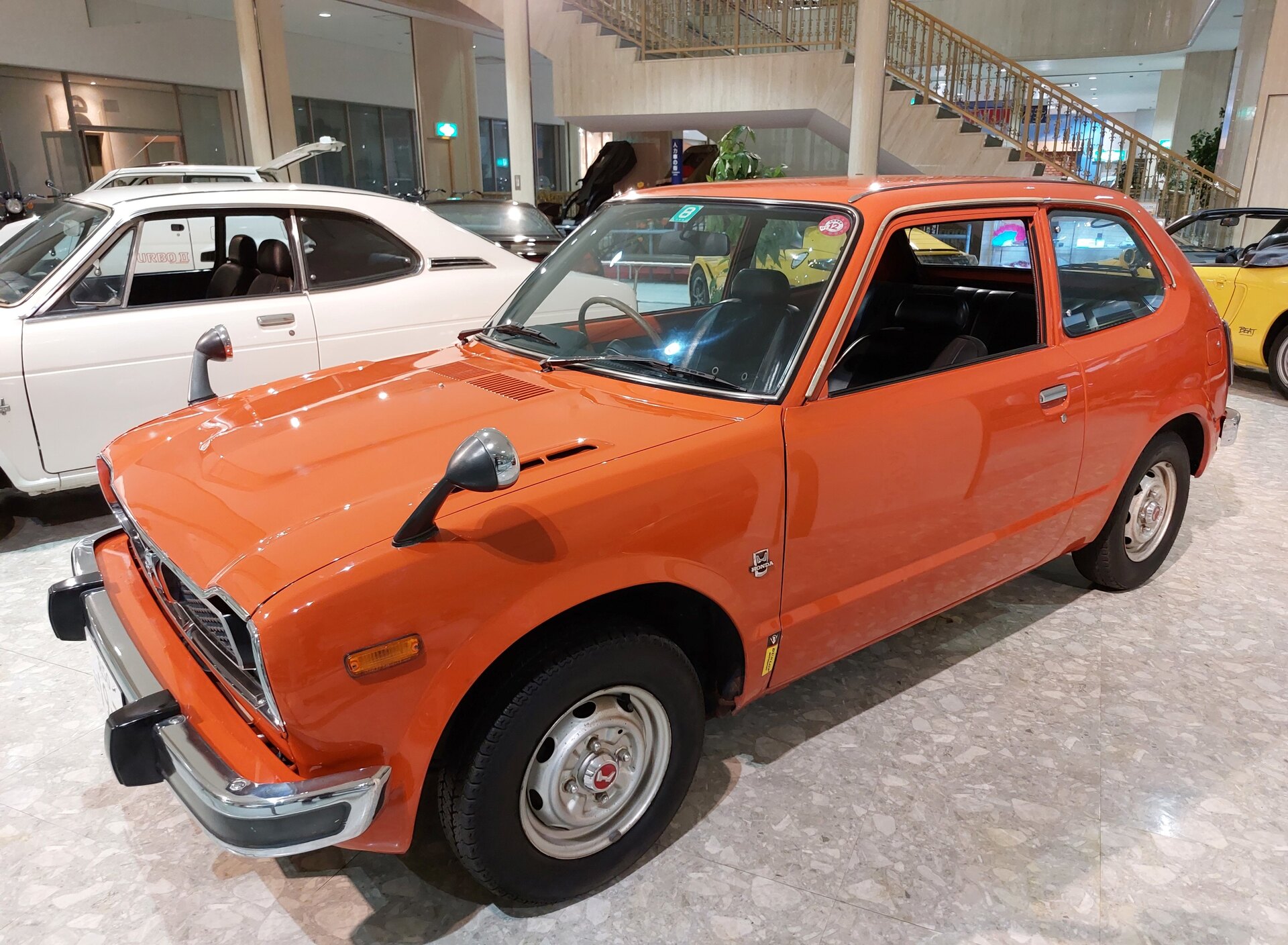
The first-generation Honda Civic, covered here for 1972–1979, launched in Japan in July 1972 as a two-door car. This page traces its body styles and the development of the sporting RS and CVCC versions. Honda’s Japanese sales chronology records the three-door hatchback following in September 1972. Honda’s Civic chronology.
A transversely mounted front engine drove the front wheels, helping keep the mechanical layout compact and preserve passenger space. Honda’s development history documents the original Civic’s adoption of independent strut suspension at both ends; this account should not be read as a specification for every later derivative. Honda’s Civic development history.
Engines and CVCC
Early cars used a water-cooled 1.2-litre inline-four; detailed engine specifications remain subject to verification against the relevant market and model-year documentation. Honda expanded the range during the generation. The Japanese-market RS arrived in 1974, with twin carburettors and a five-speed manual gearbox. These were RS features, not equipment shared by every Civic. Honda’s RS retrospective.
CVCC stands for Compound Vortex Controlled Combustion. Its auxiliary chamber sends a flame into the main chamber to support lean combustion. Honda’s history records the 1,500 cc four-door Civic CVCC’s Japanese introduction on 13 December 1973, separately from American exports beginning with the 1975 model year. The 1975-model Civic CVCC passed EPA certification in November 1974 for the applicable 1975 U.S. emissions requirements under the Clean Air Act of 1970, using combustion control without a catalytic converter. This does not establish CVCC availability or emissions compliance for every first-generation Civic, market or model year. Honda’s CVCC history.
Body styles and development
Two-door car. The original Japanese two-door Civic went on sale in July 1972. Its separate boot opening means luggage is loaded through a lid below the rear window, rather than by lifting the window with a hatch.
Three-door hatchback. Honda’s Japanese chronology lists the three-door version from September 1972. The third door is the rear hatch: it lifts with the rear window to give access to the luggage area. The previously listed folding rear seat remains subject to verification for individual versions.
Four-door car. Honda lists the Japanese 1500 four-door from December 1973. Four doors describe the passenger entrances; the designation does not imply a rear hatch. The four-door car should therefore be distinguished from a five-door hatchback.
Van or estate derivative. Honda’s chronology records the Japanese Civic VAN from November 1974. The existing description of a five-door van or estate derivative requires further market-specific documentation for its configurations and export names; the Japanese launch date should not be applied to every export version. Honda’s Japanese sales chronology.
Availability, lighting, bumpers, engines and equipment varied by market and model year. These body styles should not be assumed to have been offered together in every country. This page retains the generation’s stated 1972–1979 span.
Key milestones
- 1972 — Japan: The two-door Civic launches in July; the three-door hatchback follows in September.
- 1973 — Japan: The 1,500 cc four-door Civic CVCC goes on sale on 13 December.
- 1974 — Japan: The sporting RS joins the range in October; the Civic VAN follows in November. These Japanese dates are recorded in Honda’s sales chronology.
- 1975 model year — United States: Civic CVCC exports begin for this model year, following EPA certification in November 1974 against the applicable 1975 U.S. emissions requirements. This is distinct from the 1973 Japanese introduction. Honda’s CVCC history.
- 1979: The existing page identifies this as the transition to the second generation; precise replacement timing by market remains to be verified.
Sources
- Civic 50th anniversary history — Honda Motor Co.
- Honda Civic celebrates its 50th anniversary — Honda Motor Co.
- The CVCC Engine — 75 Years of Honda History
- Announcing the Civic / 1972 — Honda development history
- Hondaには「RS」がある — Honda RS retrospective (Japanese)
- CIVIC 1992.07 — Japanese Civic sales chronology