Jaguar F-Type
Jaguar's 2013–2024 two-seat sports-car line combined aluminium construction with convertible and coupé bodies, supercharged V6 and V8 engines and a later turbocharged four-cylinder.
Overview
The F-Type, marketed as F-TYPE, was Jaguar’s front-engined, two-seat sports-car line built at Castle Bromwich, Birmingham, England, from 2013 to 2024. It began as a fabric-roof convertible and gained a fixed-roof coupé. Jaguar Heritage records the first production example, a US-specification left-hand-drive convertible, as completed on 4 March 2013. The public unveiling had already taken place at the Paris Motor Show in September 2012: reveal year and production year are different milestones. Jaguar Daimler Heritage Trust’s first-production record.
This record covers the model line across its body styles and revisions. F-Type S, V8 S, R and SVR identify derivatives rather than successive generations; R-Dynamic is a trim designation. The coupé and convertible coexisted, and the later restyling belongs within the same model history. Jaguar connected the F-Type to its E-Type heritage, but the two are separate models, not successive series of one car. Jaguar’s final-production announcement.
Development and design
Ian Callum’s design team developed the F-Type from the C-X16 concept shown at Frankfurt in 2011. The production car featured deployable door handles and a retractable rear spoiler. Jaguar Heritage’s development summary.
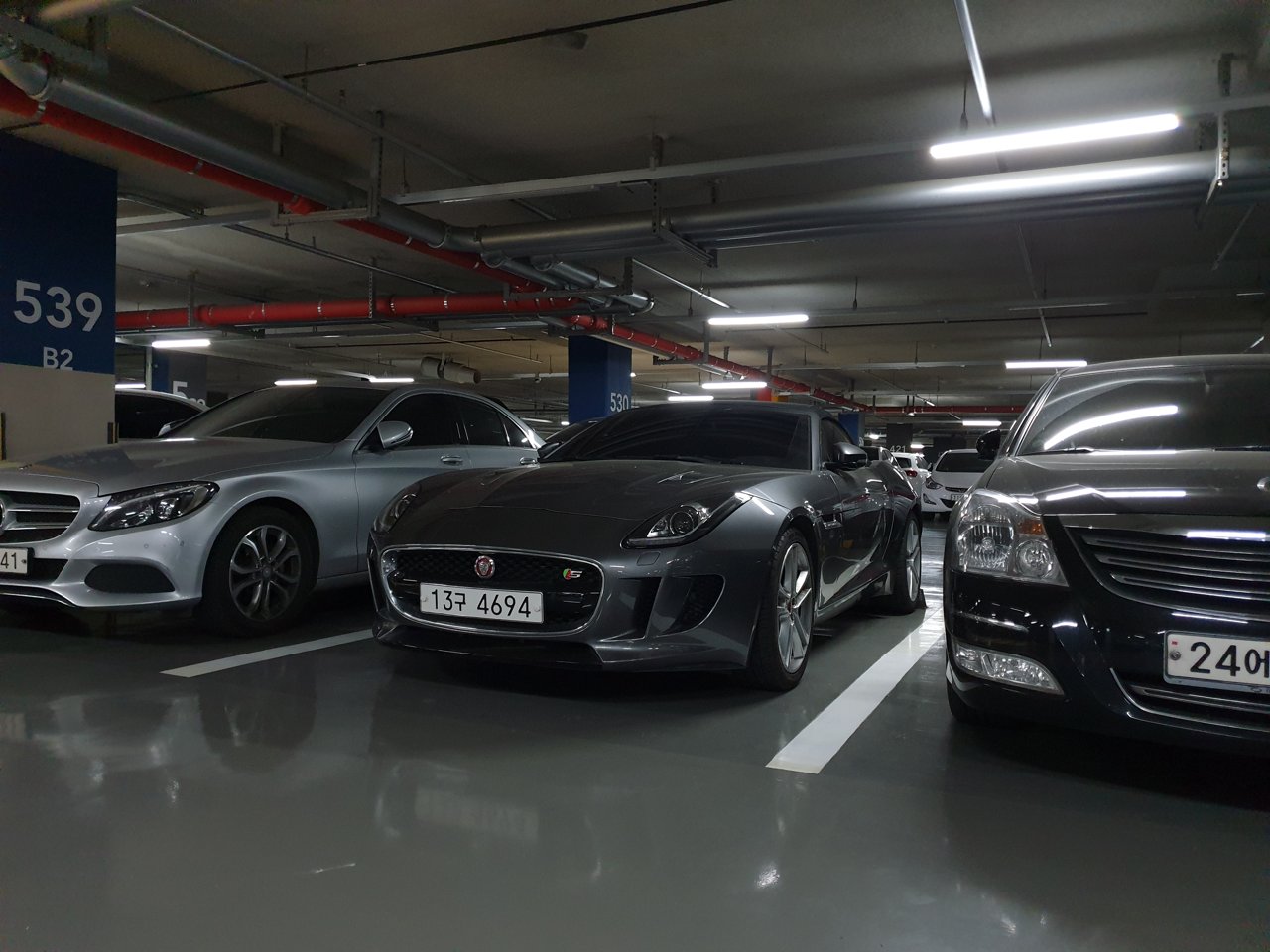
The coupé translated the C-X16’s long bonnet, rearward cabin and sweeping roof into a production body. Jaguar revealed it in November 2013, with US sales beginning in spring 2014 under the 2015 model-year designation. Its tailgate and enclosed luggage compartment gave it a different practical character from the convertible. The roof could be aluminium or panoramic glass; those were roof specifications, not separate generations. Jaguar’s US coupé launch documentation.
Structure and engineering
Jaguar used a bonded and riveted aluminium structure. For the coupé, a hydroformed structural beam around the door opening helped reconcile the low roof with body strength, while a large single-piece aluminium body-side pressing reduced visible joints. These construction methods supported the car’s shape as well as its chassis rigidity. Jaguar’s coupé engineering description.
The original coupé range drove the rear wheels through an eight-speed Quickshift automatic. The R added an electronically controlled active rear differential and torque vectoring by braking, alongside adaptive damping. Optional carbon-ceramic brakes were offered for the S and R coupés in the international launch specification. Such equipment should not be attributed to every F-Type: chassis hardware and its standard or optional status depended on derivative and market. International coupé launch specification.
Engines and transmissions
The opening convertible range used supercharged petrol engines: a 3.0-litre V6 in two states of tune and a 5.0-litre V8. Jaguar Heritage gives their outputs as 340 PS, 380 PS and 495 PS respectively, all coupled to the eight-speed automatic. These are the original range ratings, not specifications for every later car carrying the same capacity. First-production archive record.
The international coupé launch retained the 340 PS and 380 PS V6 choices but introduced the 550 PS F-Type R coupé above them. It therefore differed from the contemporary 495 PS V8 S convertible; the body styles did not initially share an identical flagship engine tune. Jaguar’s international launch release.
For the 2016 model year, on sale from spring 2015, Jaguar added all-wheel drive and a six-speed manual option. These were separate developments: the manual was restricted to rear-wheel-drive supercharged V6 versions. The same programme introduced electric power-assisted steering and an R convertible, replacing the V8 S. An announcement dated November 2014 thus describes cars sold in calendar 2015 as model-year 2016 vehicles. Jaguar’s 2016-model-year announcement.
In April 2017 Jaguar announced a 2.0-litre turbocharged Ingenium four-cylinder for the US 2018 model year, rated at 296 hp and paired with the eight-speed automatic. This was a separate engine family and induction system from the supercharged six- and eight-cylinder cars. That US range also included the all-wheel-drive, 575 hp V8 SVR. The four-cylinder broadened the entry point without replacing all the larger engines. Jaguar’s US 2018 range announcement.
Revisions and market differences
The 2018-model-year US update also brought revised bumpers and air intakes, full-LED headlights, slimmer seats and R-Dynamic trim. It was a range update rather than the arrival of another body generation. US update documentation.
A more substantial visual revision was announced on 2 December 2019, with slim horizontal headlights, a reshaped bonnet and a digital instrument display. Jaguar’s announcement listed different engine selections by territory:
| Market in the December 2019 announcement | Advertised engine selection |
|---|---|
| UK, EU and selected overseas markets | 300 PS four-cylinder; 450 PS and 575 PS V8s |
| North America | 300 PS four-cylinder; 380 PS V6; 575 PS V8 |
| China | 300 PS four-cylinder; 380 PS V6 |
These are the PS ratings and market groupings in the international release, not a conversion of North American hp figures. The V6 therefore did not disappear everywhere at the same time. The revised range used eight-speed automatics; the R combined the 575 PS V8 with all-wheel drive. Jaguar’s December 2019 specification and market notes.
Final production and legacy
Jaguar announced the F-Type 75 and R 75 in October 2022, with first deliveries from January 2023. Offered as coupés and convertibles, these commemorative V8 derivatives celebrated 75 years of Jaguar sports cars. The international release specified 450 PS and 575 PS respectively and also retained a four-cylinder entry in the wider range. The anniversary number identifies an edition, not a production year or new generation. Jaguar’s final-model-year update.
On 13 June 2024, Jaguar announced the final F-Type: a Giola Green 5.0-litre V8 convertible with a black roof and tan interior, destined for the Jaguar Heritage collection. The company reported 87,731 cars produced. That figure is Jaguar’s published model-line total, not a breakdown by body, engine or market. Its statement that cars would remain available into early 2025 concerned sales availability after manufacture ended; it does not extend the production period. The announcement date is retained here without assuming it was the final car’s precise assembly date. Jaguar’s end-of-production release.
The F-Type’s place in Jaguar history rests on its combination of a dedicated two-seat layout, aluminium construction and a wide progression of powertrains. Its open and closed bodies carried the marque’s sports-car identity through the 2010s and into the 2020s. In the catalogue it sits alongside the earlier E-Type and XK8 histories, while retaining its own model, derivative and production chronology.