Jaguar C-Type
Built from 1951 to 1953, Jaguar's purpose-built endurance racer combined XK120-derived mechanicals with a tubular chassis and aerodynamic aluminium body, winning Le Mans twice.
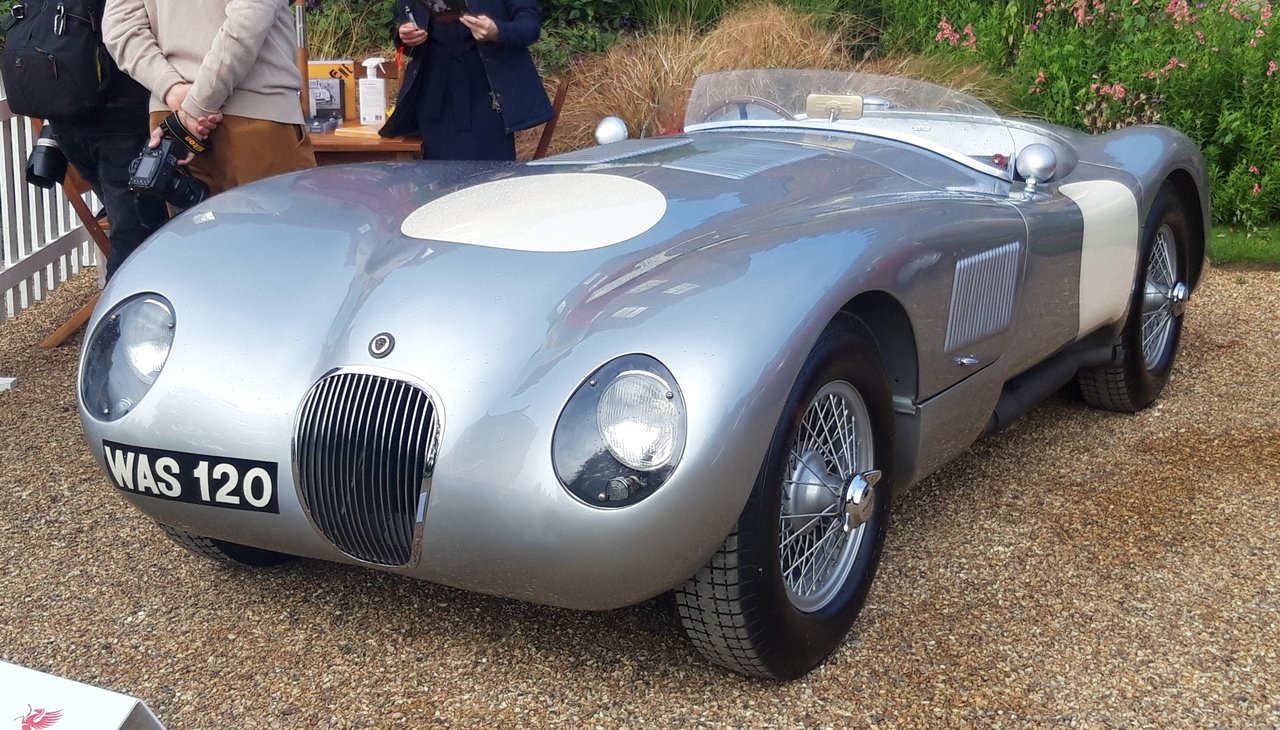
Overview
The C-Type was Jaguar’s purpose-built endurance-racing sports car of 1951–1953. Originally called XK120C, it grew from the XK120 competition programme but replaced the road car’s conventional chassis with a lightweight tubular structure. The “C” meant Competition. It belongs here as a separate Jaguar model, rather than an XK120 body style or trim. Jaguar Daimler Heritage Trust’s model register and structural history.
Its Le Mans victories in 1951 and 1953 established Jaguar as an endurance-racing manufacturer. Between those successes, the C-Type became a development vehicle for the disc brakes Jaguar and Dunlop were adapting to competition. The winning 1953 works specification was materially different from the cars supplied to private customers. Jaguar’s C-Type retrospective.
Development, structure and body
Experience with XK120s at Le Mans in 1950 encouraged Jaguar to pursue lower weight and better aerodynamics. William Heynes and competition manager Lofty England persuaded William Lyons to authorise a dedicated racer. Jaguar’s historical account credits Bob Knight with the triangulated tubular frame and Malcolm Sayer with the aerodynamic body. Jaguar’s history of the 1950s.
The resulting open two-seater wore aluminium panels over a steel spaceframe. Its structure and flowing shape served racing requirements; it did not reproduce the XK120’s roadster and coupé range. The central frame supported the occupants, while the competition layout reduced the weight associated with the road car’s separate conventional chassis. This was an important step towards Jaguar’s later racing structures, although the C-Type itself was not a monocoque. JDHT’s structural evolution account.
The XK120 supplied the starting point for the engine, transmission and front suspension. At the rear, the C-Type used transverse torsion bars. Development therefore combined familiar mechanical components with a substantially different chassis and body, rather than merely increasing the road car’s engine output. JDHT’s C-Type history.
Engine and competition specifications
The engine was the 3.4-litre XK straight-six. Induction and braking equipment distinguish the principal specifications:
| Specification | Induction and published output | Braking |
|---|---|---|
| Customer production cars, broadly following the 1951 racing specification | Twin SU carburettors; Jaguar’s detailed 2021 history quotes 200 bhp | Drum brakes |
| Developed 1953 Le Mans works cars | Three Weber 40DCO3 carburettors; the same history quotes 220 bhp | Dunlop disc brakes |
These are attributed historical ratings, not a universal output for every surviving car. Jaguar’s detailed Continuation research account differentiates the original customer and works specifications. The shorter JDHT collection history instead gives 260 bhp in its development narrative without establishing an equivalent configuration. That figure is not substituted for the specification-specific ratings above.
Disc-brake development was under way during the winter of 1951–1952. Stirling Moss won at Reims in a disc-braked C-Type in June 1952, before the better-known Le Mans success the following year. Improved resistance to brake fade mattered over repeated high-speed stops; the historical significance lies in proving the system in competition, rather than claiming that Jaguar invented the disc brake. Jaguar’s braking-development account.
Production and racing chronology
Original C-Types were hand-built in Coventry, England. Their production period overlapped Jaguar’s transfer from Foleshill to Browns Lane, completed in November 1952, with the Experimental department among the last to move. Coventry is therefore the appropriate model-level location; the factory history does not establish a chassis-by-chassis division between the two sites. JDHT’s Browns Lane history.
| Calendar period | Development or result |
|---|---|
| 1951 | First cars completed; Peter Walker and Peter Whitehead won Le Mans on the model’s debut. |
| 1952 | Modified Le Mans bodywork was followed by cooling problems and retirement of all three works entries. |
| 1953 | Works cars returned to the earlier body shape in thinner aluminium, with disc brakes; Tony Rolt and Duncan Hamilton led a first, second and fourth finish. |
These are racing-season milestones, not market model years or three separate generations. Jaguar’s period history. The archive’s 1951–1953 production range is separate from the subsequent racing careers of individual cars. JDHT model register.
Jaguar records 53 original cars, with 43 sold to private owners. The limited series was offered to customers, not reserved entirely for the factory team. Jaguar’s production account.
Customer cars and identification
Build year alone does not identify works specification. XKC045, completed on 19 March 1953 and dispatched to Italian racer Mario Tadini on 10 April, retained SU carburettors and drum brakes. Its export destination did not make it a separate Italian-market variant, and its 1953 build did not make it a disc-braked works car. JDHT’s chassis-specific record.
For an individual C-Type, chassis identity, build and dispatch dates, original equipment and subsequent racing modifications should be recorded separately. A later registration, restored body or changed carburettors cannot by itself establish a new production year or factory specification.
Successors and legacy
The D-Type followed in 1954, adopting a central body tub in place of the C-Type’s complete spaceframe. It was a successor competition model, not a C-Type facelift. That structural development subsequently contributed to the E-Type road car. JDHT’s model chronology and engineering lineage.
Jaguar Classic’s 2021 Continuation programme recreated the developed 1953 works configuration. Those newly manufactured cars belong to a separate programme and are excluded from the original 1951–1953 period and 53-car total. Jaguar’s Continuation announcement and historical specification.
The C-Type’s lasting contribution was the combination of aerodynamic body design, reduced structural weight and sustained braking performance in a successful endurance racer. It connected Jaguar’s XK road-car engineering with a competition lineage whose influence extended beyond its short original production run.