Audi Quattro
The turbocharged five-cylinder coupé built from 1980 to 1991 that made permanent all-wheel drive central to Audi's road-car and rally identity.
Overview
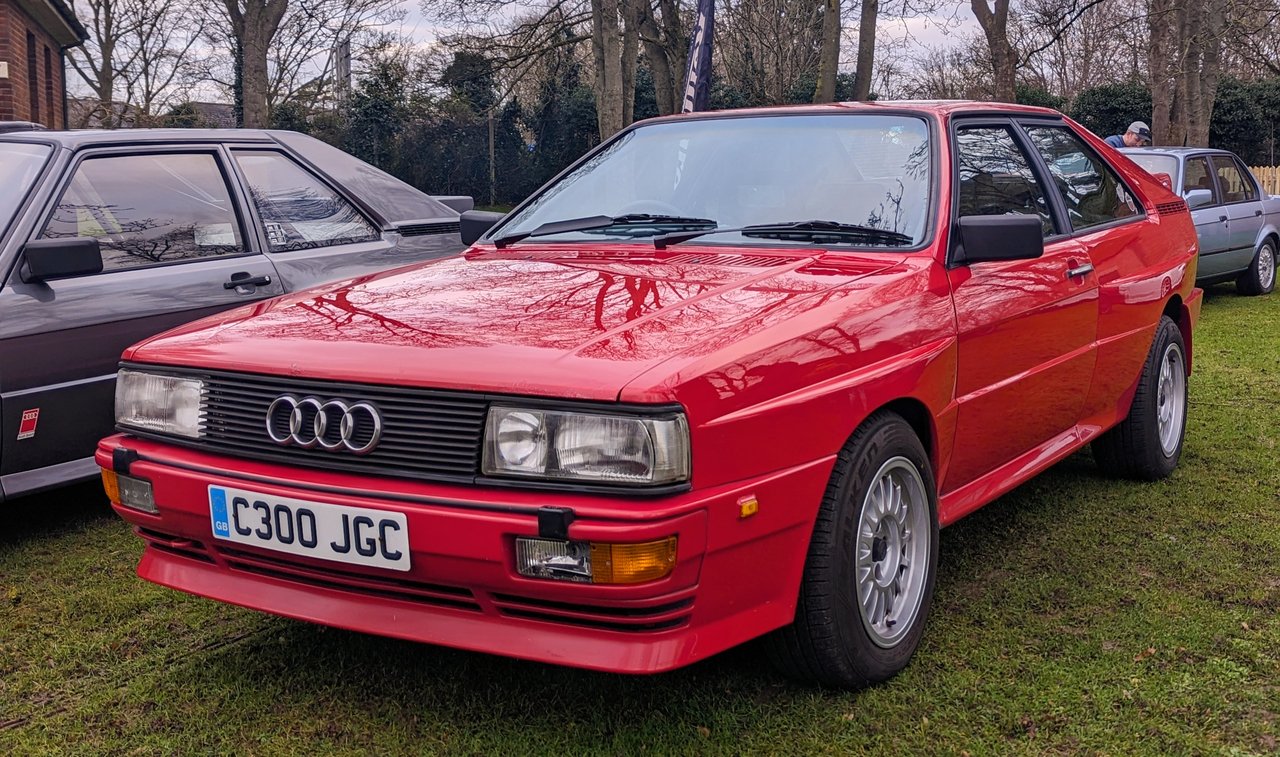
The Audi quattro was a turbocharged five-cylinder sports coupé produced from 1980 to 1991. Often called the Ur-quattro, meaning the original quattro, it established permanent all-wheel drive as a defining feature of Audi. This record covers that model, rather than every Audi sold with a quattro drivetrain. Audi’s historical model catalogue identifies the coupé as a distinct 1980–1991 line. Model history — Audi.
Development and design
Winter testing in Scandinavia in 1976–1977 provided the impetus: the Volkswagen Iltis military vehicle demonstrated how effective four-wheel drive could be on snow. Audi began developing a permanent-drive passenger car in February 1977 under project manager Walter Treser. The resulting quattro appeared at the Geneva Motor Show in March 1980. Development chronology — Audi.
The body was based on the B2 Audi Coupé, itself derived from the Audi 80. Flared wheel arches, fuller bumpers and sills, and a larger rear spoiler distinguished the quattro. Its original turbocharged engine came from the Audi 200 5T lineage, with intercooling helping raise output to 147 kW (200 PS). The combination gave familiar saloon-derived engineering a much more specialised sporting role. Body and engine origins — Audi archive.
The regular production body was a fixed-roof coupé. The much shorter Sport quattro was a separate homologation derivative, not a facelift of the standard car; its proportions and engine specification should not be used to describe an ordinary Ur-quattro. Body versions — Motor Klassik.
Permanent all-wheel drive
The original transmission used a hollow shaft to package the drive to both axles compactly. The centre differential sent drive rearwards through the propeller shaft and forwards through an output shaft running inside the hollow shaft. This avoided a bulky separate transfer case and an additional external shaft to the front axle.
With the centre differential unlocked, the nominal torque split was equal between front and rear. The differential allowed the axles to turn at different speeds in corners; the driver could lock it and the rear differential when traction required it. Audi replaced the initial cable controls with pneumatic operation in 1981. ABS arrived during the model’s development, but could not operate with the differentials locked. Original quattro drivetrain — Audi Technology Portal.
Later cars used a self-locking Torsen centre differential. Published dates differ: Audi’s retrospective places its introduction in 1986, while the Quattro Owners Club’s model chronology lists it with the September 1987 MB-engine revision. These accounts are retained separately rather than converted into a single universal model-year change. Audi retrospective, Owners Club chronology.
Engines and production development
The familiar European engine sequence comprised three main stages. All used turbocharged petrol inline-fives; the road car had a five-speed manual gearbox. The power figures below are metric PS, not US-market SAE horsepower.
| Main European version | Engine | Quoted power | Place in the sequence |
|---|---|---|---|
| Original 10-valve | 2,144 cc | 200 PS | Launch specification in 1980 |
| Enlarged 10-valve | 2,226 cc | 200 PS | Late-1980s development |
| 20-valve | 2,226 cc | 220 PS | Introduced in 1989, retained to the end of production |
The additional valves distinguished the final engine from the earlier ten-valve units; they were an engineering revision within the original model line. These specifications do not describe the more powerful Sport quattro or competition engines. Engine development and transmission — Motor Klassik.
The Owners Club identifies the principal engine codes as WR, MB and RR respectively, dating the MB introduction to September 1987 and the RR to October 1989. Its chronology also records a September 1984 exterior revision with sloping headlamps and grille, body-coloured rear spoiler and darker rear lamps. These changes are useful identification points, but do not constitute new model generations. Model revisions — Quattro Owners Club.
Markets and production
Export specifications and steering positions evolved during the run. Early cars were left-hand drive; the Owners Club dates factory right-hand-drive availability to October 1982. Its chronology is particularly useful for British-market identification, but equipment dates should not automatically be transferred to every export market. Calendar introduction dates also differ from the model year or first registration of an individual car. Steering and equipment chronology — Quattro Owners Club.
The original quattro was built at Audi’s Ingolstadt factory in Germany. Volkswagen Group’s TPS publication describes individual hand assembly and testing there. Audi records 11,452 original quattros across 1980–1991. That total belongs to this model, not to all quattro-badged Audis. Manufacture — TPS Insider, issue 5, pages 8–9, Production total — Audi.
The production endpoint is given here as 1991. Audi Japan’s historical record gives May 1991, whereas the Owners Club gives 1 March; this page does not assign an undisputed final build day. Production period — Audi Japan, Owners Club account.
Rallying and legacy
Audi entered the World Rally Championship with the quattro in 1981. Across the original car and subsequent Sport quattro competition programme, Audi Japan records 23 WRC event victories and four world titles before the factory withdrawal in 1986. Those results belong to a developing family of competition cars, rather than an unchanged road-car specification. Competition history — Audi Japan.
The quattro’s importance extended beyond its modest production volume. It helped make all-wheel drive desirable for road performance and gave Audi a technical identity that spread into other model lines. Later cars such as the V8 and TT carried the quattro name in different vehicle concepts; they were not later generations of this coupé. Historical significance — Audi.