Volvo PV444 and PV544
Volvo's compact post-war saloon evolved from the PV444 into the PV544, with a one-piece windscreen, larger rear window, five-seat accommodation and, later, the B18 engine.
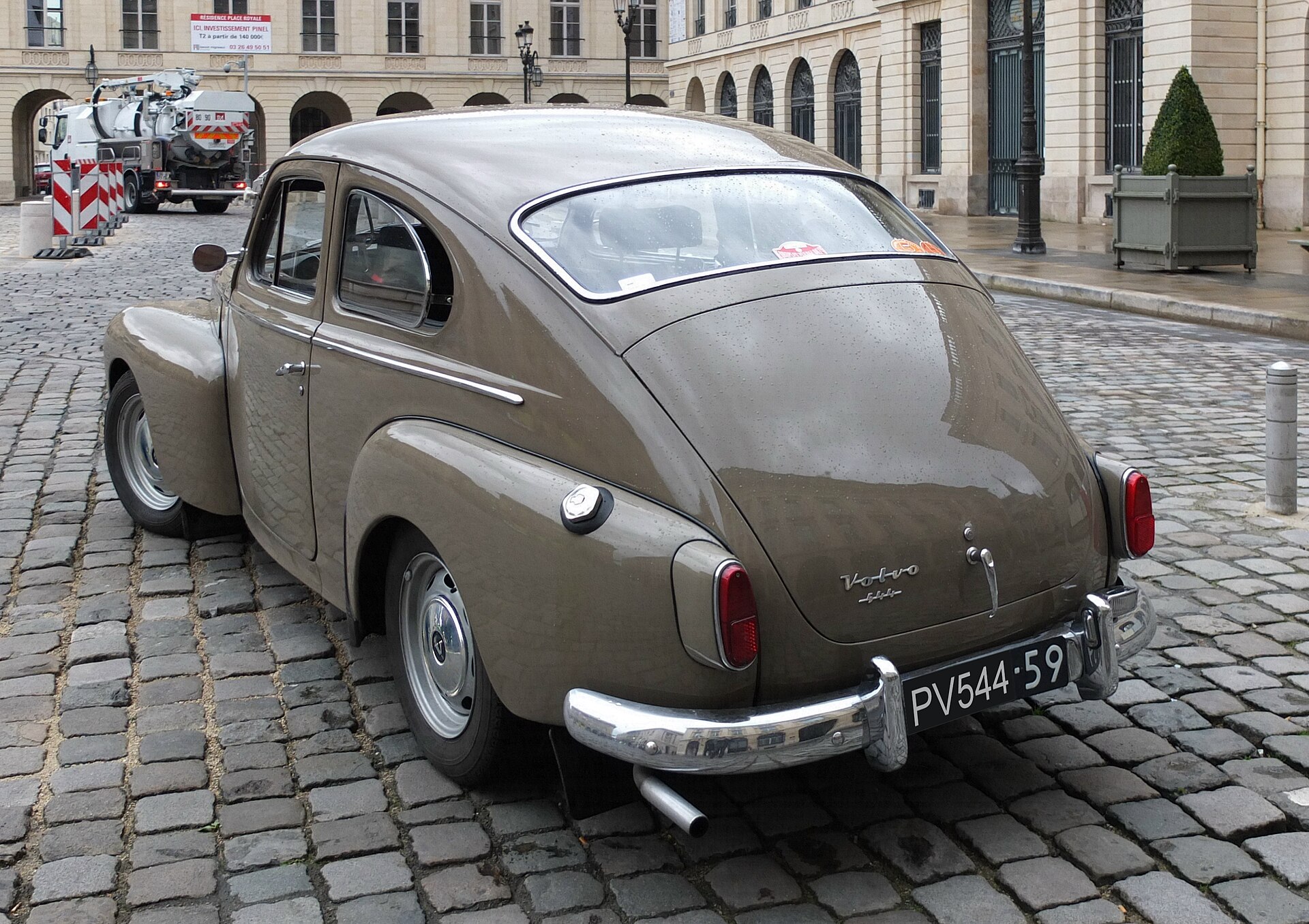
Overview
Volvo presented the PV444 in Stockholm in September 1944 as a small car for the post-war world. Its price of 4,800 Swedish kronor deliberately matched that of Volvo’s first car in 1927. Although American cars influenced its rounded fastback styling, its construction was an important departure for Volvo: the PV444 was the company’s first production car with a unitary body instead of a separate chassis, and it also used a laminated windscreen.
Series production began in 1947. Volvo initially planned to build 8,000, but demand turned the PV into the model that put the company’s passenger-car production onto a much larger footing. The PV444 and its 1958 successor, the PV544, shared the same basic two-door body and rear-wheel-drive layout. Continuous mechanical development, stronger engines and international exports kept that body competitive until 1965.
PV444, 1947–1958
The PV444 was a compact four-seat saloon with a split windscreen and a three-speed, floor-shift manual gearbox. Early cars used a 1,414 cc overhead-valve four-cylinder engine; later series adopted a 1,583 cc unit, with output varying by specification. The all-steel unitary shell helped distinguish it technically from Volvo’s earlier cars, while hydraulic drum brakes were fitted at all four wheels.
Volvo revised the model through eight principal 444 series rather than replacing it quickly. Export markets became increasingly important, including North America, where higher-output versions helped build an image around durability and performance. In all, Volvo’s model archive records 196,005 PV444s produced.
PV544, 1958–1965
The PV544 was unveiled on 25 August 1958, according to Volvo’s anniversary history. Its most obvious change was a large one-piece windscreen in place of the PV444’s divided glass; a larger rear window improved visibility as well. Inside, Volvo installed a new dashboard with a padded upper section and reshaped the rear seat to accommodate a fifth occupant—the source of the first digit in the 544 designation. The glazing, dashboard and seating changes are described in Volvo’s model overview.
The new model offered more than one engine specification and, for the first time in the PV line, an available four-speed manual gearbox. The four-speed was not universal: Volvo’s model overview lists both three- and four-speed transmissions.
Under 1959, Volvo’s historical review credits the PV544 and Amazon with making three-point front safety belts standard and describes Volvo as the first manufacturer to do so. This is a calendar-year historical claim. The passage does not establish the precise model-year or market coverage of standard fitment, and the release cautions that specifications could differ by country; it should not be read as confirmation for every worldwide specification.
The later 1,778 cc B18 engine brought additional power. Volvo’s model overview dates the 1,778 cc engine to 1961, but does not distinguish a calendar-year introduction from model-year availability or establish its rollout by market. It lists Special I, Special II and Sport variants without a complete market or model-year breakdown. More specifically, Volvo’s anniversary history documents Special and Sport versions in Sweden for the final series, presented in August 1965 as 1966 models. That evidence does not establish identical availability elsewhere or throughout production.
The PV544 remained recognisably related to the 1944 design, but its solid construction and steady technical development also made it effective in competition. Volvo’s anniversary history records a PV544 victory in the 1965 East African Safari Rally. It also identifies a black Sport leaving Lundby on 20 October 1965 as the last PV and the 440,000th car in the combined PV444/PV544 run. Source: Volvo’s anniversary history.
Production totals: an unresolved discrepancy
Volvo’s model overview records 196,005 PV444s and 243,990 PV544s. Adding those figures gives 439,995, five fewer than the 440,000th-car milestone in Volvo’s anniversary history. The supplied evidence does not reconcile the discrepancy. Both attributed totals and the milestone are retained here; they should not be treated as a consistent exact accounting.
PV444 versus PV544 at a glance
- PV444: production 1947–1958; split windscreen; four seats; three-speed manual transmission.
- PV544: production 1958–1965; one-piece windscreen; five seats; three-speed manual transmission or an available four-speed.
These production periods describe when the cars were built, rather than every market’s model-year labels. Both used unitary construction: the body itself formed the supporting structure, without a separate chassis. The main glazing, seating and transmission differences are described in Volvo’s model overview.