Volvo P1800
The P1800 family developed from the British-built P1800 through the Swedish-assembled 1800S and fuel-injected 1800E coupés to the 1800ES sports estate. Its history includes a two-stage manufacturing transfer, engine changes and overlapping coupé and estate production.
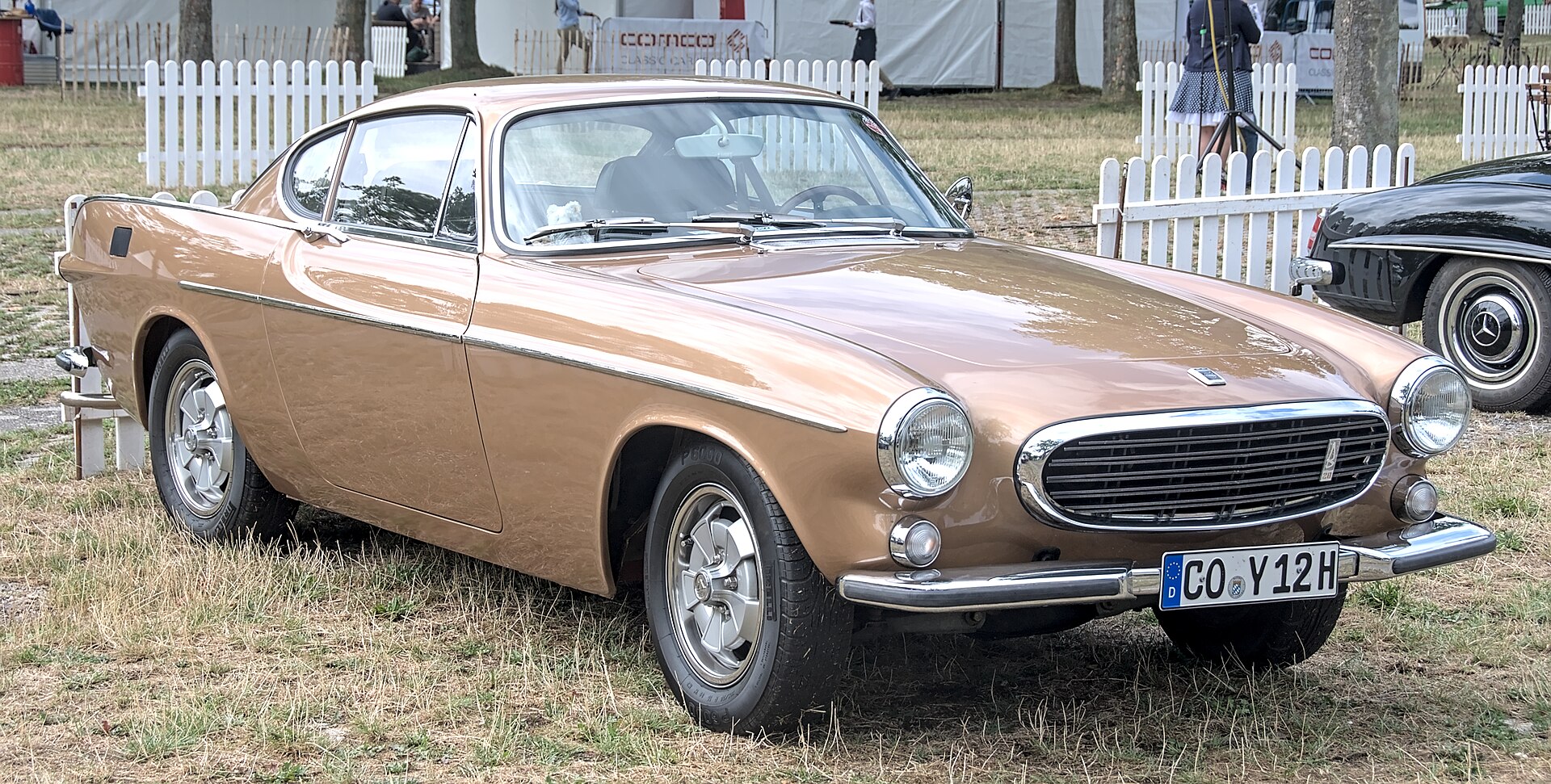
Overview
Volvo presented the P1800 in 1960 and began production in 1961. Pelle Petterson created its Italian-influenced shape while working at the Frua design studio, giving Volvo a sleek image-building sports car based on a shortened version of the 121/122S platform.
Because Volvo lacked production capacity, early bodies were pressed in Scotland and final assembly took place at Jensen Motors in West Bromwich, England. Assembly moved to Volvo’s Lundby factory in Gothenburg in spring 1963. The car initially carried the transitional P1800 S designation, becoming 1800 S later that year; S signifies Sweden. Body pressings continued to come from Scotland until their transfer to Volvo’s Olofström press shop in 1969, in connection with the 1800E. Assembly and body production therefore moved to Sweden in separate stages. Volvo’s P1800 history.
The original 1.8-litre B18 inline-four gave way to a 2.0-litre B20, followed by fuel injection on the 1800E. The model also became widely recognisable through its appearance as Simon Templar’s car in the television series The Saint.
Versions
P1800 and 1800S (1961–1969)
The British-built P1800 established the model’s two-door coupé form. Swedish assembly distinguished the 1800S from 1963, while progressive engine changes raised output. The B20 enlarged capacity to 2.0 litres for the 1969 model year; its introduction took place in autumn 1968.
1800E (1970–1972 model years)
The fuel-injected version was introduced in 1969, ahead of the 1970 model year shown in this heading. The 1800E introduced electronic fuel injection and four-wheel disc brakes. Its body was also produced in Sweden, following the transfer of body pressings to Olofström in 1969 and completing the manufacturing move from the original British suppliers.
1800ES (1972–1973 model years)
Unveiled in autumn 1971, the 1800ES sports estate combined an extended roof with a large frameless glass tailgate. Volvo built it for the 1972 and 1973 model years. E coupé and ES estate production overlapped in 1972; only the ES continued in 1973, when 1800 production ended. These introduction dates and the production overlap are documented in Volvo’s P1800 overview.
Volvo’s manufacturer records conflict on production totals. Its P1800 overview reports 39,414 cars including 5,078 ES examples. However, the dedicated P1800/1800 coupé heritage page lists 39,414 coupés, while the separate 1800ES heritage page lists 8,078 ES cars. These records disagree about both the scope of the 39,414 figure and the ES count; the discrepancy remains unresolved here, so the overview’s combined total should not be treated as settled.