Volvo Amazon
Presented as a prototype in 1956, the Volvo Amazon entered production in 1957; Volvo's model overview dates final production to 2 July 1970. Its saloon and estate bodies had different production spans, and front-seat three-point safety belts were introduced as standard equipment in 1959.
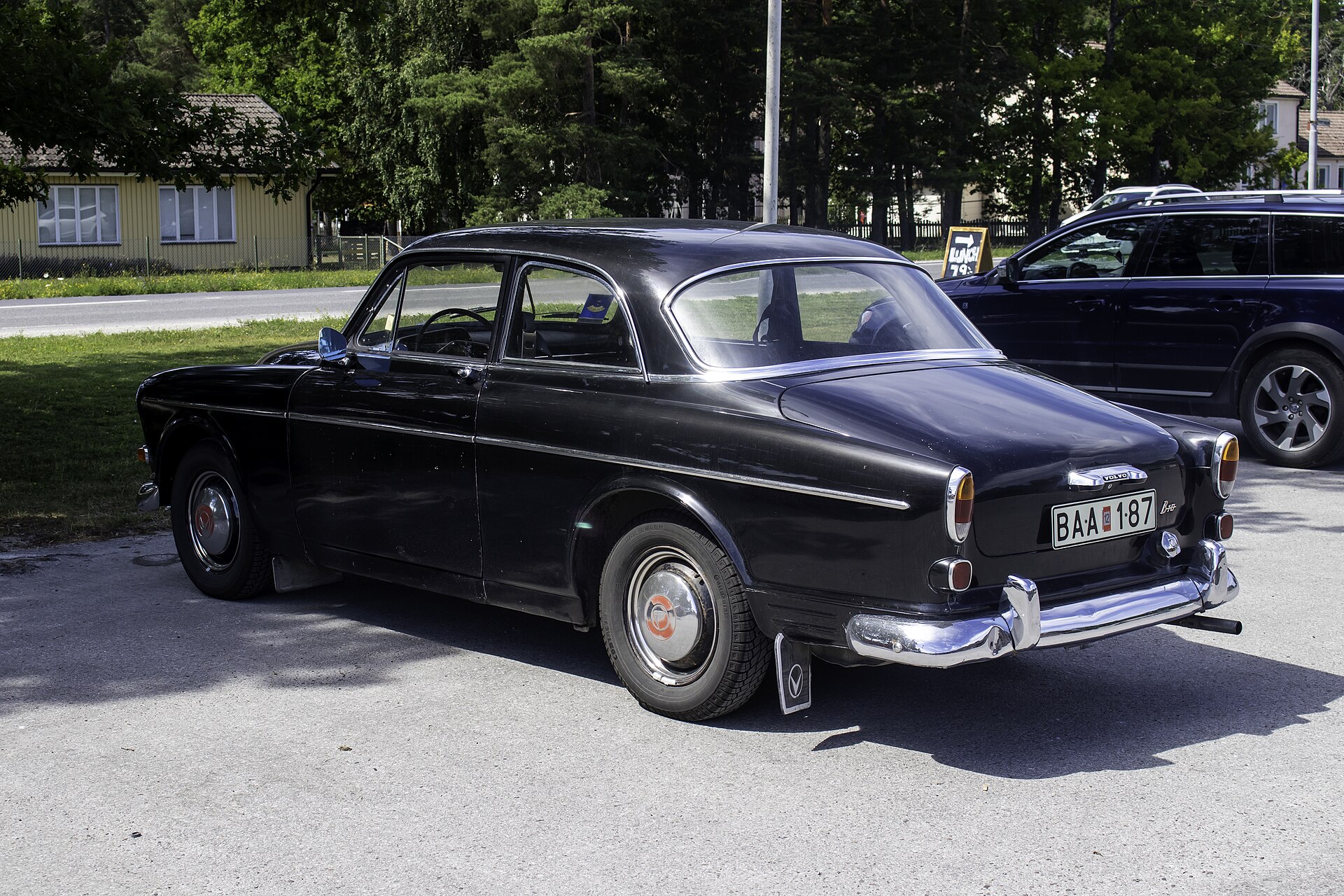
Overview
Volvo presented the Amazon prototype in 1956 and began production in 1957. Its model overview dates final production to 2 July 1970. These are calendar dates; references such as the B20’s introduction for the 1969 model year describe model years. The individual body families had different production spans. Volvo model overview.
Known as the Amazon in the Nordic countries and generally as the 121 or more powerful 122S elsewhere, it introduced Volvo’s first ponton body: the wings, bonnet and passenger compartment formed a unified shape rather than the separate-wing outline of the PV444.
The Amazon became an important export model. Approximately 60 per cent of production was sold outside Sweden, and in 1963 it became the first Volvo assembled outside the country when the company opened a plant in Halifax, Canada. Assembly later expanded to Durban in South Africa and Ghent in Belgium. Volvo’s anniversary history.
In 1959, Volvo introduced Nils Bohlin’s three-point safety belt as standard equipment in the front seats of the Amazon and PV544. Volvo identifies this as the first standard fitment of the design by a car manufacturer. The cited account does not specify which markets were covered, so this milestone should not be read as confirmation of identical equipment in every market. Volvo’s account of Bohlin’s invention.
Body styles and variants
P120, P130 and P220 identify body families. The 121, 122S and 123GT designations describe versions within the Amazon range, rather than interchangeable names for those body families. Amazon was the Nordic-market name; elsewhere, 121 and 122S were generally used, with 122S identifying a more powerful version.
- P120 four-door saloon (1957–1966): The original four-door model began with Volvo’s 1.6-litre B16 inline-four. The higher-output 122S supplemented the 121, and a 1.8-litre B18 engine arrived in 1961. Front disc brakes were initially fitted to S versions and became standard across the range in 1964.
- P130 two-door saloon (1961–1970): Introduced in September 1961, particularly for markets where two-door family cars were popular. Its lighter body also formed the basis of the 123GT, launched for the 1967 model year with the 1800S sports car’s engine, four-speed gearbox with overdrive, tachometer and additional lamps.
- P220 estate (1962–1969): The five-door estate completed the range at the 1962 Stockholm Motor Show. Its horizontally split tailgate had an upper section that lifted and a lower section that folded down, combining a family-car cabin with a practical rectangular load area.
Sources: Volvo model overview and Volvo’s anniversary history.
Engines and later production
The overhead-valve four-cylinder range grew from the 1.6-litre B16 to the 1.8-litre B18 and, for the 1969 model year, the 2.0-litre B20. Volvo’s model overview lists the 2.0-litre engine under 1968, while its anniversary history explicitly identifies the B20 with the 1969 models; calendar-year and model-year references should therefore be distinguished. Three- and four-speed manual gearboxes, optional overdrive and a three-speed automatic were offered across different models and markets. Volvo model overview; Volvo’s anniversary history.
The four-door Amazon gave way to the Volvo 144 after 1966, but the two-door and estate continued alongside the newer car. Estate production ended in 1969. Volvo’s model overview dates the end of two-door production to 2 July 1970; its anniversary history instead dates the final Amazon at Torslanda to 3 July 1970. The sources also give different exact production totals, so the rounded total of more than 667,000 examples across the three body families is retained. Volvo model overview; Volvo’s anniversary history.