Volvo 240
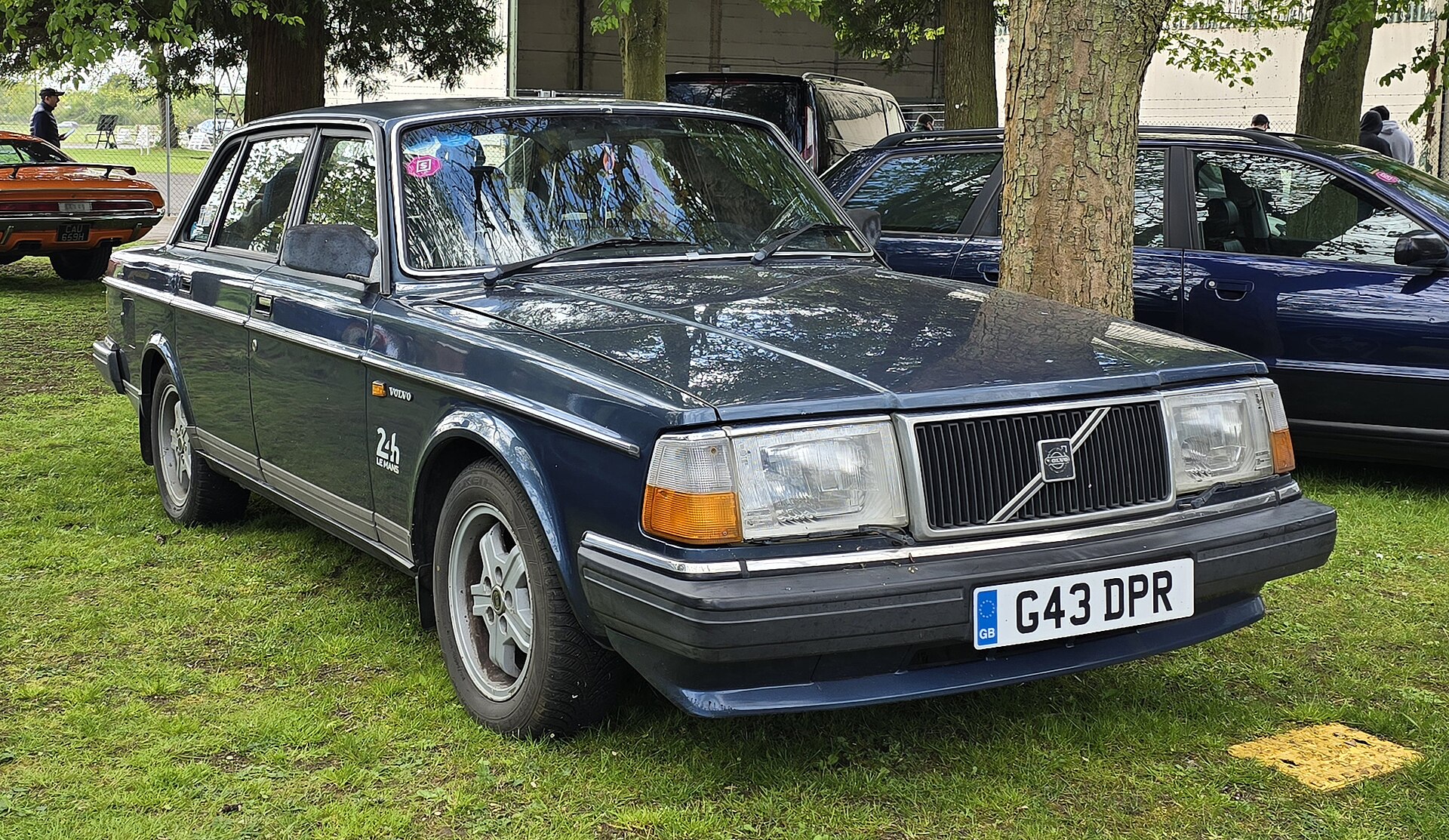
Produced from 1974 to 1993, the Volvo 240 range included the 242 two-door saloon, 244 four-door saloon and 245 estate. From the 1983 model year, all three used 240 rear badges.
Overview
The Volvo 240 was produced from 1974 to 1993, with three body styles: the 242 two-door saloon, 244 four-door saloon and 245 five-door estate. Introduced in August 1974, it developed the 140’s design with VESC safety-concept influences, substantial bumpers and MacPherson-strut front suspension. Performance versions included the late-1970s 242 GT and the 1980s 240 Turbo; these were specific versions within the wider range. Volvo 200 series overview.
A new overhead-camshaft four-cylinder engine family arrived at launch, but basic versions initially retained the earlier B20 engine. Four-wheel disc brakes appear in Volvo’s model specifications. Engine and equipment availability should be read in the context of the particular market and model year. Volvo 244 model history.
Volvo reports that NHTSA crash-test results for the 244 informed subsequent US safety legislation; the listed accounts do not specify the year of its selection as a benchmark. Volvo introduced its Lambda sensor in 1976, regulating the fuel/air mixture for catalytic exhaust treatment. Its retrospective discusses equipped cars against California’s 1977 emissions limits, without establishing availability across every 240 version or market. It also records a European Touring Car Championship victory for the 240, a competition achievement rather than a specification of ordinary road cars. Volvo’s production retrospective.
Body styles
242 two-door saloon (1974–1984)
The two-door 242 shared the 240’s passenger compartment and mechanical layout but used longer front doors. It provided the basis for the 242 GT and prominent competition versions.
244 four-door saloon and 245 estate (1974–1993)
The four-door 244 was the range’s highest-volume body, while the five-door 245 paired a long, near-vertical cargo area with the same rear-wheel-drive platform.
Body designations and badges
From the 1983 model year, Volvo replaced the 242, 244 and 245 rear badges with 240 across all three body styles. The earlier designations remain useful for identifying the bodies; the badge change itself did not signify a major redesign. Volvo 244 model history.
Production ending and totals
Volvo 240 production continued until 5 May 1993. Volvo’s retrospective gives a combined 240/260 total of 2,862,573 cars, including 177,402 related six-cylinder 260s. Subtracting the 260 total gives 2,685,171 Volvo 240s; the 260s are additional to that figure. End of the line for the Volvo 240.