Volkswagen Type 2
An introduction to the Volkswagen Type 2 commercial-vehicle family, its origins and early generations, with brief T3 and T4 transition context.
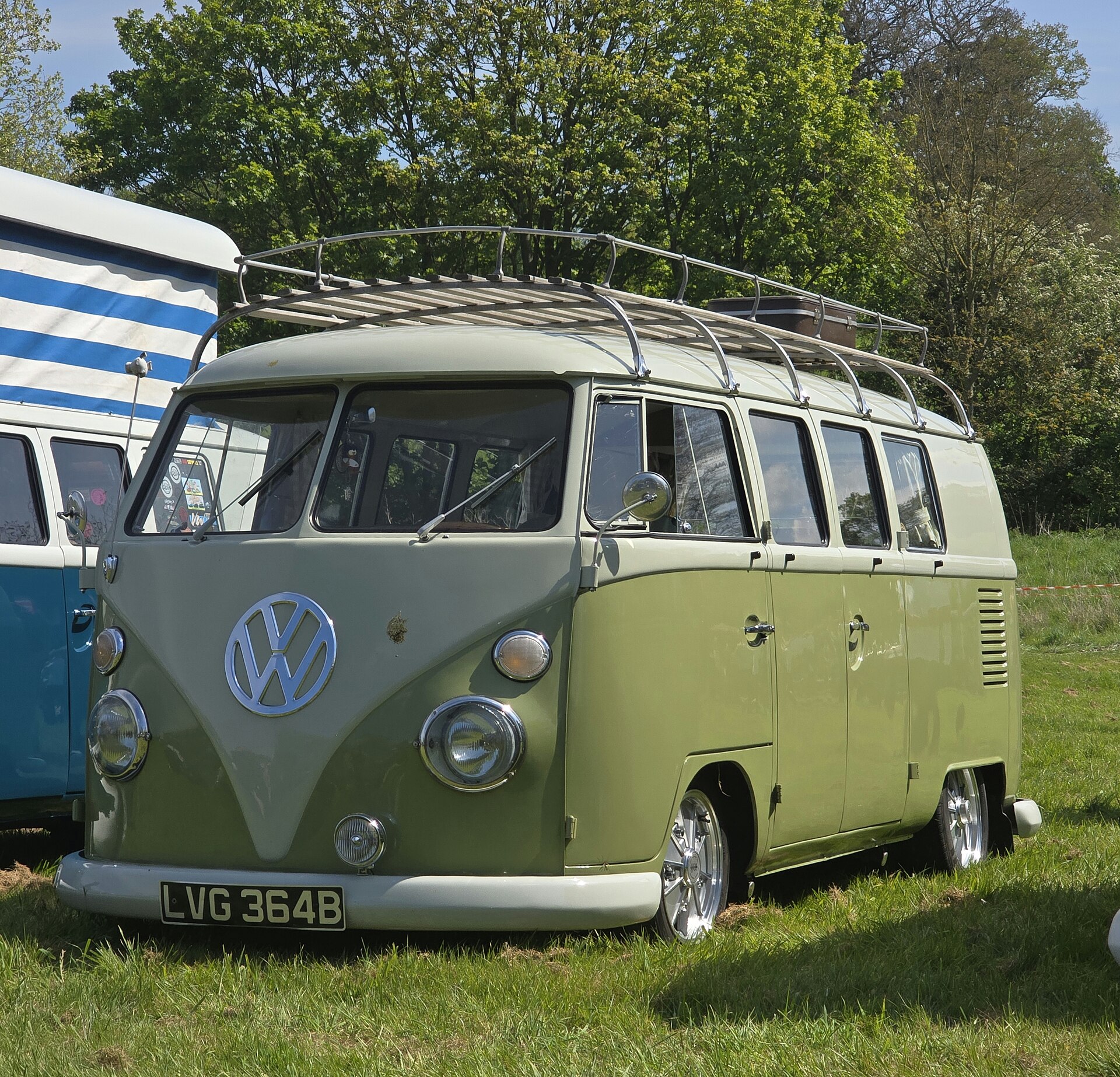
Overview
The Volkswagen Type 2 is the commercial-vehicle family that began with the Transporter in 1950. Names associated with the family include Transporter, Bus, Kombi, Microbus and Bulli; their usage varies by market and body configuration. This page concentrates on its origins and early T1 and T2 generations, with brief context on the T3 and T4 transitions.
Its origins include Dutch Volkswagen importer Ben Pon’s 1947 sketch. Development began in 1948, a hand-built prototype appeared in 1949, and series production began at Wolfsburg on 8 March 1950. See Volkswagen’s heritage account.
The early Transporter had an air-cooled boxer engine behind the rear axle: its pistons moved horizontally in opposing pairs. It initially shared its engine and gearbox with the Volkswagen Beetle Type 1, but used a purpose-developed self-supporting body, meaning the body itself formed the load-bearing structure. Its forward-control layout placed the driver at the front, over the front axle, helping make room for cargo. Volkswagen Newsroom confirms the specially developed body.
The first version had a maximum payload of 750 kilograms; this figure does not describe every subsequent Type 2. The early range included panel vans, Kombis and eight-seat buses, followed by other configurations. See Volkswagen’s early-years account.
Early generations
The dates in these headings describe German production, rather than worldwide production spans. Volkswagen’s 75th-anniversary history distinguishes the German changeovers from continued production abroad.
T1 (1950–1967 in Germany)
The first generation is recognised by its two-piece windscreen and V-shaped front panel. Volkswagen introduced the Samba in 1951 and a pick-up in 1952. Production moved from Wolfsburg to Hanover in 1956. Volkswagen’s 70th-anniversary timeline reports approximately 1.9 million T1 purchases by 1967. This is presented as a sales-related figure, not a production count, and the source does not explicitly define its geographic coverage; it should not be treated as a verified German or worldwide production total.
The T2 replaced the T1 in German production in 1967, while Brazilian T1 production continued until 1975, according to the 75th-anniversary history.
T2 (1967–1979 in Germany)
The T2 replaced the split windscreen with a single curved pane and made a sliding side door standard. It retained the rear-engine layout and continued the passenger, cargo and camper range. German production ended in 1979, but production elsewhere continued; Volkswagen records Brazilian production through 2013. See the 75th-anniversary history, T2 section.
The T3 continued the rear-engined formula from 1979. The front-engined T4 arrived in 1990; Volkswagen’s historical account explains that the T1, T2 and T3 generation names were applied retrospectively at that transition. See The changing face of the Volkswagen van.
Sources
- Volkswagen van heritage — Volkswagen Commercial Vehicles
- The changing face of the Volkswagen van — Volkswagen Commercial Vehicles
- Celebrating 70 years of the Transporter — Volkswagen Commercial Vehicles
- The Type 2 T1 and its design — Volkswagen Newsroom
- 75 Jahre Bulli — Volkswagen Nutzfahrzeuge: German production dates and continuation abroad