Porsche 911
An introduction to the Porsche 911's debut and early engineering, with catalogue coverage focused on the original generation produced in 1964–1973.
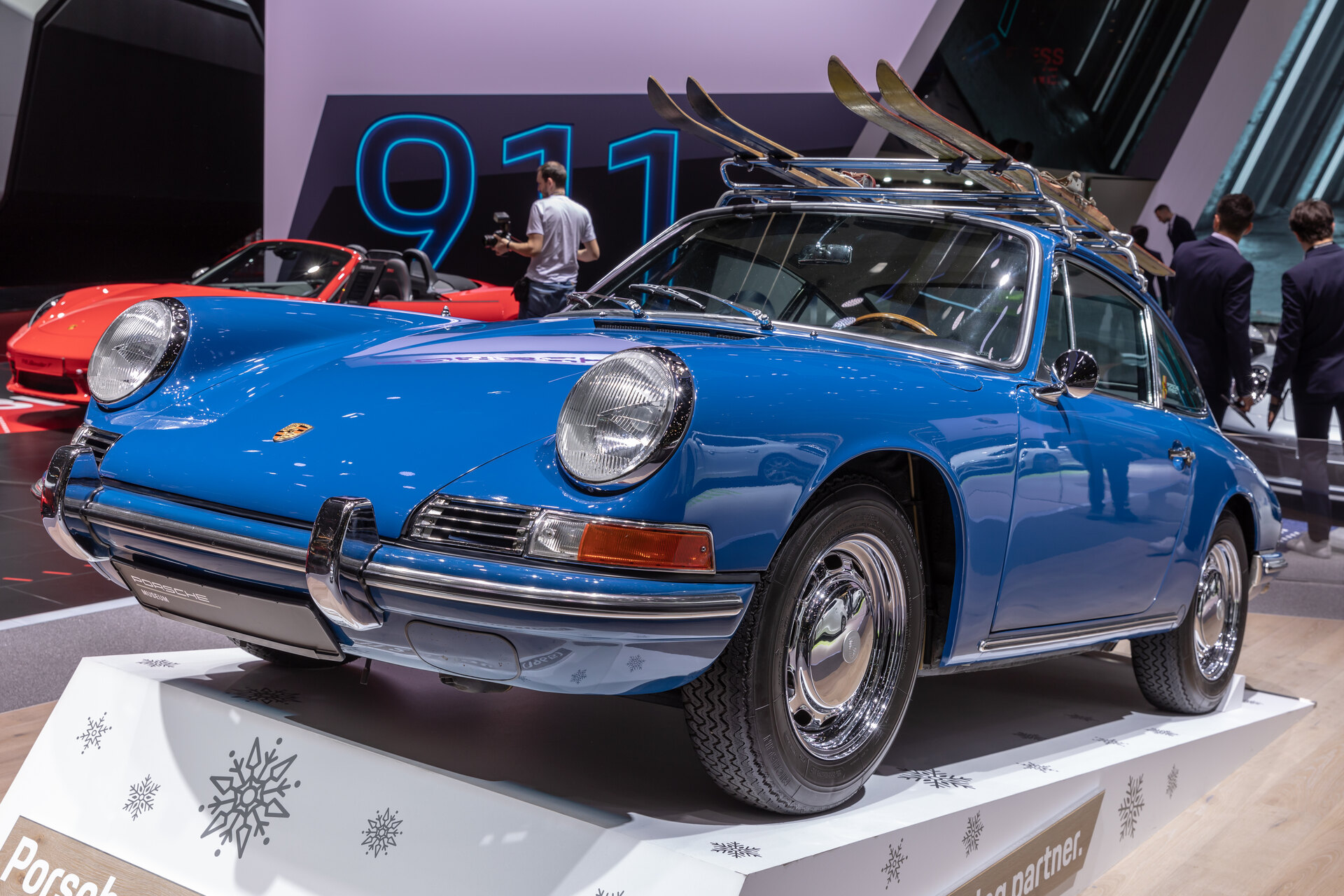
Introduction
Porsche presented the successor to the 356 at the Frankfurt motor show in September 1963. This presentation preceded the original generation’s 1964–1973 production period covered by the catalogue. The new car was initially called the 901 and subsequently renamed 911. Ferdinand Alexander Porsche led the exterior design, retaining a recognisable relationship with the 356 while providing a more spacious cabin and luggage area.
Original engineering
The original 911 initially used a rear-mounted, air-cooled 2.0-litre flat-six engine: six cylinders arranged horizontally in two opposing banks of three. It drove through a five-speed transaxle, a unit combining the gearbox and differential that transmits power to the driven wheels. Independent suspension and four-wheel disc brakes complemented the compact 2+2 body, with two front seats and two smaller rear seats. These specifications describe the original car, rather than every generation of the 911.
Early development
The more powerful 911 S joined the range in 1966, and Porsche introduced the open-roof Targa soon afterwards. Porsche lengthened the wheelbase for 1969 to improve the car’s handling balance. During the original generation, engine capacity subsequently grew to 2.2 and then 2.4 litres, while competition and road-going derivatives steadily widened the range. The basic rear-engined flat-six concept continued into the later G-series and remained central to successive 911 generations.
Sources
- Porsche Media — The history of the Porsche 911 (broader historical context)
- Porsche Classic — Porsche 911 F model (original-series reference)
Browse related records
1 records
Original Porsche 911 (1964–1973)
The 1964–1973 Porsche 911 generation established the rear-mounted air-cooled flat-six layout. This page covers its 1963 unveiling, production and naming chronology, coupe and Targa bodies, wheelbase extension and engine development from 2.0 litres to the Carrera RS 2.7.
Generation
No matching records.