Mercedes-Benz 190 (W201)
Introduced in 1982 and produced until 1993, the Mercedes-Benz 190 W201 family included the 190, 190 E and 190 D. Its compact saloon body and five-link rear suspension broadened the Mercedes-Benz range before the C-Class.
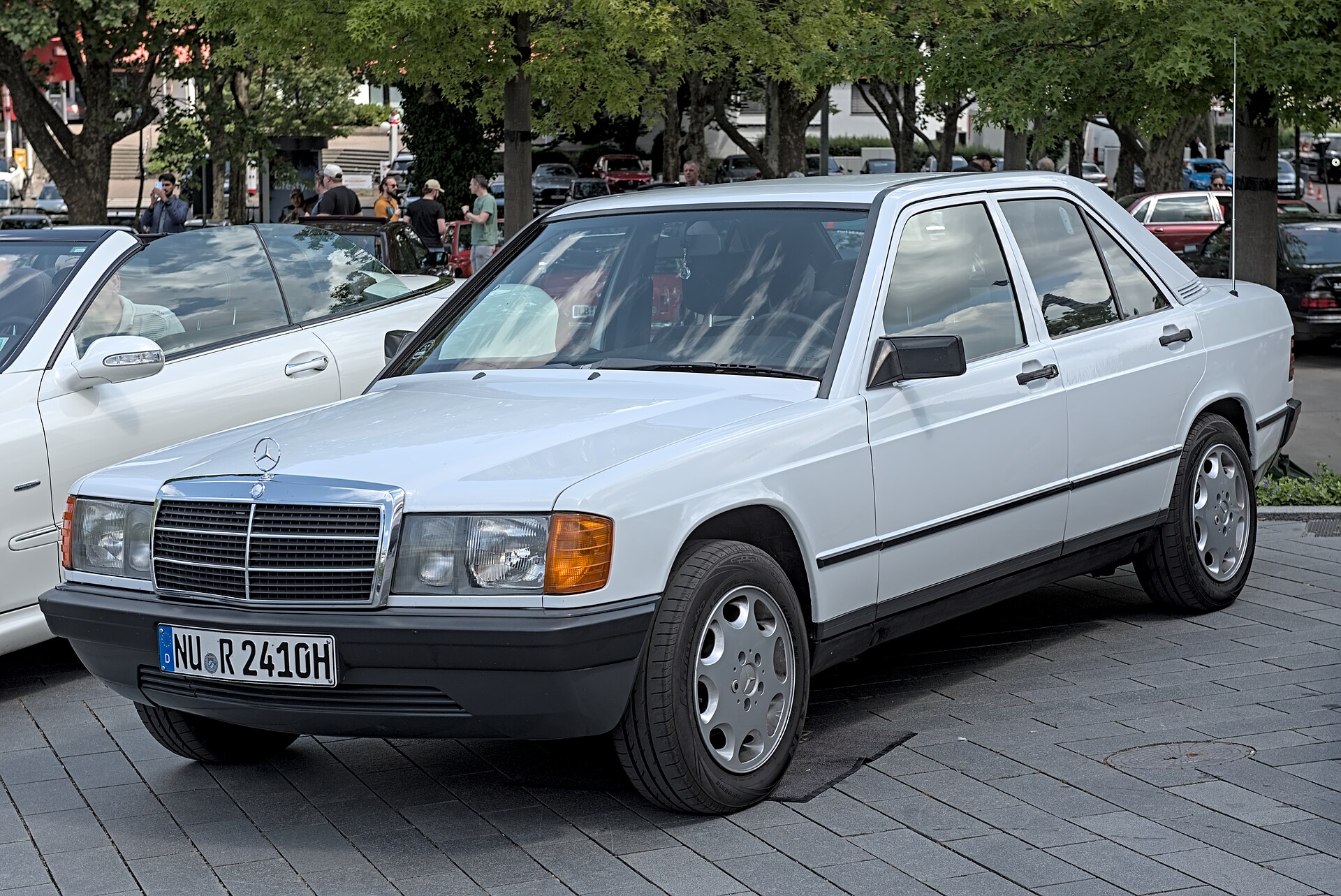
Overview
This page covers the Mercedes-Benz 190 W201 family, including the 190, 190 E and 190 D, the direct predecessor of the C-Class. Mercedes-Benz presented the W201 series on 8 December 1982; production ended in 1993, when the C-Class arrived. Sold initially as the carburettor-equipped 190 and fuel-injected 190 E, it established a fourth passenger-car line below the company’s larger saloons and SL sports cars. The compact four-door was informally called the “Baby-Benz”.
The W201 was smaller and lighter than the W123 while retaining the marque’s emphasis on durability and passive safety. A forked front structure managed deformation in frontal impacts, and the carefully shaped body combined a clear wedge profile with comparatively low aerodynamic drag. Mercedes-Benz produced the saloon at Sindelfingen and Bremen.
Its most influential chassis feature was a new five-link independent rear suspension. Each rear wheel was located by five separate links intended to control longitudinal and lateral forces without sacrificing ride comfort. Variations of the arrangement subsequently appeared throughout the Mercedes-Benz passenger-car range.
Engines and variants
The subsection date ranges describe groups of variants, not the availability of every engine listed or an unchanged specification throughout each period. Outputs are given in PS, the metric horsepower unit.
190 and 190 E (1982–1993)
At the 1982 launch, the original 2.0-litre four-cylinder 190 produced 90 PS with a carburettor, while the fuel-injected 190 E produced 122 PS. These are launch specifications, not figures applying throughout 1982–1993. Further petrol versions included the smaller 190 E 1.8 and 190 E 2.3, while the 190 E 2.6 fitted a 2.6-litre inline-six into the compact engine bay.
190 D (1983–1993)
The 190 D used extensive engine-compartment sound insulation and gained the nickname “whisper diesel”. A five-cylinder 190 D 2.5 followed in 1985, and the turbocharged 190 D 2.5 Turbo is recorded with an output of 122 PS. The complete market and model-year coverage of that figure remains unverified here; it should not be applied to every 190 D 2.5 Turbo or throughout the subsection’s date range. These models helped establish quieter, higher-performing diesel cars within the Mercedes-Benz range.
Sixteen-valve models (1984–1993)
The 190 E 2.3-16 combined a four-cylinder engine with a sixteen-valve cylinder head developed with Cosworth. Before the production launch, three cars established endurance records at Nardò in 1983. The larger 190 E 2.5-16 replaced it in 1988 and became the basis for increasingly specialised touring-car derivatives.
Evolution and Evolution II (1989–1990)
Mercedes-Benz built the 190 E 2.5-16 Evolution and Evolution II as road-going homologation models: production cars built to satisfy the eligibility requirements for their racing counterparts. They were developed for the Deutsche Tourenwagen-Meisterschaft (DTM), the German Touring Car Championship. Each was produced in a series of 502 road cars. The 1990 Evolution II used extended wheel arches, revised suspension and a prominent adjustable rear wing. The racing cars derived from it, rather than the road cars themselves, helped Mercedes-Benz secure the 1992 DTM drivers’ and manufacturers’ titles.
1988 facelift
A major 1988 update brought revised bumpers, protective side mouldings, interior changes and improved seats. These body and cabin revisions were distinct from the introduction of the 190 E 2.5-16 engine variant in the same year, described under Engines and variants.
Production
Production ended in 1993 as the first C-Class arrived. Mercedes-Benz records a total of 1,879,630 W201 saloons, making the compact series a major expansion of the company’s customer base as well as an engineering reference for later models.