Mercedes-Benz W123
The Mercedes-Benz W123/123-series family comprises saloon, long-wheelbase saloon, coupé and T-Model estate body styles. This page covers their introductions, engineering and body-style distinctions.
Overview
This Mercedes-Benz W123 page covers the full 123-series family: the W123 four-door saloon, V123 long-wheelbase saloon with seven or eight seats, C123 pillarless coupé and S123 T-Model estate. W123 identifies the conventional saloon within this broader family.
Mercedes-Benz presented the 123-series saloon in January 1976 as the successor to the W114 and W115 models. The initial range offered nine petrol and diesel versions spanning the 200 D to the fuel-injected 280 E.
Its double-wishbone front suspension used zero steering offset, while passive-safety measures included a collapsible steering column and a fuel tank protected above the rear axle. Anti-lock brakes became optional in 1980, followed by a driver’s airbag in 1982. Approximately 2.7 million vehicles were produced across the range. These launch, engineering, safety-equipment and production details are documented in Mercedes-Benz’s E-Class history.
Body families
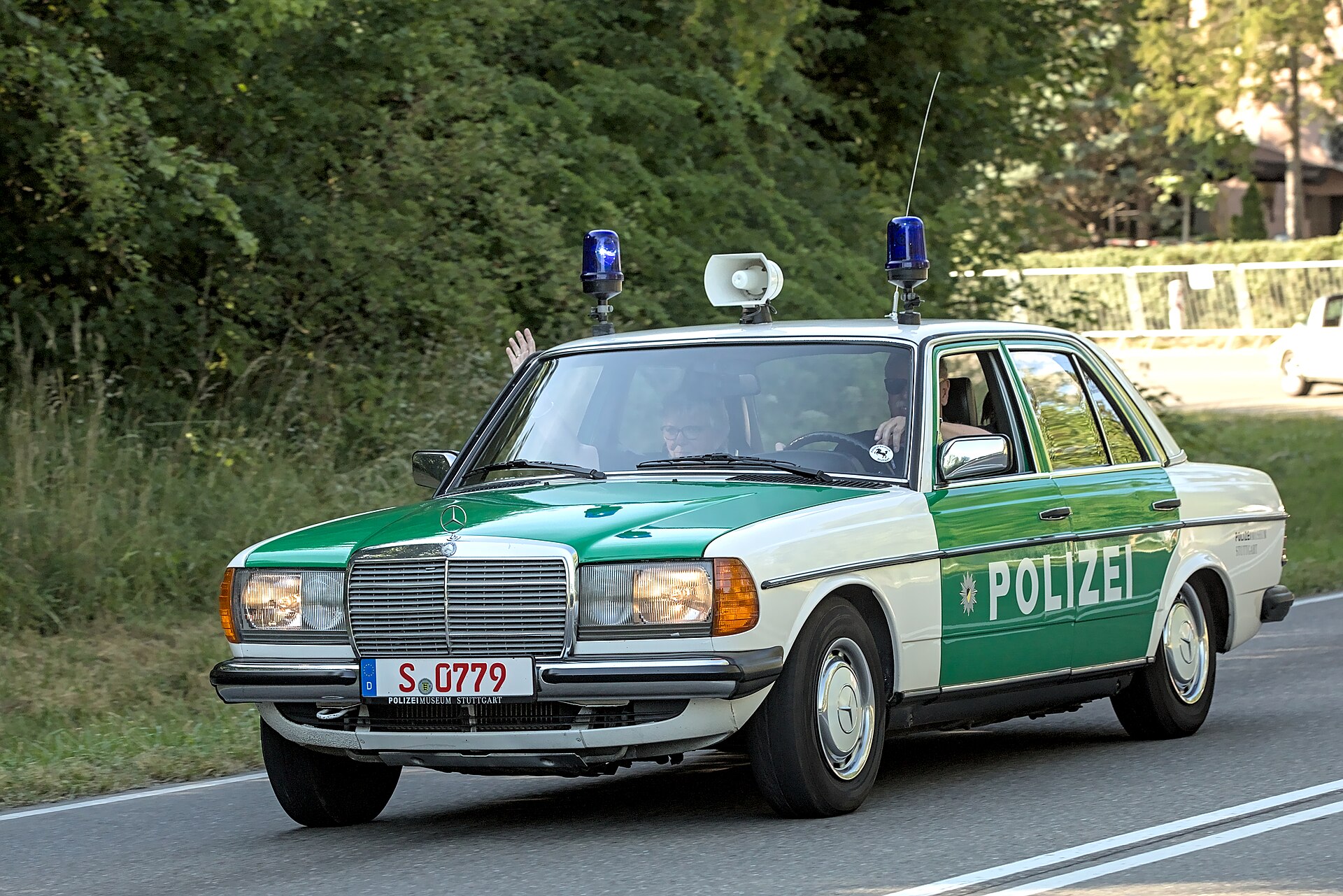
Saloon (W123, 1976–1985)
Presented in January 1976, the four-door saloon formed the core of the range. Mercedes-Benz records nearly 2.4 million saloons in its E-Class history.
Long-wheelbase saloon (V123)
The lengthened saloon offered seven or eight seats and served customers needing additional seating, including taxi and chauffeur operators.
Coupé (C123, 1977–1985)
The pillarless coupé had a wheelbase 85 millimetres shorter than the saloon’s and a roof 40 millimetres lower, giving it distinct proportions while retaining the main model’s engineering. Mercedes-Benz describes these dimensions in its history of E-Class coupés and cabriolets.
T-Model estate (S123, 1978–1986)
The T-Model was unveiled in 1977; series production began in 1978. It was Mercedes-Benz’s first estate designed and built in-house. Its designation referred to tourism and transport, and self-levelling rear suspension was standard. In 1980, the 300 TD Turbodiesel brought turbocharged diesel power to the 123-series estate range, as documented in Mercedes-Benz’s E-Class history.