Mazda Cosmo Sport L10 Generation (1967–1972)
The original Cosmo Sport introduced Mazda’s production rotary engine in 1967. This generation includes the initial L10A and revised L10B, with production ending in 1972.
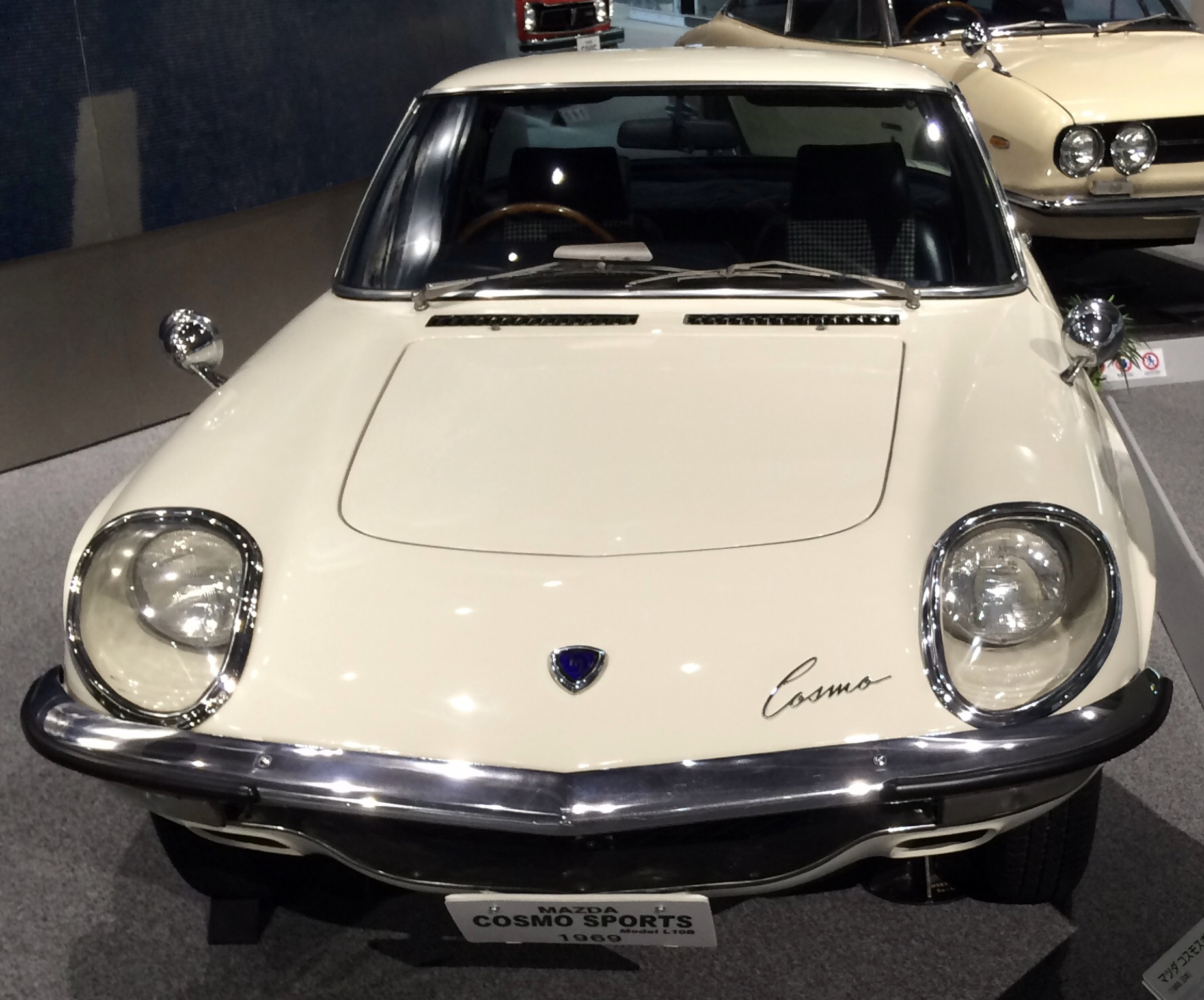
The original rotary-powered Cosmo
The Cosmo Sport was a Japanese-built, two-seat coupé made by Toyo Kogyo, now Mazda. It introduced the production rotary engine to the Mazda Cosmo line. Sales began on 30 May 1967; production ended in 1972. Mazda identifies it as the first production car with a two-rotor rotary engine. Overseas, it was known as the 110S. Mazda’s model history.
This record groups L10A and L10B as revisions of one L10 generation. Mazda’s Japanese virtual museum groups them together, whereas a Mazda USA retrospective calls the 1968–1972 version a second generation. The grouping here follows the Japanese museum; the dates describe production chronology rather than a universal model-year designation. Mazda USA retrospective.
Development and launch
Mazda began rotary-engine development in 1961. A central obstacle was wear that left chatter marks inside the rotor housing; Mazda’s historical account credits aluminium-impregnated carbon seals with overcoming the problem. A prototype appeared publicly in 1963, followed by a formal motor-show announcement in 1964. Development continued before the 1967 sales launch, including endurance work at the Miyoshi Proving Ground. These prototype appearances should not be confused with the start of customer deliveries. Mazda’s development history.
Design and chassis
The low nose, compact cabin and extended tail gave the Cosmo Sport a distinctive silhouette. Mazda describes its engine position as front-midship. Double-wishbone front suspension, a de Dion rear arrangement and front disc brakes supported its sporting role. Mazda’s Japanese virtual museum.
L10A and L10B
L10A, introduced in 1967: Japan’s National Museum of Nature and Science identifies the original car’s engine as the 10A, with two rotary chambers of 491 cc each and an output of 110 PS at 7,000 rpm. Its record describes a two-seat coupé. These figures belong to the early specification. National Museum of Nature and Science.
L10B, introduced in 1968: The revision added 150 mm to the wheelbase, adopted 15-inch radial tyres, strengthened the brakes and introduced a five-speed transmission. Mazda records an increase to 128 PS. Mazda’s revision history.
The Toyota Automobile Museum’s 1969 L10B record specifies a water-cooled twin-rotor engine of 491 cc × 2, producing 128 PS at 7,000 rpm, and a 2,350 mm wheelbase. Those are specifications for its later example, not figures to apply indiscriminately to L10A cars. The displacement notation describes the rotary chambers; it is not a piston-engine equivalence. Toyota Automobile Museum.
Competition, production and legacy
Two L10B-based cars entered the 1968 Marathon de la Route at the Nürburgring. One finished fourth in the 84-hour event, demonstrating endurance as well as speed. Production ended in 1972, after the Cosmo Sport had established the rotary engine’s public identity for Mazda. Mazda’s virtual museum.
Mazda’s centenary history gives total production as 1,176 cars. Its historical importance therefore rests less on sales volume than on introducing a technology that became central to Mazda’s identity. Mazda’s centenary overview.
For the later branches of the nameplate, see the Cosmo AP generation introduced in 1975, 1981 generation and Eunos Cosmo generation.
Sources and image credit
- Mazda Virtual Museum — Cosmo Sport, L10A and L10B: design, revisions, competition and production chronology.
- Mazda — Cosmo Sport (1967–): development, launch date and overseas 110S name.
- National Museum of Nature and Science — Cosmo Sport: original 10A engine and two-seat coupé specification.
- Toyota Automobile Museum — 1969 Cosmo Sport L10B: later-car specifications.
- Mazda USA — 2017 Japanese Classic Car Show retrospective: alternative generation terminology.
- Mazda centenary history — Cosmo Sport: total production and historical role.
- Ghostofakina — 1969 Cosmo Sport L10B photograph, Wikimedia Commons, CC BY-SA 4.0.
