Ferrari
An Italian sports-car manufacturer whose road cars grew from Enzo Ferrari's racing operation and made competition, V12 engines and coachbuilt design central to the marque.
Historical overview
Ferrari’s beginnings have four distinct milestones:
- 1929 — Racing team: Enzo Ferrari founded Scuderia Ferrari to race Alfa Romeo cars.
- 1939 — Independent business: Enzo established Auto Avio Costruzioni.
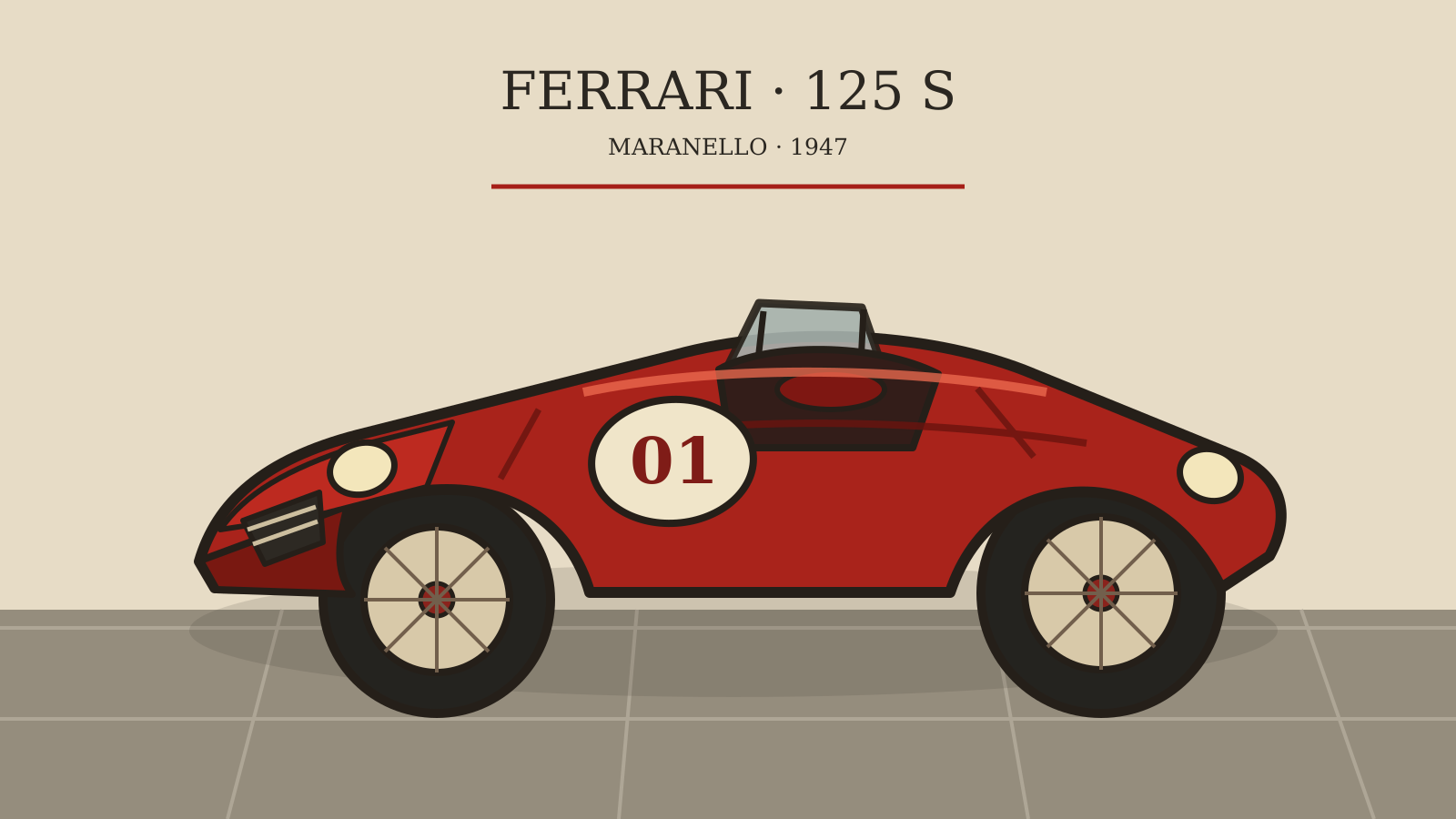
- 1947 — Ferrari-badged car: The 125 S became the first car to carry the Ferrari name.
- 1948 — Road-going grand tourer: The 166 Inter established Ferrari’s road-car strand.
These dates distinguish the racing organisation, the founder’s independent business and the first Ferrari cars. The corporate chronology is documented in Ferrari’s 2018 Annual Report.
Ferrari is an Italian manufacturer of sports, grand-touring and competition cars based in Maranello, near Modena. The 125 S was a racing sports car with a front-mounted 1.5-litre V12. From those beginnings the marque developed road cars, sports-racing cars and single-seaters in parallel. Competition publicised the road cars and tested ideas, while road-car sales helped sustain racing. A Formula One car, sports prototype and road-going grand tourer (GT) nevertheless serve different purposes and belong to distinct model lines.
Ferrari joined small-series Italian coachbuilding—the design and construction of bodies for a chassis—with engines and chassis developed around high performance. Front-engined V12 grand tourers, mid-engined V6 and V8 sports cars, flat-12 flagships, turbocharged limited-series cars, hybrid road cars and a four-door model illustrate changes in its engineering and design.
This page covers selected historical milestones, with the road-car chronology ending at the Purosangue’s 2022 introduction. It is not a complete model list or a description of the current range. The ownership and production-site account is bounded by the 2018 Annual Report.
From Scuderia Ferrari to the road-car company
Enzo Ferrari founded Scuderia Ferrari in Modena in 1929 to enter and support Alfa Romeo racing cars. After leaving Alfa Romeo, he established Auto Avio Costruzioni in 1939. The Auto Avio Costruzioni 815 raced in 1940, but it was not sold as a Ferrari; it belongs to the founder’s pre-marque history. Enzo Ferrari moved the operation from Modena to Maranello in late 1943.
Gioachino Colombo designed the compact V12 commissioned for Ferrari’s first post-war car, with Giuseppe Busso and Luigi Bazzi contributing to its development. The unbodied 125 chassis first ran on 12 March 1947. The 125 S made its competition debut at Piacenza on 11 May and retired while leading; Franco Cortese then gave Ferrari its first victory at the Rome Grand Prix later that month. These dates mark racing events, rather than model years for a road-car range. Ferrari recounts them in First Victory.
The 166 Inter of 1948 established the road-going GT strand. Early Ferraris were built in very small numbers and could receive bodies from different Italian coachbuilders, or carrozzerie, including Touring, Vignale, Ghia and Stabilimenti Farina. Cars sharing a chassis or engine designation could therefore have different bodies without being successive generations of a model.
The 250 Europa GT shown in 1954 helped move Ferrari towards a more standardised road-car product. Its Pinin Farina design and expanded Maranello facilities made the 250 GT family the basis of a larger, more consistent series, although competition berlinettas, luxury coupés, cabriolets and spiders remained distinct derivatives. A bare number such as 250 does not identify one body style, production period or specification.
Ownership and production sites
This account follows Ferrari’s 2018 Annual Report; it describes corporate history and production arrangements reported at that time, rather than freshly verified ownership or factory information.
The Fiat group acquired a 50 per cent interest in Ferrari in 1969. Its holding rose to 90 per cent after Enzo Ferrari died in 1988, with Piero Ferrari retaining the remaining 10 per cent. Fiat Chrysler Automobiles announced a separation in 2014; Ferrari’s share listing began in 2015 and the separation was completed on 3 January 2016. The report described Ferrari N.V. as incorporated in the Netherlands, with its principal place of business in Maranello, Italy.
The report located assembly and engine manufacture at Maranello, alongside the corporate offices and racing activities, and identified chassis manufacture at a nearby Modena facility. “Built in Maranello” is therefore a broad description: body construction, chassis work, final assembly, engine manufacture and later Ferrari Classiche restoration can be separate stages in a car’s history.
Design and coachbuilding
Ferrari’s bodies have been shaped by both independent design houses and its own engineering and styling departments. The long association with Pinin Farina began after Enzo Ferrari and Battista “Pinin” Farina met in 1951. Pinin Farina, later Pininfarina, designed or developed much of the marque’s road-car appearance for decades. Ferrari describes the partnership in Pure Pinin: Master of Design. Scaglietti was especially important to the construction and refinement of competition and road bodies, while Touring, Vignale, Ghia and Bertone contributed to particular early or special cars.
The designer and the body builder were not always the same firm. Pininfarina’s long association with Ferrari does not mean it designed every post-war model, and Scaglietti’s construction work does not necessarily mean it alone designed a body’s shape. The Ferrari Design Centre, established in the twenty-first century, progressively brought more design work in-house, alongside collaborative programmes.
Berlinetta generally denotes a closed sporting coupé; Spider and cabriolet describe open cars, although Ferrari used these as distinct model names; GTS has often identified a removable-roof derivative; and 2+2 denotes two main seats plus two smaller rear seats. The Purosangue unveiled in 2022 was Ferrari’s first production car with four doors and four full-size seats, a different format from the earlier 2+2 coupés.
Engines, layouts and construction
The Colombo-designed V12 established a defining Ferrari theme, but “Ferrari V12” is not one unaltered engine family. Capacities, block architecture, valve gear, induction, fuel delivery and intended use changed repeatedly. Later road-car programmes also used Lampredi V12s, Dino V6s, several V8 families and the 180-degree twelve-cylinder layout commonly associated with the Berlinetta Boxer and Testarossa lines.
Road-car layout changed as well. Early GTs and sports cars placed the engine ahead of the driver. The Dino 206 GT of the late 1960s used a transverse mid-mounted V6—mounted across the car behind the cabin—and carried Dino rather than Ferrari badging. The 365 GT4 BB, shown in 1971 and produced later in the decade, moved Ferrari’s twelve-cylinder production flagship behind the cabin with a longitudinal 180-degree engine and a gearbox mounted beneath it. The later 308 GTB established the transverse mid-engined V8 berlinetta as a major production line, while cars such as the 456 GT and 550 Maranello renewed the front-engined V12 grand-tourer format in the 1990s.
Construction evolved from tubular chassis and hand-formed coachwork to mixed steel, aluminium and composite structures. The first 308 GTBs used glass-fibre body panels; Ferrari changed the United States-market cars to steel and aluminium in late 1976, with European production following. Ferrari describes this market-specific sequence in First Time.
Limited-series cars including the GTO, F40, F50, Enzo and LaFerrari used turbocharging, composites, structural engine installation or hybrid assistance in different combinations. Their engineering differed by model and production period; these features were not shared by every contemporary Ferrari.
Road-car chronology: selected milestones through 2022
This chronology follows selected model families and introductions through the 2022 unveiling of the Purosangue. It does not cover every Ferrari or establish the current range.
The first broad road-car era centred on front-engined twelve-cylinder sports and GT cars. The 166, 195, 212 and America families of the late 1940s and early 1950s led into the wide-ranging 250 line. The 250 GT family included coupés, competition berlinettas, the California Spider and the 250 GTO, developed around homologation requirements—approval for a competition category—among other forms. The larger-engined 275, 330 and 365 series developed rather than simply replaced every branch at once; overlapping production was normal.
During the late 1960s and 1970s Ferrari added smaller mid-engined cars through the Dino line, introduced the 365 GT4 BB twelve-cylinder berlinetta, and built four-seat GTs alongside them. The 308 GTB and GTS became the basis of the later 328 line. Mondial coupés and cabriolets provided 2+2 mid-engined alternatives, while the front-engined 400 and 412 continued the four-seat V12 tradition. The Testarossa and its 512 TR and F512 M developments carried the mid-engined twelve-cylinder line into the 1990s.
From the 1990s, the 348, F355, 360, F430, 458, 488 and F8 formed successive mid-engined V8 model families, each with its own engines, body styles and revisions. Front-engined GT lines included the 456, 550/575, 612 Scaglietti, 599, FF/GTC4Lusso, F12berlinetta and 812 families. The California and Portofino names identified front-engined retractable-hardtop road cars, while Roma was a separate coupé programme within this period.
Electrification entered the road-car range in stages. LaFerrari used hybrid assistance in a limited-series model in 2013, an introduction described in the 2018 Annual Report. Ferrari introduced the SF90 Stradale in 2019 as its first series-production plug-in hybrid, combining a turbocharged V8 with three electric motors. Its launch press kit distinguishes this milestone from the earlier limited-series hybrid. The later 296 family paired plug-in assistance with a V6.
The Purosangue, unveiled in 2022, extended the body range with four doors while retaining a front-mid-mounted V12 and rear transaxle, with the gearbox at the rear. Ferrari’s Purosangue press kit describes its introduction and layout. Introduction, production start, first delivery and market-specific model year are different milestones; an unveiling date alone does not establish the others.
Markets, names and model distinctions
Ferrari’s naming is informative but not uniform. Early numbers such as 125, 166 and 250 referred approximately to the displacement of one cylinder. In 365 GTB/4, 365 again referred to per-cylinder capacity, GTB to Gran Turismo Berlinetta and 4 to the number of camshafts. 308 instead combined approximate total capacity with cylinder count. Names such as Testarossa, California, Roma and Purosangue follow other logic. A badge’s meaning depends on its period and model.
Market demand and regulation created genuine specification differences. Luigi Chinetti and John von Neumann encouraged the 250 GT California Spider for American clients. The 308 changed body materials first for the United States, and tightening emissions rules—especially in that market—prompted fuel injection and the GTBi/GTSi names in 1980, as described in Ferrari’s 308 history.
In Italy, taxation above two litres encouraged the 2.0-litre 208 and the later 208 GTB Turbo. Ferrari’s account of turbocharging specifically connects the 208 GTB Turbo to that tax threshold. Similar-looking cars could therefore have different engines, outputs and body materials depending on their market and production period.
Calendar year, unveiling date, production period, registration year and market model year can all differ. Ferrari’s archive also documents individual chassis, original assembly details and later factory-authorised work, as explained in True to the Last Bolt. For a hand-built or restored car, its appearance today may differ from its original engine, body or market specification.
Competition and historical importance
Scuderia Ferrari entered the Formula One World Championship in its first season in 1950 and became its longest-continuing participant. Ferrari also built sports-racing and GT cars for works and customer teams, winning major events including Le Mans, the Mille Miglia, Targa Florio, Daytona and Sebring in different eras. Racing success gave the road-car marque visibility, while programmes such as the 250 GTO, GTO and F40 illustrate different relationships between competition requirements and limited-series road cars.
Ferrari’s legacy is not reducible to victories or high auction values. It helped preserve the Italian coachbuilding tradition while moving from bespoke bodies to recognisable series, sustained the front-engined V12 grand tourer through periods when mid-engined cars defined the exotic-car market, and repeatedly adapted its engineering identity to injection, turbocharging, electronic control and hybrid power. Its narrow focus contrasts with broad-volume manufacturers such as Ford, while its relationship between road cars and racing invites comparison with Porsche.
Selected notable model lines
These examples accompany the historical chronology through the Purosangue’s 2022 introduction.
- 125 and 166: The first Ferrari-badged competition car and the early sports and road-going GT families.
- 250: A diverse 1950s–1960s group spanning coachbuilt road cars, competition berlinettas, spiders and homologation models, including the 250 GTO.
- Dino 206/246 and 308 GT4: Mid-engined V6 and V8 cars initially presented under the Dino identity.
- 365 GTB/4 and 365 GT4 BB: Distinct front- and mid-engined twelve-cylinder berlinettas, despite their shared opening number.
- 308/328 and Mondial: Related mid-engined V8 two-seat and 2+2 programmes with multiple bodies, engines and market specifications.
- Testarossa/512 TR/F512 M: The later mid-engined twelve-cylinder road-car lineage.
- GTO, F40, F50, Enzo and LaFerrari: Separate limited-series flagships, each with its own identity and engineering.
- 348 through F8: Successive mid-engined V8 sports-car families with distinct coupé, spider, updated and special-series versions.
- 456 through 812: Several front-engined V12 GT families covering two-seat and 2+2 roles.
- SF90 and 296: Plug-in-hybrid model families with different combustion engines and positions in the range.
- Purosangue: The first four-door, four-seat Ferrari production model, distinct from earlier 2+2 coupés.
Sources
- Ferrari company history and corporate chronology — Ferrari N.V. Annual Report 2018
- The 125 S and Ferrari’s first victory — Ferrari
- The 250 GT and the transition towards series production — Ferrari
- Ferrari and Pininfarina design partnership — Ferrari
- The 365 GT4 BB layout and development — Ferrari
- The 308 GTB, body materials and United States emissions changes — Ferrari
- The 208 GTB Turbo and Italian taxation context — Ferrari
- SF90 Stradale series-production plug-in-hybrid press kit — Ferrari
- Purosangue four-door model press kit — Ferrari
- Ferrari Classiche and individual-car archive records — Ferrari
Browse related records
2 records
Ferrari 250 GTO
A front-engined V12 competition berlinetta that developed the 250 GT racing line through aerodynamic bodywork and sustained GT success from 1962 to 1964.
ModelFerrari F40
The Ferrari F40 was Ferrari's fortieth-anniversary two-seat road car, with a twin-turbocharged V8, composite construction and a deliberately sparse cabin. Its road-car production period is generally recorded as 1987–1992. It was the last new road model presented by Enzo Ferrari before his death in 1988.
Model
No matching records.