Bugatti
A luxury and sporting marque founded by Ettore Bugatti in 1909, shaped by Molsheim craftsmanship, competition, an Italian revival and successive advances in supercar engineering.

Historical overview
Bugatti is a luxury and sporting automobile marque founded by Ettore Bugatti at Molsheim in Alsace in 1909. Its history encompasses the original family enterprise, Romano Artioli’s Italian revival and a later return to manufacturing in France. These were distinct business and engineering eras, separated by interruptions in car production. Bugatti’s anniversary history.
This manufacturer record sits within the Automobile Manufacturers and Marques catalogue. Individual vehicle types belong below it as model records; ownership changes are not vehicle generations.
Molsheim and the original enterprise
The Milan-born Ettore Bugatti established his works in a former dye factory in Molsheim in 1909; Volkswagen’s historical account dates independent vehicle manufacture there to 1910. The Type 13 helped establish the early sporting business. Licensing designs provided additional income, including the small Bébé manufactured by Peugeot.
The First World War interrupted Molsheim automobile production. Aircraft-engine design and licensing supported Bugatti during the interruption, and the factory resumed activity in 1919. Racing success, careful workmanship and small-series manufacture subsequently helped establish the marque’s prestige. Customers could select combinations of chassis, engine and bodywork, making the individual car’s specification important when describing surviving examples. Volkswagen Group’s history of Bugatti.
Racing engineering and road-car design
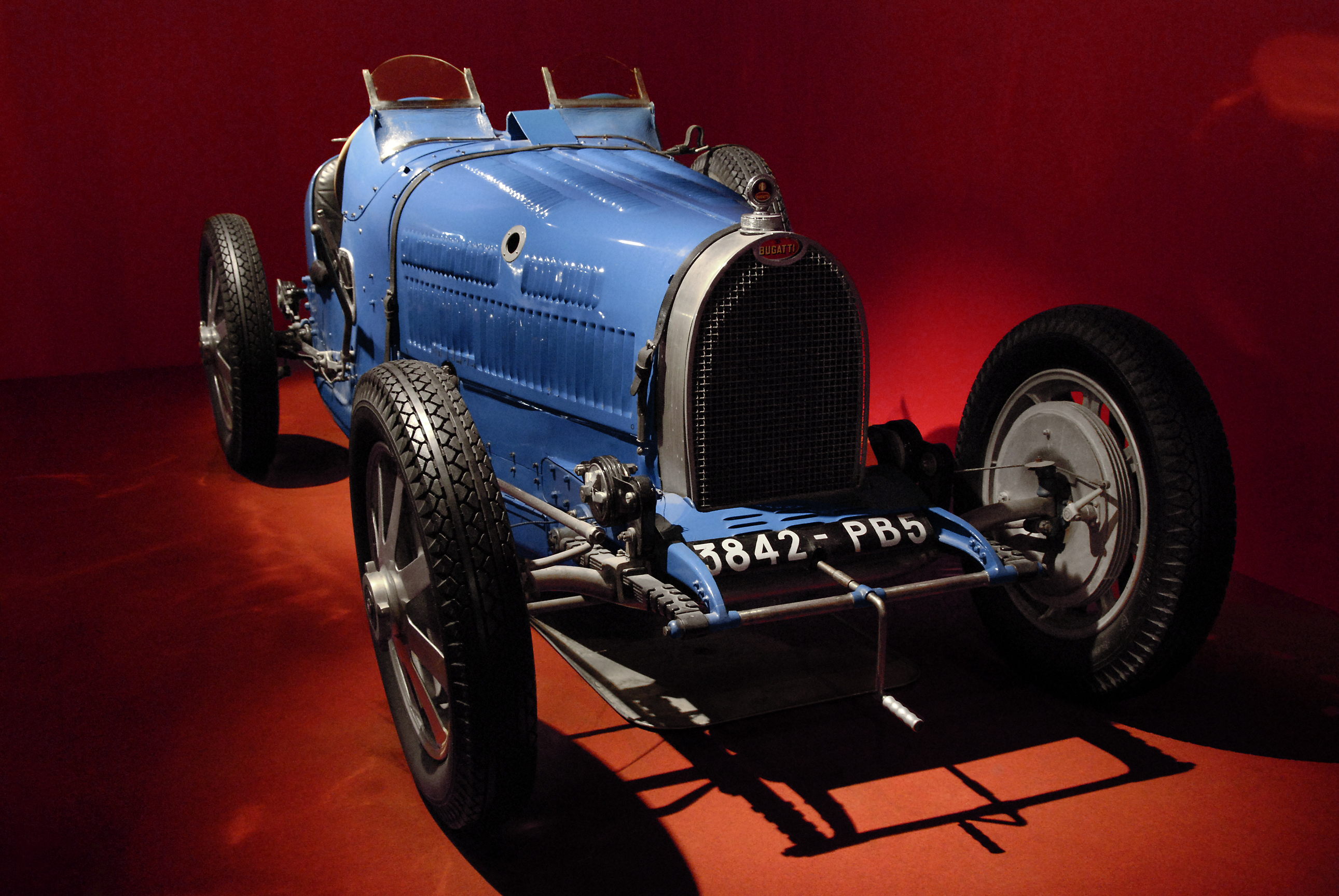
The Type 35 family illustrates Bugatti’s competition engineering during the 1920s. Introduced in 1924, it combined a two-seat Grand Prix body, eight-cylinder engine and distinctive alloy wheels. Its development included different engine capacities and induction systems: the Type 35B and 35C used superchargers, while the Type 35 and 35T did not. The family therefore cannot be represented by one universal engine specification. The Bugatti Trust’s Type 35 reference.
Jean Bugatti became an important figure in the company’s engineering and styling. The Type 55 brought ideas from the Type 51 racing car into a road-going design and was offered with roadster and coupé coachwork. Bugatti’s Type 55 history.
The marque’s luxury identity also embraces the Type 41 Royale and Type 57 family. Bugatti later displayed the Royale and Type 57SC Atalante alongside the Type 35 when introducing the Tourbillon, explicitly connecting luxury, design and competition in its interpretation of its heritage. Bugatti’s 2024 heritage presentation.
War and the end of the family enterprise
Jean Bugatti died in 1939, the year the Second World War began. Wartime disruption weakened the business, and Ettore died in 1947. Roland Bugatti attempted to sustain the enterprise, but its eventual sale to Hispano-Suiza in 1963 led into an aeronautical industrial history. That corporate succession should be distinguished from continuous production of Bugatti automobiles. Bugatti’s account of the post-war transition.
Campogalliano and the EB110 revival
Romano Artioli’s revival began in 1987. A new factory at Campogalliano, near Modena in Italy, opened in 1990, placing the enterprise near an established pool of sports-car engineering expertise. The EB110 was unveiled in Paris on 15 September 1991, marking the 110th anniversary of Ettore Bugatti’s birth.
The EB110 coupé combined a carbon-fibre monocoque, a 3.5-litre V12 with four turbochargers, permanent four-wheel drive and a six-speed gearbox. GT and Super Sport were distinct versions. Falling demand and financial difficulties brought the Campogalliano operation to an end in 1995. The EB112 luxury saloon shown in 1993 did not become an established series-production range. Bugatti’s Campogalliano history.
Return to France and the W16 era
Volkswagen revived Bugatti in 1998 as part of its expansion into luxury automobiles. Volkswagen Group’s historical account.
Assembly at the modern Molsheim Atelier began in 2005 with the Veyron programme. Bugatti’s manufacturing history.
The Veyron and the Chiron, introduced in 2016, centred on successive developments of an 8.0-litre engine with sixteen cylinders in a W configuration and four turbochargers. The W16 also powered more specialised projects including the Divo, La Voiture Noire, Centodieci and Bolide. Their shared engine architecture does not make their bodies, chassis settings or intended uses interchangeable; the Bolide, for example, is a track vehicle rather than a road car. Bugatti’s marque and engineering overview.
Bugatti Rimac and the hybrid transition
The Bugatti Rimac venture began operating in November 2021. Its founding arrangement brought together Bugatti, Rimac and Porsche while retaining Bugatti’s headquarters and vehicle manufacture in Molsheim. This was a corporate transition rather than a relocation of Bugatti assembly to Croatia. The 2021 company announcement.
The Tourbillon was unveiled at Molsheim on 20 June 2024. Its new chassis and electrified V16 powertrain marked another engineering direction after the Veyron and Chiron era. The unveiling date identifies a presentation event, not the start of customer deliveries or a universal model year. Bugatti’s Tourbillon launch account.
Reading Bugatti’s history
Bugatti’s history connects competition machinery, individually bodied luxury cars and modern supercars through a recurring emphasis on engineering and design. It also demonstrates how a marque can survive interruptions and changes of ownership without retaining one continuous production organisation.
For individual vehicles, distinguish chassis type from coachwork, engine specification from marketing name, and calendar-year events from model-year availability. Production location also matters: the Campogalliano EB110 belongs to a different manufacturing programme from the Molsheim cars. Market-specific equipment and homologation require evidence for the particular model and version.
For related catalogue reading, see Volkswagen and Porsche, whose corporate histories intersect with later chapters of Bugatti.
Sources and image credit
- Volkswagen Group — The History of Bugatti
- Bugatti — Les 110 ans de Bugatti: family history, revivals and Molsheim assembly
- The Bugatti Trust — Type 35, 35B, 35C and 35T technical reference
- Bugatti — The Blue Factory in Campogalliano
- Bugatti — About Bugatti: modern models and W16 engineering
- Bugatti — Formation of Bugatti Rimac, November 2021
- Bugatti — Tourbillon premiere and heritage presentation, June 2024
- Dontpanic / Wikimedia Commons — Bugatti Type 35B photograph, CC BY-SA 3.0