BMW
BMW's automobile history: its entry into car manufacturing in 1928, post-war recovery and the development of its numbered model series.
Early engines and vehicle production
BMW stands for Bayerische Motoren Werke. The name appeared in 1917 when the Munich aircraft-engine manufacturer Rapp-Motorenwerke was renamed. BMW introduced its first motorcycle, the R 32, in 1923.
Entry into car manufacturing was a separate milestone: in 1928 BMW acquired the existing manufacturer Fahrzeugfabrik Eisenach, which built the Dixi 3/15 under licence from the Austin Seven. BMW’s historical timeline documents these events.
BMW’s 1930s cars included the six-cylinder 328 roadster, which competed in motor racing. BMW’s 328 history records its development and competition career.
Post-war recovery
After the Second World War, BMW rebuilt its car business in Munich. The 501 was unveiled in 1951 and entered production in 1952. By 1959 the company faced a financial crisis; restructuring and the Neue Klasse saloons, first presented as the BMW 1500 in 1961, helped its recovery. BMW Group’s history distinguishes these presentation and production milestones.
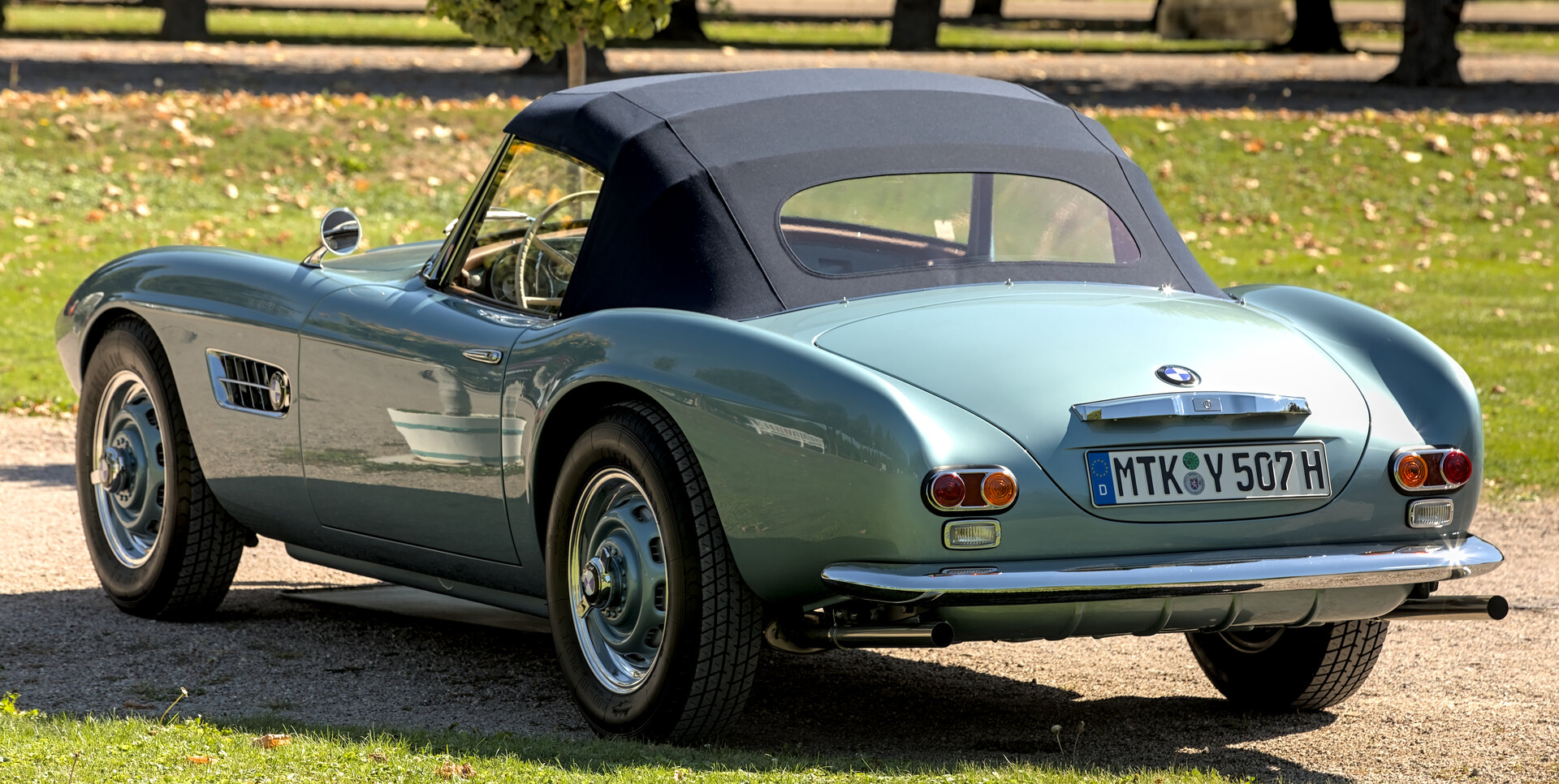
The post-war range also included the 502 saloon, V8-powered 507 roadster and small Isetta. The compact 700 helped support the recovery. These models are covered in BMW’s historical account.
The numbered series and later ranges
BMW introduced the 5 Series in 1972, beginning its modern series naming system, followed by the 3 Series in 1975. BMW’s timeline records both introductions. The luxury 7 Series followed in 1977, as documented in BMW’s 7 Series history.
The catalogue later broadened through M performance cars, X-badged sport-utility vehicles and electrified i models. BMW Group’s history traces these developments.
Notable model lines
- 328: A six-cylinder roadster from the 1930s with a documented motor-racing career. BMW 328 history.
- 507: A V8 roadster built from 1956 to 1959. BMW Group Classic model record.
- 5 Series: The mid-size range introduced in 1972 with BMW’s modern series naming system. BMW 5 Series history.
- 7 Series: The flagship saloon line introduced in 1977. BMW 7 Series history.
- M cars: High-performance road cars developed through BMW’s motorsport organisation. BMW Group history.
Sources
- BMW Group historical account and timeline, March 2016
- BMW Group History
- BMW 3 Series celebrates 50 years
- The BMW 328 turns 75
- BMW Group Classic: BMW 507
- The History of the BMW 5 Series
- Luxury and elegance: 30 years of the BMW 7 Series
Browse related records
1 records
BMW 3 Series
Introduced in 1975, the BMW 3 Series is a model family. This overview focuses on its E21 beginnings.
Model
No matching records.