Audi R8
Audi's mid-engined flagship sports car, unveiled in 2006 and developed across two generations before production ended in March 2024.
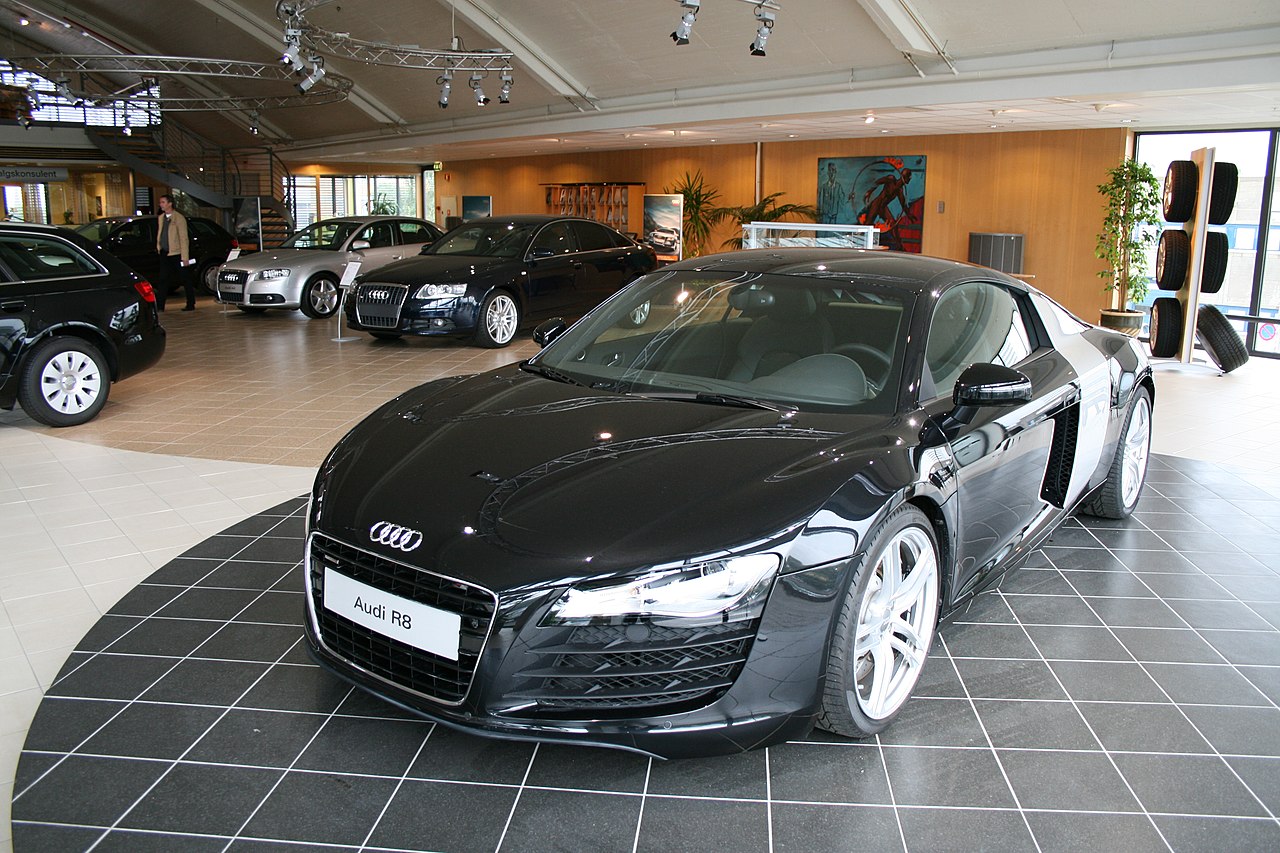
Overview
The R8 was Audi’s mid-engined flagship sports-car line, developed by quattro GmbH, later Audi Sport GmbH. Unveiled at Paris in 2006, it brought Audi into the supercar market. Audi’s retrospective counts series cars from 2007 and records the final example on 22 March 2024. The road car borrowed its name from Audi’s earlier Le Mans prototype; that racing car was not a generation of the road-going R8. Origins and chronology — Audi.
The R8 sat above the compact TT in Audi’s sports-car offering. Its fixed-roof Coupé and open Spyder were body styles within the model line. V8 and V10 identify engine layouts, while quattro and RWD distinguish driven-wheel arrangements; none of those labels alone identifies a generation.
Development and first generation
The 2003 Le Mans quattro concept previewed the R8’s appearance and mid-engine layout. Developed with Lamborghini connections, it used a twin-turbocharged V10. The production R8 instead began with a naturally aspirated 4.2-litre V8, later joined by a naturally aspirated 5.2-litre V10. Audi presented the open Spyder in 2009. Concept and first-generation history — Audi.
An aluminium Audi Space Frame supported the original car. The cabin’s curved “Monoposto” surround emphasised the driver’s instruments and controls, while an exposed gate made the available six-speed manual gear lever a distinctive interior feature. Audi’s American history dates the US debut to autumn 2007, illustrating the distinction between a motor-show unveiling and arrival in a particular market. Construction, cabin and US introduction — Audi of America.
The first generation also offered R tronic, a six-speed automated manual. The update announced in July 2012 replaced that option with seven-speed S tronic dual-clutch transmission and revised the lighting, bumpers and rear diffuser. A V10 plus Coupé joined the range. This was a facelift of the existing car, rather than the second generation; manual availability and standard transmission equipment depended on version and market. Contemporary facelift report — Carbuyer, 25 July 2012.
Second generation and later development
The replacement R8 reached the German market in autumn 2015. Audi’s July 2015 technical dossier describes a 5.2-litre V10 range with seven-speed S tronic and a revised quattro system using an electrohydraulically controlled multi-plate clutch. The new structure combined aluminium with carbon-fibre-reinforced polymer, including structural sections around the passenger compartment. The body retained recognisable sideblades, now divided into two parts, while the virtual cockpit display concentrated instruments and infotainment in front of the driver. Second-generation German-market technical dossier — Audi, July 2015.
Rear-wheel drive became a significant additional branch of the line. Audi unveiled the V10 RWS, meaning Rear Wheel Series, at Frankfurt in September 2017. Its announced 999-car run covered Coupé and Spyder bodies together. Removing the front-drive components reduced weight, with chassis and stability-control settings adapted to the changed drivetrain. RWS therefore describes a derivative of the second generation, not a new generation. RWS introduction — Audi Australia.
A further facelift reached European dealers in early 2019. Revised exterior details and chassis settings accompanied updated V10 quattro models. Audi renamed the V10 plus as V10 performance quattro. Both Coupé and Spyder remained in the offering. The following figures belong specifically to that European facelift range and use metric horsepower, or PS. European facelift dossier — Audi.
| European version at the early-2019 introduction | Engine | Rated output | Drive |
|---|---|---|---|
| R8 V10 quattro, Coupé or Spyder | Naturally aspirated 5.2-litre V10 | 419 kW / 570 PS | All-wheel drive |
| R8 V10 performance quattro, Coupé or Spyder | Naturally aspirated 5.2-litre V10 | 456 kW / 620 PS | All-wheel drive |
Rear-wheel-drive cars subsequently became a regular part of the offering. Audi’s December 2021 documentation describes the V10 performance RWD with 419 kW / 570 PS, seven-speed S tronic and either body style. Despite sharing an output figure with an earlier quattro model, it was a different drivetrain specification. V10 performance RWD — Audi.
Markets and related programmes
National introductions and equipment did not follow one universal model-year timetable. Audi of America records second-generation US sales beginning in calendar 2016, following the 2015 unveiling. Its 2017 V10 plus exclusive edition introduced Audi laser lighting to that US offering in a limited 25-car specification. A US model-year description should therefore not be substituted for the global generation’s introduction date, nor should a lighting feature on one special edition be assigned to every R8. US chronology and equipment — Audi of America.
Audi’s 2015 dossier also documented the battery-electric R8 e-tron and the competition R8 LMS separately. Their electric propulsion and racing specifications do not describe the regular petrol road-car range. Separate e-tron and LMS programmes — Audi, pages 39–42.
Production and legacy
R8 manufacture was based in Germany, initially at Neckarsulm. Production moved to the Böllinger Höfe facility in nearby Heilbronn in 2014. Audi’s dedicated manufacturing account identifies that start date and describes predominantly hand assembly. The facility was subsequently expanded and adapted to build the electric e-tron GT alongside the R8. This factory chronology is more precise than treating every R8 as having been built at Böllinger Höfe. Manufacturing history — Audi.
Audi reports a total of 45,949 R8s and places the last car at Böllinger Höfe in March 2024. The model extended Audi’s identity beyond front-engined performance cars, combining a mid-engine flagship with a customer-racing programme. Production endpoint and historical assessment — Audi.