Volkswagen Karmann Ghia
The Volkswagen Karmann Ghia family combined Italian styling and Karmann coachbuilding with Volkswagen mechanicals: the Beetle-based Type 14 offered coupé and cabriolet bodies, while the Type 3-based Type 34 entered series production only as a coupé.
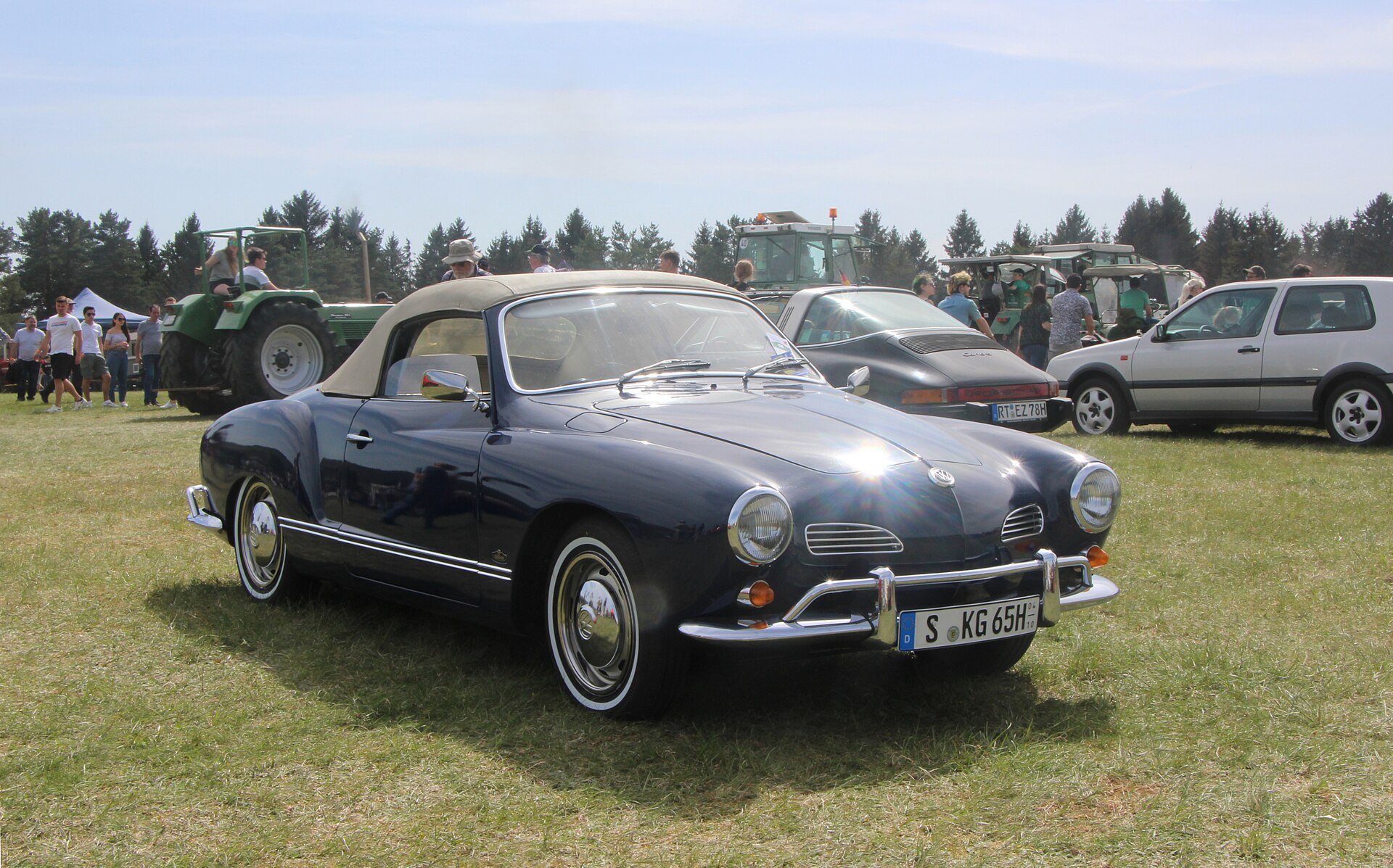
Overview
The Volkswagen Karmann Ghia family comprised the Beetle-based Type 14, offered as a coupé and cabriolet, and the larger Type 3-based Type 34, built in series only as a coupé. Volkswagen documents these branches in its model history and Type 34 history.
Volkswagen Classic’s design-origin account traces the project to Wilhelm Karmann’s commission to Luigi Segre of Carrozzeria Ghia in 1953. Ghia’s closed prototype impressed Karmann and Heinrich Nordhoff, leading to a production 2+2 coupé. The Type 14 was presented in July 1955 and publicly launched at Frankfurt that September.
Ghia shaped the body in Turin, while Karmann built it in Osnabrück using extensive hand-finishing. A widened Beetle platform carried the rear-mounted, air-cooled flat-four. The result emphasised styling rather than exceptional speed; engine applications are distinguished below.
Models and body styles
Type 14 Coupé — Osnabrück production, Germany (1955–1974)
The original coupé entered production in August 1955, according to Volkswagen Classic’s historical account. A 1959 update raised the headlamps, enlarged the front air inlets and revised the rear lamps. Later changes brought larger bumpers, safety improvements and further detail revisions without altering the basic silhouette.
Volkswagen’s Type 14 Coupé engine profile lists the following applications. PS means metric horsepower. The profile does not specify sales markets or a complete production-period breakdown, so these figures are not presented as universal market specifications.
- 1200, 1,191 cc: 30 PS in the early production period; the profile records 34 PS from 1960. Market coverage and the end date are unspecified.
- 1300, 1,285 cc: 40 PS. The profile does not specify the applicable years or markets.
- 1500, 1,493 cc: 44 PS. The profile does not specify the applicable years or markets.
- 1600, 1,584 cc: 50 PS. Volkswagen’s model history records 50 PS by 1971, and its historical account identifies the final 1974 coupé as a 1,584 cc, 50 PS car. These references do not establish a complete market-specific application period.
Four-speed manual transmission was standard. Saxomat and the later automatic stick-shift were available in selected markets; availability should not be assumed for every engine and year. Volkswagen’s model history dates the introduction of Saxomat to 1961 without providing a market-by-market availability list.
Type 14 Cabriolet — Osnabrück production, Germany (from 1957; end year unresolved)
Karmann began building the open Type 14 in November 1957. Its lined folding roof and strengthened body required substantial hand assembly, making it more expensive and less numerous than the coupé. Mechanical development generally followed the closed model, but the coupé engine list above does not establish specifications for every Cabriolet, market or year. The differing end-date indications in Volkswagen’s references are retained in Production below.
Type 34 Coupé — Osnabrück production, Germany (1961–1969)
Volkswagen’s Type 34 history identifies Osnabrück as its production location. The larger Type 34 used the Volkswagen Type 3 platform and its flatter engine, providing more cabin and luggage space. Ghia’s sharper body featured integrated front fog lamps and pronounced horizontal creases. A cabriolet was developed but did not enter series production. The Type 14 engine specifications above do not describe this branch.
Production
The dates above describe the German, Osnabrück production account. They should not be treated as a verified worldwide manufacturing chronology.
Volkswagen Classic’s 2020 historical account places the final coupé on 31 July 1974 and reports 362,601 Type 14 coupés and 80,881 cabriolets in its account of the Osnabrück model’s retirement and replacement by the Scirocco. These totals are retained as reported: the article does not explicitly define their geographic accounting boundary, so they are not labelled as verified German-only or worldwide totals.
The Cabriolet end year remains uncertain across the supplied references. Volkswagen’s model-history text states 1973, while Volkswagen’s Classic navigation labels the Cabriolet 1957–1974. The 2020 account describes the model’s retirement in 1974 without separately dating the final cabriolet. These references do not reconcile the difference or establish a worldwide Cabriolet end date.
Volkswagen’s Type 34 history records production in Osnabrück from 1961 and its end in July 1969.
Sources
- Volkswagen model history — Type 14 and Type 34 branches, updates and stated end years
- Volkswagen Classic — design origins, Type 14 launches, reported production totals and final coupé
- Volkswagen Type 14 Coupé engine profile — displacements and outputs; limited date and market coverage
- Volkswagen Type 34 history — Type 3 foundations, Osnabrück production and non-series Cabriolet