Toyota Supra
The front-engined, rear-wheel-drive performance car that evolved from a six-cylinder Celica derivative into a distinct sports-car line.
Overview
Toyota introduced the Supra name in 1978 on a longer, wider and more powerful derivative of the Celica liftback. The first two generations were marketed as the Celica Supra in several export markets, combining practical hatchback bodywork with an inline-six engine and rear-wheel drive. The model became independent of the Celica with the third generation in 1986. Toyota’s model history.
Across the following generations, the Supra retained a front-engine, rear-wheel-drive layout and a strong association with inline-six power. Naturally aspirated and turbocharged variants served both grand-touring and high-performance roles. The fifth-generation GR Supra also offered turbocharged 2.0-litre four-cylinder engines in selected markets; Toyota’s 2019 Japanese-market specifications listed these alongside the 3.0-litre inline-six. Toyota’s GR Supra premiere announcement.
Fourth-generation production ended in 2002. Toyota revived the name after a 17-year absence with the GR Supra in 2019, developed through a collaboration with BMW and assembled by Magna Steyr in Graz, Austria. Toyota’s premiere announcement confirms the 2002 production end and 2019 return.
In its April 2025 U.S. announcement, Toyota scheduled the end of fifth-generation production for spring 2026 and introduced the MkV Final Edition for the U.S. 2026 model year. That announcement establishes a planned end date, not confirmation that production subsequently ended on schedule. Separately, Toyota’s November 2024 announcement identified Japan and Europe as the planned markets for the A90 Final Edition. These announcements describe market-specific editions rather than a single worldwide edition sequence. Toyota’s MkV Final Edition announcement; Toyota’s A90 Final Edition announcement.
Generations
First generation: A40/A50 (1978–1981)
The original Supra extended the second-generation Celica’s wheelbase to accommodate an inline-six engine. Its equipment and interior placed greater emphasis on comfort than the four-cylinder Celica, while the liftback body and driven rear axle established the basic formula carried into later models. Toyota’s model history.
Second generation: A60 (1981–1986)
Still connected to the Celica range, the A60 adopted angular styling, retractable headlamps and a more performance-focused chassis. Engine availability depended on market. Toyota’s UK history describes the 2.8-litre 5M-GE inline-six and independent rear suspension on the export Celica Supra; this account should not be read as establishing the specification of every Japanese-market grade. Toyota’s model history.
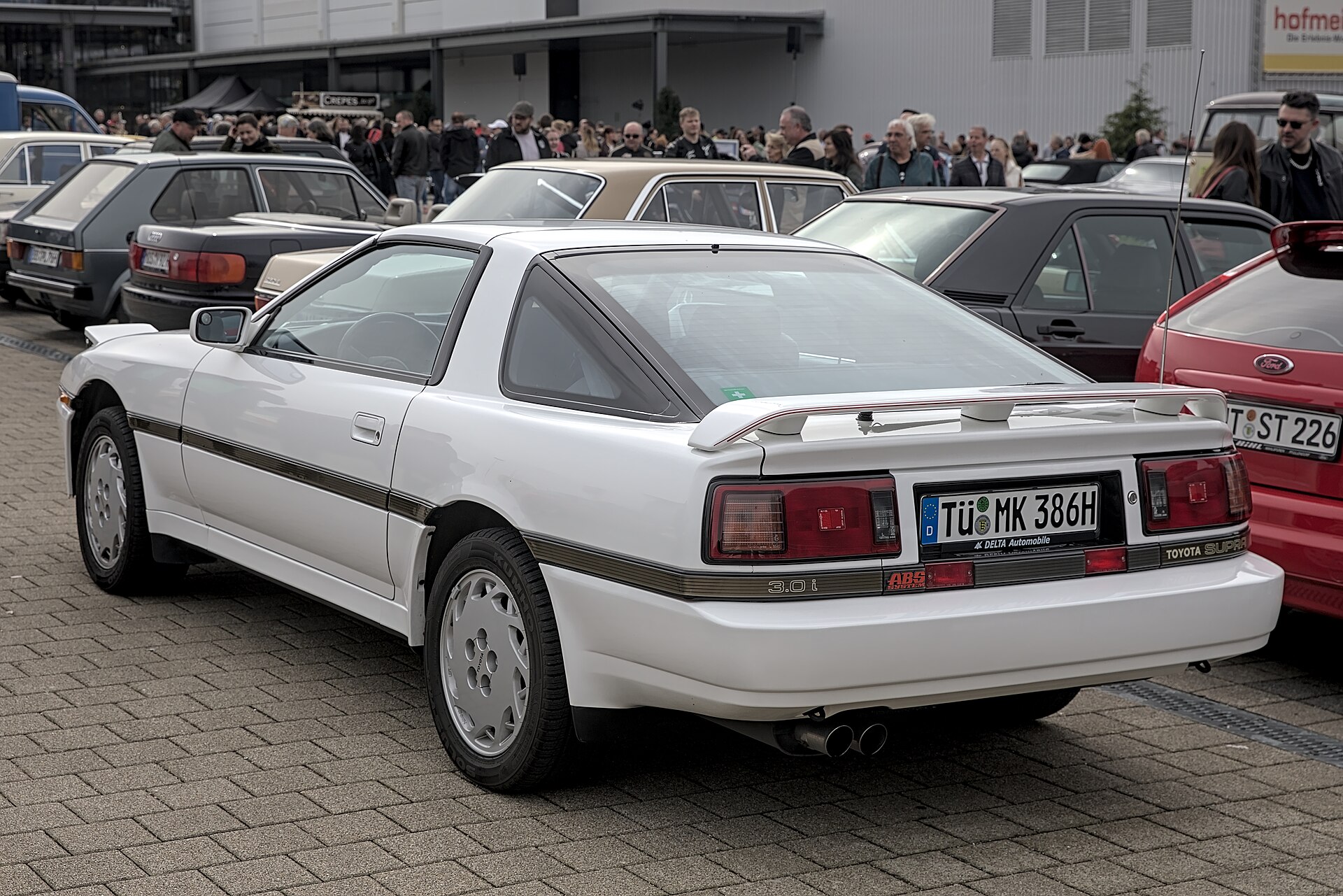
Third generation: A70 (1986–1993)
The A70 was the first Supra developed as a separate model after the Celica moved to front-wheel drive. Four-wheel double-wishbone suspension and four-wheel disc brakes accompanied naturally aspirated and turbocharged inline-six engines. Toyota’s February 1986 Japanese launch announcement specifies double-wishbone suspension and disc brakes on all grades. Toyota’s A70 launch announcement.
The Japanese range gained a 2.5-litre 1JZ-GTE twin-turbo engine in 1990, while many export cars used the 3.0-litre 7M-GE or turbocharged 7M-GTE.
Fourth generation: A80 (1993–2002)
Toyota reduced weight through aluminium body and suspension components and gave the A80 a rounder, more compact shape. The naturally aspirated 2JZ-GE and sequentially turbocharged 2JZ-GTE 3.0-litre engines powered the principal variants. Toyota’s May 1993 Japanese launch announcement identifies a six-speed manual gearbox developed with Getrag for the turbocharged RZ grade. Toyota’s A80 launch announcement.
Toyota’s heritage account credits fourth-generation competition Supras with four GT500 championship victories in the All-Japan GT series. Toyota Supra heritage.
Fifth generation: A90/J29 (introduced 2019; production end planned for spring 2026)
The two-seat GR Supra returned as the first global road car from Toyota Gazoo Racing. It shared its basic architecture and BMW-sourced engines with the BMW Z4 but received Toyota-specific bodywork and chassis tuning.
Engine and gearbox availability must be read by market and date. Toyota’s January 2019 Japanese-market specifications paired the RZ’s turbocharged 3.0-litre inline-six and the SZ-R and SZ grades’ turbocharged 2.0-litre four-cylinder engines with an eight-speed automatic transmission. Toyota’s 2019 premiere specifications.
For the U.S. 2023 model year, Toyota introduced a six-speed manual option on the 3.0 and 3.0 Premium grades, as well as the A91-MT Edition. This announcement does not establish a manual option for the 2.0-litre engine. Availability in other markets and model years remains unresolved here unless separately documented. Toyota’s U.S. manual-transmission announcement.
Toyota’s April 2025 U.S. announcement scheduled production to end in spring 2026. The planned date does not by itself confirm completion. Toyota’s production-end announcement.
Sources
- Toyota Supra heritage — Toyota Motor Corporation
- Toyota introduces the independent A70 Supra — Toyota Motor Corporation
- Toyota launches the A80 Supra — Toyota Motor Corporation
- Fifth-generation GR Supra premiere — Toyota Motor Corporation
- GR Supra MkV Final Edition and production end — Toyota Motor North America
- A90 Final Edition announcement and planned markets — Toyota Motor Corporation
- 2023 U.S. GR Supra manual-transmission availability — Toyota USA Newsroom
- History of the Toyota Supra — Toyota UK