Toyota Prius
The production hybrid that brought Toyota's petrol-electric powertrain from a 1997 Japanese saloon to a global model family.
Overview
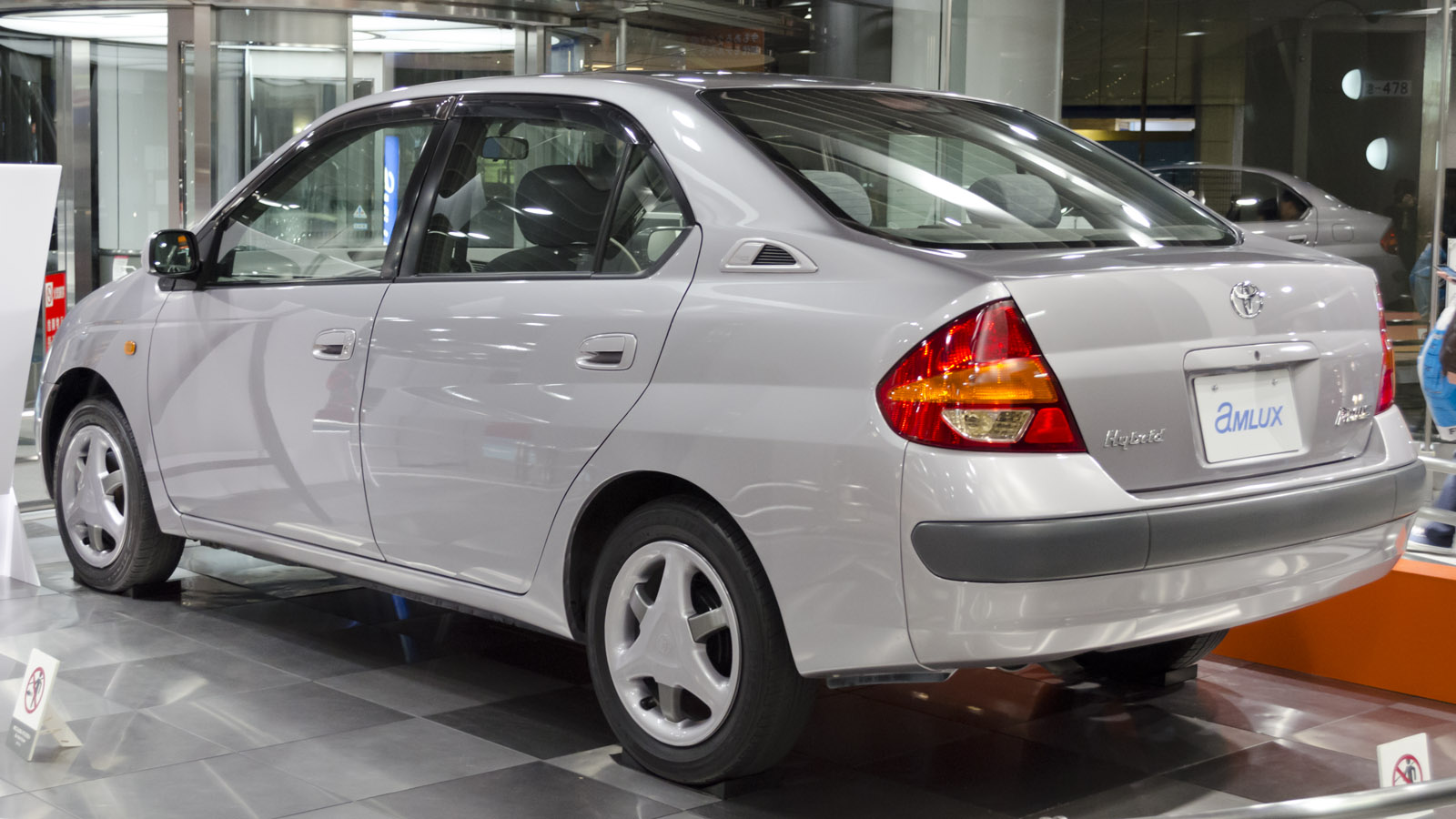
The Prius is Toyota’s petrol-electric hybrid model. Japanese sales began in December 1997, following its October announcement. Originally a compact four-door saloon, it became a five-door liftback with the second generation in 2003.
Development began with Toyota’s G21 project in 1993, investigating a more resource-efficient car for the 21st century. The programme moved towards hybrid propulsion during 1994, and a concept appeared at the 1995 Tokyo Motor Show.
The Toyota Hybrid System combined a petrol engine with electric motor-generators, a battery and a power-split transmission. It could propel the car using the engine, electric power or both, while regenerative braking recovered energy during deceleration. Later versions added plug-in hybrid derivatives. Both types combine petrol and electric propulsion; a plug-in hybrid also allows its battery to be charged from an external electricity supply.
The second generation’s rising roof and tapered tail established the recognisable triangle silhouette retained by the next two generations. Toyota subsequently applied related hybrid technology across a much wider vehicle range.
Generations
The dates below describe the broad generation chronology, rather than model-year designations or identical sales periods in every market. Announcements, sales launches and overseas introductions are distinguished where the sources establish them.
First generation (1997–2003)
Toyota announced the production Prius in October 1997, with Japanese sales beginning on 10 December. An updated version reached Europe, North America and other overseas markets in 2000. It used a 1.5-litre petrol engine and the original Toyota Hybrid System. Toyota recorded approximately 123,000 first-generation sales worldwide.
At its Japanese launch, the Prius had a fuel-economy rating of 28.0 km/L on the Japanese 10-15 test cycle. Toyota described its fuel economy as approximately twice that of a comparable conventional petrol car; this is Toyota’s comparison, rather than a claim about every driver’s results.
Second generation (2003 redesign; succeeded in 2009)
The second generation introduced the five-door liftback body and Toyota Hybrid System II, marketed as Hybrid Synergy Drive. The revised system increased electric-motor contribution and improved performance. Toyota reports 35.5 km/L on the Japanese 10-15 test cycle for the Japanese-market second-generation Prius; its evolution overview does not identify a particular trim for that figure.
The 28.0 and 35.5 km/L figures are test-cycle ratings, not measured real-world consumption. Although both use the 10-15 cycle, they should not be read as a controlled comparison of every version or market specification.
The third generation succeeded it in Japan in May 2009, but Toyota continued the second generation there as the Prius EX, with production ending in December 2011.
Third generation (2009–2015)
A larger 1.8-litre engine replaced the earlier 1.5-litre unit, allowing lower engine speeds in many driving conditions. The range expanded to include a plug-in hybrid, while the standard car retained the established high-roofed aerodynamic profile.
Fourth generation (introduced in 2015)
The fourth Prius was Toyota’s first global model based on the Toyota New Global Architecture. A lower centre of gravity, a more rigid body and revised suspension accompanied further efficiency improvements. A second-generation plug-in derivative was sold under the Prius Prime name in some markets. The fifth generation was unveiled in November 2022; that unveiling does not establish a worldwide end date for fourth-generation sales.
Fifth generation (unveiled November 2022)
Toyota unveiled the fifth generation on 16 November 2022, with a lower, more cab-forward shape. Its announcement described forthcoming standard hybrid (HEV) and plug-in hybrid (PHEV) launches, with Japan preceding overseas markets. The unveiling date therefore does not indicate simultaneous worldwide availability or a universal model year.
The announced range included 1.8- and 2.0-litre standard hybrids and a 2.0-litre plug-in hybrid, with increased output for the 2.0-litre versions compared with their predecessors. Availability and specifications depend on the market and derivative; one version’s engine or output should not be applied to the entire generation.