Peugeot
A French marque rooted in the Montbéliard region, shaped by industrial manufacturing, durable family cars, diesel engineering and successful small hatchbacks.
Historical overview
Peugeot is a French automobile marque whose industrial roots lie in the Montbéliard region of eastern France. Its history connects metalworking and cycles with early motor vehicles, large-scale car manufacture and international production. The familiar 1810 foundation date concerns the family’s industrial enterprise, not the beginning of automobile manufacture. In that year, Jean-Pierre and Jean Frédéric Peugeot converted a grain mill into a steelworks. Peugeot’s company timeline.
Peugeot belongs at the manufacturer level of the catalogue. The 201, 403, 504 and 205 are separate model families within its history. The marque’s significance spans practical passenger transport, diesel-powered family cars, sporting hatchbacks and competition; no single engine layout or body style defines its entire output.
From industrial products to motor cars
Armand Peugeot presented the Type 1 in 1889, followed by the Type 2 in 1890 and Type 3 in 1891. These dates describe successive early vehicles, rather than competing foundation dates for the same company. The Musée de l’Aventure Peugeot’s account of the early cars records this sequence.
In 1896, Armand established the Société Anonyme des Automobiles Peugeot separately from the family’s traditional manufacturing activities. A dedicated automobile factory followed at Audincourt in 1897 and another at Lille in 1898. The family branches reunited in 1910 as the Société Anonyme des Automobiles et Cycles Peugeot. Peugeot’s industrial timeline distinguishes these company and factory milestones.
Sochaux and volume production
The Sochaux factory opened in 1912, initially making lorries. After the First World War, Peugeot concentrated production there. Its subsequent output included the 201, 402, 203, 403, 404 and 504, making the site central to successive periods of the marque’s passenger-car history. PSA’s Sochaux centenary account.
The 201, produced from 1929 to 1937, exemplified the move towards an affordable, carefully industrialised car. Its development prioritised a low selling price, straightforward construction and accommodation for four in the saloon. The wider range included open, closed and utility bodies. Its importance lay as much in production organisation at Sochaux as in the vehicle itself. L’Aventure Peugeot’s 201 record.
Post-war rebuilding and diesel development
The Second World War left Sochaux damaged after occupation, bombing and sabotage. Peugeot’s recovery centred on the 203, presented at the 1948 Paris Motor Show. A medium-sized family saloon provided a basis for rebuilding the company’s market position, rather than concentrating exclusively on the smallest and cheapest cars. Peugeot’s 203 retrospective.
The 403 of 1955 developed this family-car approach with more spacious bodywork and styling by Pininfarina. The range expanded beyond the saloon to include a long-wheelbase Familiale, a cabriolet and commercial derivatives. Diesel power joined the range in the late 1950s, helping establish a durable association between Peugeot passenger cars and economical compression-ignition engines. These body and engine choices were distinct versions, not equipment shared by every 403. Peugeot’s 403 history.
Front-wheel drive and the international family car
The 204, unveiled in April 1965, introduced front-wheel drive to Peugeot’s passenger-car range. Its transverse four-cylinder petrol engine and compact transmission arrangement supported a design brief that sought generous passenger space within modest exterior dimensions. This was an engineering change within the range, not an immediate conversion of every Peugeot to the same layout. Peugeot’s 204 development account.
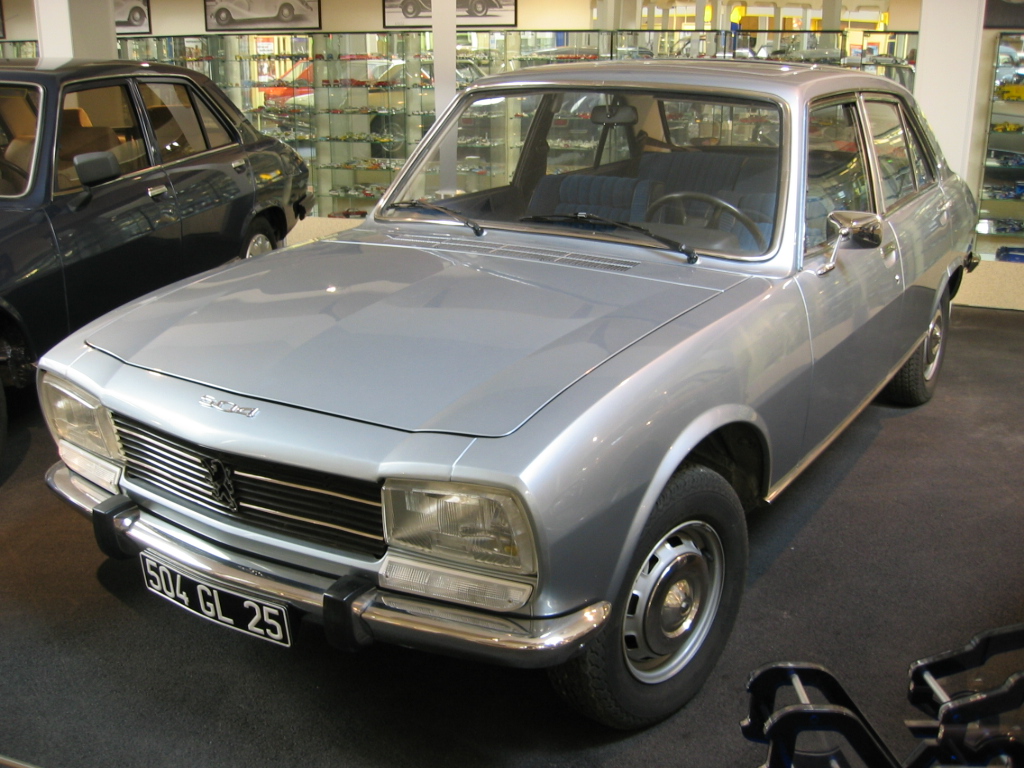
The larger 504, introduced in 1968, retained rear-wheel drive. Its saloon design resulted from collaboration between Peugeot’s own styling department and Pininfarina. The model won the European Car of the Year award for 1969: the award year and introduction year are different milestones. Peugeot’s retrospective on its Car of the Year winners.
The 504 family encompassed petrol and diesel engines, saloons, estates, pickups, coupés and cabriolets. Chassis specification varied: independent rear suspension on the original saloon should not be assigned to every derivative, since simpler rigid-axle versions also existed. Pininfarina both designed and manufactured the coupé and cabriolet bodies. Peugeot’s 504 retrospective.
Production and sales histories were regional. The same retrospective places the French saloon’s withdrawal in 1983 but records continued manufacture outside Europe for African and South American markets, with Nigerian production ending in 2005. That Nigerian endpoint is not a claim that every 504 body or engine remained in production until then. The family’s lengthy overseas career is a major part of Peugeot’s international history.
The 205 and competition
Launched on 24 February 1983, the 205 helped renew Peugeot’s small-car identity. Its brief combined compact dimensions with sufficient versatility for family use. Petrol and diesel versions served everyday buyers, while the GTI broadened its sporting appeal; a three-door body joined the range in 1984. Peugeot’s retrospective identifies the XUD7 diesel among the engines used, a designation belonging to the engine programme rather than a trim level.
Competition strengthened the model’s public profile. The 205 Turbo 16 entered Group B rallying in 1984, and Peugeot won the manufacturers’ world championship in 1985 and 1986. The Turbo 16 was a distinct competition and homologation programme: its results and specifications must not be attributed to the ordinary GTI or diesel hatchback. Peugeot’s fortieth-anniversary history of the 205.
Group expansion and broader production
The formation of PSA Peugeot Citroën in 1976 brought Peugeot and Citroën into a common group. PSA acquired Chrysler’s European industrial and commercial subsidiaries in 1978, with the acquired car business subsequently operating under the Talbot name. These changes enlarged the industrial organisation without making the marques’ earlier vehicles one model lineage. Groupe PSA’s 2018 registration document, company history.
Peugeot also broadened its vehicle types. The 806 brought the marque into the people-carrier market in 1994; the Partner followed in 1996 with passenger and light-commercial applications. Peugeot’s historical review places these alongside its established saloon and estate ranges.
International development involved local partnerships as well as exports. In China, the group’s Dongfeng joint venture was extended to the Peugeot brand in 2000, according to the PSA registration document. French brand identity therefore does not establish the assembly country or specification of an individual Peugeot.
Electrification and the Stellantis era
The new 208 programme announced in 2019 offered petrol, diesel and battery-electric powertrains, with the electric version named e-208. Peugeot’s British announcement scheduled customer deliveries for early 2020, illustrating why an unveiling year should not automatically become a universal market introduction date. Active, Allure and GT Line were equipment grades spanning different powertrains, rather than engine families. Peugeot UK’s 208 and e-208 announcement.
The merger of Groupe PSA and Fiat Chrysler Automobiles became effective on 16 January 2021, creating Stellantis. This changed Peugeot’s corporate setting; it did not mark an end to Peugeot-badged vehicle production. Stellantis merger announcement.
Legacy and related records
Peugeot’s history joins manufacturing development with adaptable vehicle families: the affordable 201, post-war 203 and 403, internationally enduring 504 and versatile 205 represent different responses to their markets. Diesel engineering, front-wheel-drive packaging and competition each contributed to that history without defining every Peugeot.
Dates above identify calendar-year events or stated production periods, not universal model years. For the wider French context, see Citroën and Renault, whose model histories remain distinct.