Mercedes-Benz S-Class
An overview of the S-Class lineage focused on the first officially named generation: the 116 series (1972–1980), its principal variants and safety engineering.
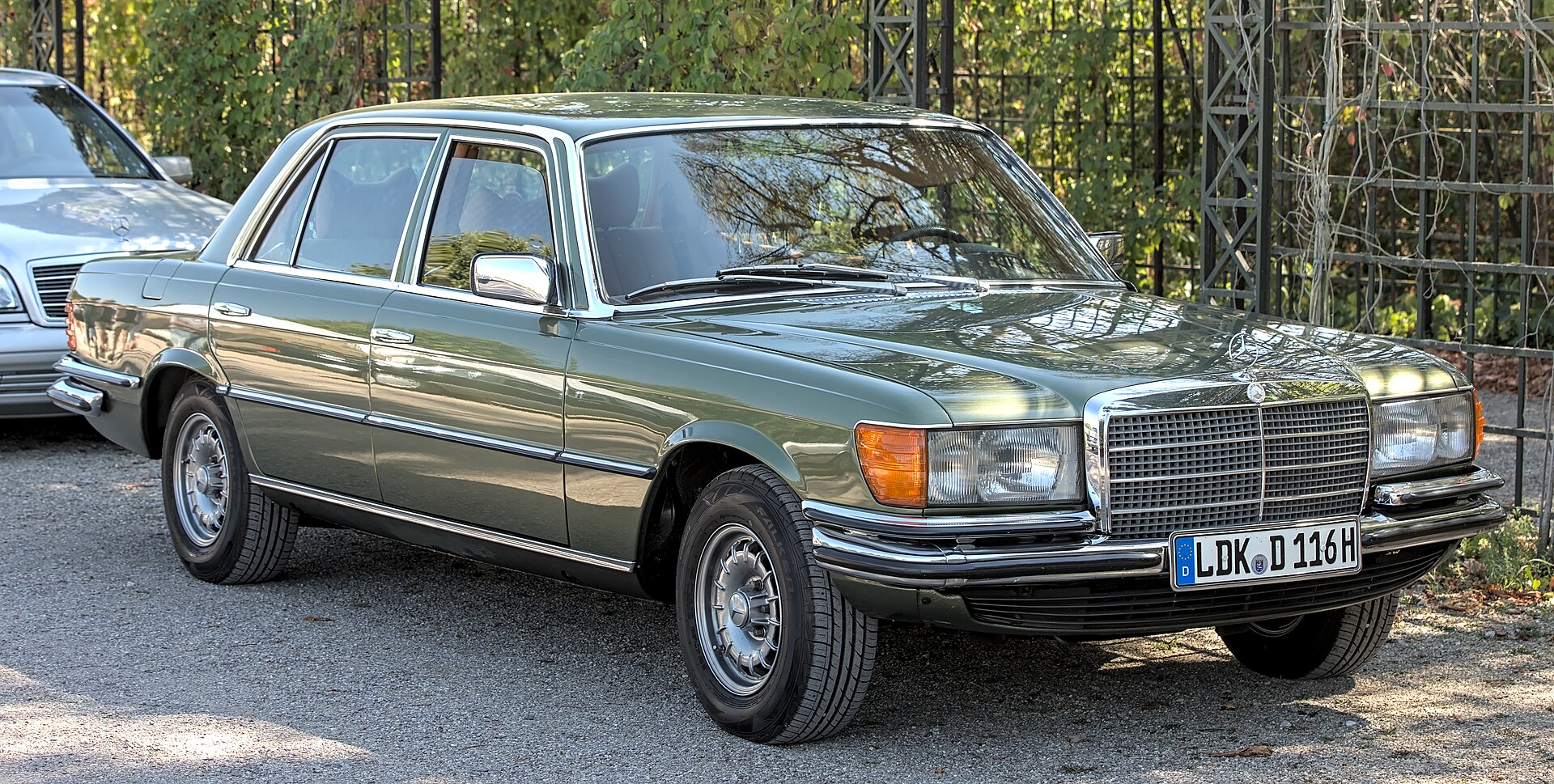
Naming and introduction
The Mercedes-Benz S-Class lineage extends beyond the 116 series. Earlier luxury saloons preceded the name; the 116 series introduced in 1972 was the first generation officially designated S-Class. This model page currently focuses on that generation rather than providing a complete history of every S-Class generation. Mercedes-Benz’s historical overview places it within the marque’s longer luxury-car tradition.
116-series coverage (1972–1980)
The coverage here comprises the 116 series, selected variants and its safety milestones. Later S-Class generations are outside this overview.
Variants and markets
The initial range comprised the six-cylinder petrol 280 S and 280 SE and the V8 petrol 350 SE. Longer-wheelbase SEL versions followed.
The 450 SEL 6.9 joined the range in 1975 with a 6.9-litre V8 and hydropneumatic suspension. These details describe that flagship variant.
The five-cylinder 300 SD turbodiesel was developed for North America, where it was offered in the United States and Canada. It provided a diesel option within the 116-series range. These variant and market details are documented in Mercedes-Benz’s 116-series retrospective.
Safety engineering
The 116 series emphasised occupant protection, including a strengthened passenger compartment, as described in the same Mercedes-Benz retrospective.
In 1978, the 116-series S-Class became the first production vehicle offered with the digital, electronically controlled anti-lock braking system developed by Mercedes-Benz and Bosch. The digital, electronically controlled qualification identifies the particular ABS milestone described in Mercedes-Benz’s innovation history.