Mercedes-Benz 300 SL
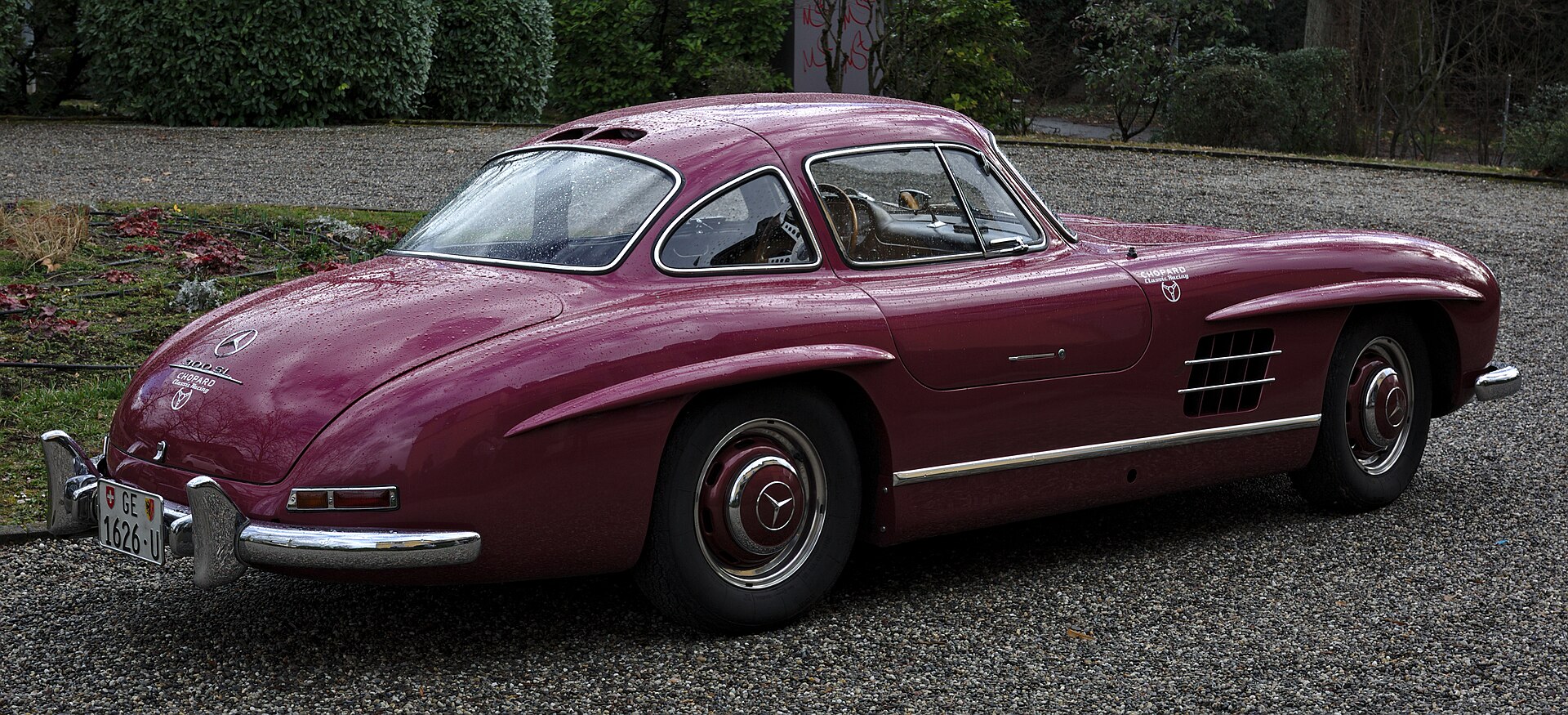
The road-going Mercedes-Benz 300 SL W198 developed from the W194 competition car and comprised the Gullwing coupé (1954–1957) and Roadster (1957–1963). Both used a direct-injection inline-six; the roof-hinged gullwing doors were a coupé feature.
Overview
The road-going Mercedes-Benz 300 SL, designated W198, comprised the Gullwing coupé (1954–1957) and Roadster (1957–1963). It developed from the W194 competition car, a distinct predecessor built for motorsport. Mercedes-Benz presented the W198 coupé at the International Motor Sports Show in New York in February 1954, during the company’s return to international markets after the Second World War.
Its lightweight tubular spaceframe rose high along the sides of the passenger compartment. Conventional doors could not be fitted without weakening that structure, so the coupé received roof-hinged doors that created its enduring “Gullwing” identity. These doors were a coupé feature; the Roadster used a revised spaceframe that permitted conventional doors.
Power came from a 3.0-litre inline-six using direct petrol injection, an unusual production-car technology at the time. The engine was inclined to reduce bonnet height, helping the 300 SL combine high performance with a low, aerodynamic profile.
Body styles
300 SL Gullwing (W198 I, 1954–1957)
The closed 300 SL established the model’s defining shape, with gullwing doors, a compact cabin and pronounced wheel-arch forms. It was conceived with the American market in mind and launched in New York rather than at a European motor show.
300 SL Roadster (W198 II, 1957–1963)
The roadster replaced the coupé in 1957. Revisions to the spaceframe permitted conventional doors and improved access, while the open body broadened the 300 SL’s appeal as a high-performance touring car.